-
- All Centrifuges
- Benchtop Centrifuges
- Floor-Standing Centrifuges
- Refrigerated Centrifuges
- Microcentrifuges
- Multipurpose Centrifuges
- High-Speed Centrifuges
- Ultracentrifuges
- Concentrator
- High-Speed and Ultracentrifuge Consumables
- Centrifuge Tubes
- Centrifuge Plates
- Device Management Software
- Sample and Information Management
-
- All Pipettes, Dispensers & Automated Liquid Handlers
- Mechanical Pipettes
- Electronic Pipettes
- Multi-Channel Pipettes
- Positive Displacement Pipettes & Dispensers
- Pipette Tips
- Bottle-Top Dispensers
- Pipette Controllers
- Dispenser & Pipette Accessories
- Automated Pipetting
- Automation Consumables
- Automation Accessories
- Liquid Handler & Pipette Services
You are about to leave this site.
Please be aware that your current cart is not saved yet and cannot be restored on the new site nor when you come back. If you want to save your cart please login in into your account.
How to Stop Dripping When Pipetting Volatile Liquids
Lab Academy
- Cell Biology
- Cell Culture
- Pipetting & Dispensing
- Efficiency
- Pipette Tips
- Essay
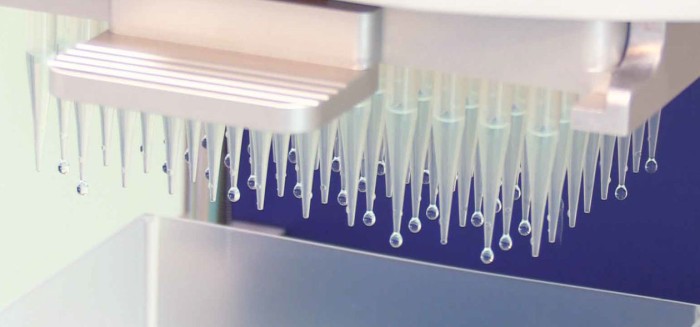
Who isn’t aware that acetone, ethanol, and other volatile liquids start to drip out of the pipette tip directly after aspiration? Probably, every one of us has experienced this. Are you wondering if this issue can be solved with pipetting “hacks” like “working as fast as possible” while “placing the tubes very close to each other to avoid chemical loss and spillage”? The answer is: probably not! Even when pipetting volatile liquids faster, you’re still likely to lose accuracy and precision. Yet all is not lost – by just adding some small changes in your pipetting techniques, and the right choice of pipette type can help you overcome these daily challenges!
Why do pipettes drip?
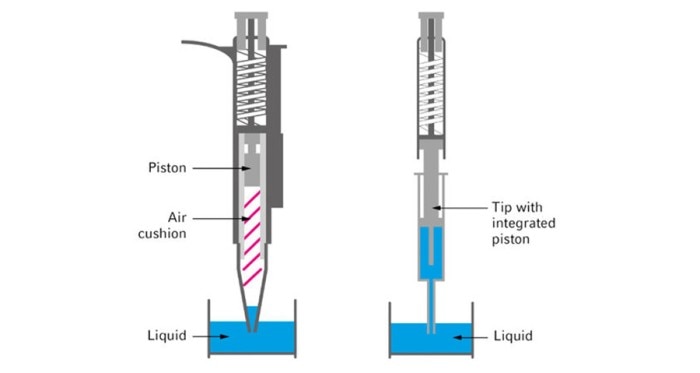
Classic air-cushion pipettes start dripping when pipetting volatile liquids due to the air inside the pipette. This so-called air cushion exists between the sample liquid and the piston inside the pipette. As commonly known, air is flexible and adapts to external influences such as temperature and air pressure, by expanding or compressing. Liquids are also subject to external influences and naturally evaporate when the humidity is lower. A volatile liquid evaporates much faster than water. During pipetting, volatile liquids evaporate into the air cushion, forcing it to expand. As a result, the liquid is pressed out of the pipette tip … causing pipette drips.Read more
To prevent liquids from dripping, start pre-wetting pipette tips
One technique to reduce or even stop the dripping is to achieve a higher percentage of humidity in the air cushion. This is done by pre-wetting pipette tips and thereby saturating the air cushion. When using low volatile liquids such as 70 % Ethanol or 1 % acetone, aspirate and dispense the sample liquid a minimum of 3 times, before aspirating the sample volume you want to transfer. If the concentration of volatile liquid is higher, repeat these pre-wetting pipette tip cycles 5-8 times.Read more
Does pre-wetting pipette tips work for liquids with higher volatility?
When pipetting volatile liquids with very high concentrations such as 100 % ethanol or chloroform, pre-wetting pipette tips won’t be enough. Instead, it’s best to use another type of pipette: a positive displacement pipette. These pipettes use tips with an integrated piston without an air cushion. The sample is in direct contact with the piston and there is no risk of dripping.Read more
Become a master of pipetting
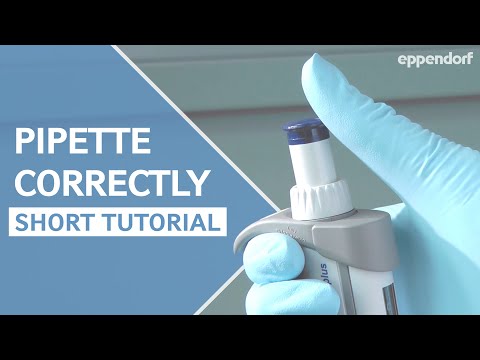
You can easily improve your accuracy when pipetting volatile liquids by choosing the correct technique or changing the tool you are using. Additionally, you will increase safety by avoiding spillage and simplifying your workflow. If you want to learn more on correct pipetting, watch our Youtube video tutorial How to pipette correctly.Read more

Videos not loading, because cookies have been rejected. Change your
Videos not loading, because cookies have been rejected. Change your