-
- All Pipettes, Dispensers & Automated Liquid Handlers
- All Micropipettes
- Mechanical Pipettes
- Electronic Pipettes
- Multi-Channel Pipettes
- Positive Displacement Pipettes & Dispensers
- Bottle-Top Dispensers
- Pipette Controllers
- Dispenser & Pipette Accessories
- Automated Pipetting
- Automation Consumables
- Automation Accessories
- Liquid Handler & Pipette Services
You are about to leave this site.
Please be aware that your current cart is not saved yet and cannot be restored on the new site nor when you come back. If you want to save your cart please login in into your account.
- Home
- Lab Academy
- Applied Industries
- Bioprocessing
- Interview: FyoniBio
Data-Driven Bioprocess Development from Molecule to GMP Manufacturing
Lab Academy
- Bioprocessing
- Cell Therapy
- Bioprocess
- Interview
FyoniBio provides services across the biopharmaceutical development value chain. In this interview, Lena Tholen, the Director of Cell Line Development and Bioprocess Development, highlights the importance of flexible bioreactor systems to suit various project demands, and the role of data-driven strategies in optimizing bioprocesses and transferring them from R&D to commercial production.
Read more
Q: Please tell us a bit about FyoniBio
Our analytical portfolio includes advanced mass spectrometry-based services to characterize critical quality attributes (CQAs), such as glycan profiling, peptide mapping, and in-depth analysis of post-translational modifications (PTMs). We are fully equipped to deliver complete IND/IMPD-compliant biochemical characterization packages.
Our scientific approach is deeply molecule-centered: we tailor each project based on the specific characteristics and development needs of the client’s biotherapeutic.
Read more
“We find the optimization of client-provided processes particularly rewarding, as they require successful technology transfer, detailed data analysis, and a targeted, science-driven approach to process improvement.”
Q: Which upstream bioprocess services do you offer? Which products do you produce using which cell lines?
In contrast, GlycoExpress is our glyco-optimized human cell line platform, particularly well-suited for difficult-to-express proteins that require human-like glycosylation patterns, specific post-translational modifications, or optimized folding and secretion. This platform has been successfully used for the production of hormones, growth factors, blood coagulation factors, and enzymes used in enzyme replacement therapies (ERTs). We bring deep expertise across a range of process formats — from fed-batch to perfusion processes — and always assess the most appropriate approach for each biologic based on its specific molecular and functional requirements.
In addition to de novo process development based on our own platforms, we frequently engage in optimization of client-provided processes. These projects often involve challenges such as suboptimal product quality, non-ideal glycosylation patterns, or insufficient productivity. We find such collaborations particularly rewarding and technically stimulating, as they require successful technology transfer, detailed data analysis, and a targeted, science-driven approach to process improvement.
Read more
Q: What challenges you face in your various bioprocess development projects?
Read more
“It’s essential to account for differences between development-scale and GMP-scale bioreactor systems from the very beginning to ensure a smooth and efficient transition from benchtop to production scale.”
In addition to molecular and process-related hurdles, we frequently encounter challenges related to tech transfer and scale-up. It’s essential to account for differences between development-scale and GMP-scale bioreactor systems from the very beginning. This includes careful consideration of factors such as raw material scalability, gassing strategies, and sensor configurations, to ensure a smooth and efficient transition from benchtop to production scale.
Read more
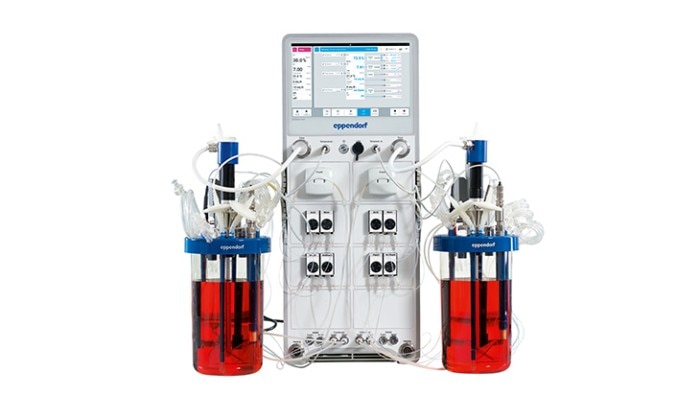
Q: Why did you choose Eppendorf? What were the main reasons for choosing the SciVario twin system?
Read more
“One of the standout features of the SciVario twin system is its flexible compatibility with both glass and single-use vessels, which allows us to adapt quickly to varying project demands.”
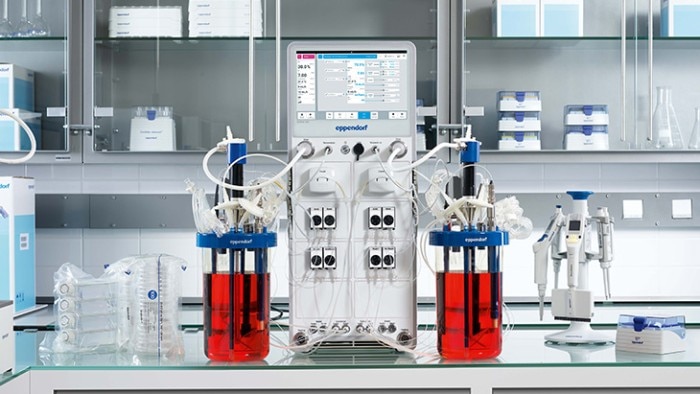
Finally, Eppendorf has proven to be a reliable and responsive partner, offering excellent support, smooth communication, and a convincing cost-performance ratio, which further solidified our decision.
Read more
“Eppendorf has proven to be a reliable and responsive partner, offering excellent support, smooth communication, and a convincing cost-performance ratio.”
Q: Your customers would eventually like to scale-up and transfer the developed bioprocess to a GMP facility. Could you tell us a bit about the challenges and how you overcome them to enable a smooth transfer?
A: Ensuring a smooth transfer from development to GMP manufacturing is a critical success factor for our clients — and a clear focus area in our project strategies at FyoniBio. A key prerequisite for successful scale-up is the early integration of scalability considerations into the upstream development process. That starts with clone selection: rather than focusing solely on the top-producing clone, we routinely evaluate multiple high-performing clones — typically the top four — under benchtop bioprocess conditions to assess their scalability potential.
During this evaluation phase, we closely monitor parameters such as:
- Cell growth and viability
- Metabolic indicators (e.g. ammonia, lactate, osmolarity)
- Process robustness and tolerance to stress conditions (e.g. gassing behavior)
- This early-stage data forms the basis for identifying the most suitable clone for large-scale, GMP-compliant production.
Once a robust production process is established, technology transfer to a GMP facility presents its own set of challenges — particularly regarding data continuity and equipment compatibility.
For example, differences in offline measurement devices (e.g. for cell counting) can lead to significant deviations in process control. We’ve experienced such a case during a perfusion process transfer, where divergent cell counting results between R&D and GMP devices caused major variations in bioprocess performance.
Read more
“A key prerequisite for successful scale-up is the early integration of scalability considerations into the upstream development process.”
- Detailed and transparent process documentation, including specifics on bioreactor types, sensors, and control strategies
- Rigorous communication between R&D and manufacturing teams
- Proactive alignment on critical parameters, such as offline analytics or probe calibration
Read more
Q: Process optimization and tech transfer depend on bioprocess data. Which process parameters do you typically analyze and can you suggest any improvements in bioprocess technology ?
Read more
“Technological advancements that allow for real-time monitoring of metabolites and product quality indicators will be key to the future of bioprocessing — making development cycles faster, more data-driven, and ultimately more robust.”
Read more
Q: How do you view the current and future role of artificial intelligence in bioprocess development?
Read more
“I believe AI-driven tools twill become a standard component of modern bioprocess development and will play a key role in improving efficiency, robustness, and product quality.”
Read more
Q: Is there any advice you would give to others who are just starting to develop a new bioprocess?
Throughout development, you’ll find that small process changes — be it in feeding strategy, temperature shifts, or pH control — can have a big impact on both product quality and productivity. Strive to design a robust and reproducible process, while keeping complexity to a minimum. Overly complex setups may seem attractive in development, but can become a liability during tech transfer or GMP implementation, where simplicity and clarity are essential. In short: know your molecule, choose your system wisely, and keep your process as elegant as it is effective.
Read more
“Know your molecule, choose your system wisely, and keep your bioprocess as elegant as it is effective.”
Read more