MENU
AT | EUR
-
-
-
- Pichia 2026
- Future Labs Live 2026
- BioProScale Sympposium 2026
- ASGCT 2026
- Eppendorf Automation Forum 2026
- ECB 2026
- WoTS 2026
- ELRIG Drug Discovery 2026
- 75th JAMT Congress & IFBLS2026
- JASIS2026
- GSCN 2026
- BPI EAST 2026
- Bioprocess Days 2026
- Bioprocess Day 2026, Texas, USA
- Bioprocess Day 2026, Philadelphia, USA
- Cell 2026
- FPP x CMS Amsterdam
-

-
-
-
- Pichia 2026
- Future Labs Live 2026
- BioProScale Sympposium 2026
- ASGCT 2026
- Eppendorf Automation Forum 2026
- ECB 2026
- WoTS 2026
- ELRIG Drug Discovery 2026
- 75th JAMT Congress & IFBLS2026
- JASIS2026
- GSCN 2026
- BPI EAST 2026
- Bioprocess Days 2026
- Bioprocess Day 2026, Texas, USA
- Bioprocess Day 2026, Philadelphia, USA
- Cell 2026
- FPP x CMS Amsterdam
-
AT | EUR
-
- All Pipettes, Dispensers & Automated Liquid Handlers
- All Micropipettes
- Mechanical Pipettes
- Electronic Pipettes
- Multi-Channel Pipettes
- Positive Displacement Pipettes & Dispensers
- Bottle-Top Dispensers
- Pipette Controllers
- Dispenser & Pipette Accessories
- Automated Pipetting
- Automation Consumables
- Automation Accessories
- Liquid Handler & Pipette Services
Sorry, we couldn't find anything on our website containing your search term.
Sorry, we couldn't find anything on our website containing your search term.
- Home
- Company & Careers
- News & Media
- Newsroom
- Eppendorf Award for Young European Investigators 2026 goes to Martin Pačesa from the University of Zurich
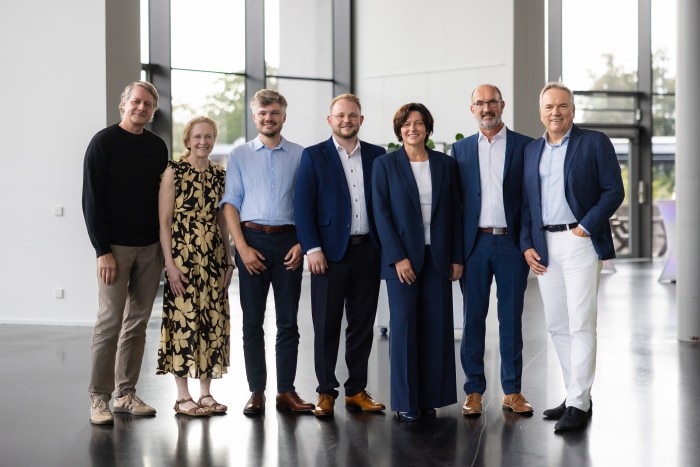
Eppendorf Award for Young European Investigators 2026 goes to Martin Pačesa from the University of Zurich
news
- Press Releases
- Corporate News
This year, the Hamburg-based life science company Eppendorf SE is awarding its prestigious research prize for the 31st time. The independent jury chaired by Prof. Laura Machesky, Cambridge, UK, selected Dr. Martin Pačesa, University of Zurich, Switzerland, as the winner of the Eppendorf Award for Young European Investigators 2026.
Martin Pačesa, born in 1993, receives the 20,000 Euro award for his research on AI-guided de novo design of functional protein binders. The jury acknowledged the importance of his contributions to this field and the impact of the tools he developed on the research community.
“It still feels a bit unreal to receive the 2026 Eppendorf Award for Young European Investigators”, says Martin Pačesa, Assistant Professor at the University of Zurich. “This recognition reflects our work on deep learning-based protein design, particularly BindCraft, which enables accurate and accessible design of protein binders. Much of biology can be framed as a binder-target problem, and the ability to design these interactions on demand opens new possibilities in biological research. I am grateful to my colleagues at École Polytechnique Fédérale de Lausanne (EPFL), especially Prof. Bruno Correia, Lennart Nickel, and Christian Schellhaas, as well as to my wife, my new lab at the University of Zurich, and the support from the European Research Council. There’s still a lot to figure out, but it feels like we are moving towards a point where protein design can become genuinely routine for the everyday biologist.”
In addition to the winner of the Eppendorf Award 2026, two finalists were honored.
Sebastiaan De Schepper, Assistant Professor and Group Leader at VIB-Center for Molecular Neurology (CMN), Wilrijk, Belgium, is honored for his research on “Understanding the immune mechanisms driving neurodegenerative diseases along the gut-brain axis”. The topicality and medical relevance of his contributions to understanding the possible connections between gut and brain in neurodegenerative diseases convinced the jury, as did the great potential of his research for future medical applications.
Tanita Wein, Group Leader at the Weizmann Institute of Science, Rehovot, Israel, is honored for her research on “From bacterial defense to human inflammation”. The jury panel was impressed by the creativity and novelty of her research and its potential to reveal fundamental principles of nature.
The Award Ceremony took place on July 16, 2026, at the Advanced Training Center of the European Molecular Biology Laboratory (EMBL) in Heidelberg, Germany.
Further information on application modalities, selection criteria, and past recipients of the Eppendorf Award for Young European Investigators can be found at www.eppendorf.com/award .
“It still feels a bit unreal to receive the 2026 Eppendorf Award for Young European Investigators”, says Martin Pačesa, Assistant Professor at the University of Zurich. “This recognition reflects our work on deep learning-based protein design, particularly BindCraft, which enables accurate and accessible design of protein binders. Much of biology can be framed as a binder-target problem, and the ability to design these interactions on demand opens new possibilities in biological research. I am grateful to my colleagues at École Polytechnique Fédérale de Lausanne (EPFL), especially Prof. Bruno Correia, Lennart Nickel, and Christian Schellhaas, as well as to my wife, my new lab at the University of Zurich, and the support from the European Research Council. There’s still a lot to figure out, but it feels like we are moving towards a point where protein design can become genuinely routine for the everyday biologist.”
In addition to the winner of the Eppendorf Award 2026, two finalists were honored.
Sebastiaan De Schepper, Assistant Professor and Group Leader at VIB-Center for Molecular Neurology (CMN), Wilrijk, Belgium, is honored for his research on “Understanding the immune mechanisms driving neurodegenerative diseases along the gut-brain axis”. The topicality and medical relevance of his contributions to understanding the possible connections between gut and brain in neurodegenerative diseases convinced the jury, as did the great potential of his research for future medical applications.
Tanita Wein, Group Leader at the Weizmann Institute of Science, Rehovot, Israel, is honored for her research on “From bacterial defense to human inflammation”. The jury panel was impressed by the creativity and novelty of her research and its potential to reveal fundamental principles of nature.
The Award Ceremony took place on July 16, 2026, at the Advanced Training Center of the European Molecular Biology Laboratory (EMBL) in Heidelberg, Germany.
Further information on application modalities, selection criteria, and past recipients of the Eppendorf Award for Young European Investigators can be found at www.eppendorf.com/award .
Read more
Download

Press Release
PDF 0.14 MB