MENU
BE | EUR
-
-
-
- Service pour centrifugeuses et rotors
- Service pour pipette
- Étalonnage pour pipette neuve
- Service pour Mastercycler
- Service pour systèmes d’automatisation
- Services pour bioprocédés
- Service pour congélateurs
- Service pour incubateurs
- Service pour agitateurs
- Service de contrôle de la température et de l’agitation
-
-
- WHX Labs Dubai 2026
- analytica 2026
- Forum Labo 2026
- SLAS Europe 2026
- Forum Labo 2026 Bioprocess
- Bioprocessing Summit Europe 2026
- BioProcess International 2026
- Swiss Biotech Day 2025
- ISCT 2026
- Pichia 2026
- Future Labs Live 2026
- BioProScale Sympposium 2026
- ASGCT 2026
- Eppendorf Automation Forum 2026
- ESACT 2026
- ELRIG Drug Discovery 2026

-
-
-
- Service pour centrifugeuses et rotors
- Service pour pipette
- Étalonnage pour pipette neuve
- Service pour Mastercycler
- Service pour systèmes d’automatisation
- Services pour bioprocédés
- Service pour congélateurs
- Service pour incubateurs
- Service pour agitateurs
- Service de contrôle de la température et de l’agitation
-
-
- WHX Labs Dubai 2026
- analytica 2026
- Forum Labo 2026
- SLAS Europe 2026
- Forum Labo 2026 Bioprocess
- Bioprocessing Summit Europe 2026
- BioProcess International 2026
- Swiss Biotech Day 2025
- ISCT 2026
- Pichia 2026
- Future Labs Live 2026
- BioProScale Sympposium 2026
- ASGCT 2026
- Eppendorf Automation Forum 2026
- ESACT 2026
- ELRIG Drug Discovery 2026
BE | EUR
-
- Pipetage manuel & distribution
- All Micropipettes
- Mechanical Pipettes
- Connected Pipettes
- Multi-Channel Pipettes
- Positive Displacement Pipettes & Dispensers
- Bottle-Top Dispensers
- Pipette Controllers
- Accessoires
- Automates de pipetage
- Automation Consumables
- Automation Accessories
- Liquid Handler & Pipette Services
Sorry, we couldn't find anything on our website containing your search term.
Sorry, we couldn't find anything on our website containing your search term.
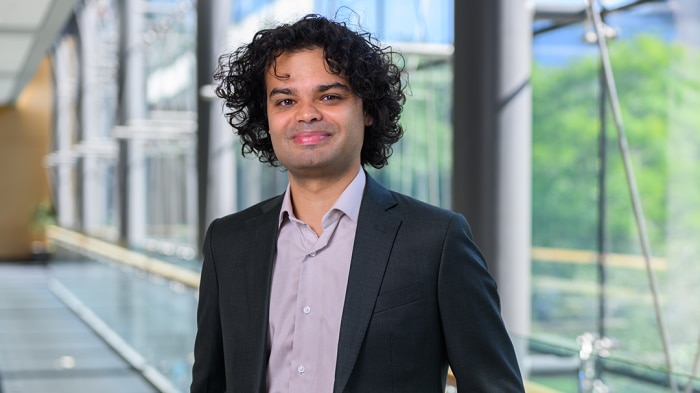
- 2026 Prize Finalist Alexander Bates, Ph.D.
2026 Prize Finalist Alexander Bates, Ph.D.
Research Fellow at Harvard Medical School, Boston, USA
Alexander Bates earned his Ph.D. with Gregory Jefferis at the MRC Laboratory of Molecular Biology, University of Cambridge, where he helped assemble and annotate the first connectome of an adult fly brain, FAFB/FlyWire, analyzed its olfactory system, and built open-source software for synaptic-resolution neuroanatomy now used across the field. He joined Rachel Wilson’s laboratory at Harvard Medical School, supported by a Sir Henry Wellcome Postdoctoral Fellowship, and together with Wei-Chung Allen Lee’s group co-led BANC, the first brain-and-nerve-cord connectome of an adult animal. With Jan Funke’s group at Janelia, he developed neurotransmitter prediction for synapses in the connectome. He now combines connectomics with functional imaging and virtual-reality behaviour to ask how the fly navigates, and holds a Warren Alpert Distinguished Scholars Award.
Essay: “Darwin’s atom split, a whole central nervous system exposed”
Alexander Bates’ research seeks to understand how a nervous system controls behaviour, using connectomics, the reconstruction of complete wiring diagrams from electron microscopy, to turn anatomy into testable circuit mechanisms. He took a leading role in two major connectome projects: the first wiring diagram of an adult insect brain, and the first synaptic map of an entire central nervous system in a limbed animal, joining the brain of Drosophila to its ventral nerve cord, the counterpart of the spinal cord. The map comprises over 160,000 neurons and 200 million connections. Bates and colleagues made it an embodied map, identifying the body part innervated by almost every peripheral axon, and, working with computer scientists, trained an algorithm that predicts the neurotransmitter released at each synapse, recovering whether connections are likely to be excitatory or inhibitory. Alexander’s findings reveal a nervous system with no central controller, in which each body part is governed largely by its own sensors while the brain’s learning and navigation centres exert more selective influence. He is now testing predictions from the map in behaving flies, imaging a hypothalamus-like region that conveys internal state to the navigation centre.
Lire la suite
Downloads

PDF 0,88 MB