-
-
-
- Pichia 2026
- Future Labs Live 2026
- BioProScale Sympposium 2026
- ASGCT 2026
- Eppendorf Automation Forum 2026
- ECB 2026
- WoTS 2026
- ELRIG Drug Discovery 2026
- 75th JAMT Congress & IFBLS2026
- JASIS2026
- GSCN 2026
- BPI EAST 2026
- Bioprocess Days 2026
- Bioprocess Day 2026, Texas, USA
- Bioprocess Day 2026, Philadelphia, USA
- Cell 2026
- FPP x CMS Amsterdam
-

-
-
-
- Pichia 2026
- Future Labs Live 2026
- BioProScale Sympposium 2026
- ASGCT 2026
- Eppendorf Automation Forum 2026
- ECB 2026
- WoTS 2026
- ELRIG Drug Discovery 2026
- 75th JAMT Congress & IFBLS2026
- JASIS2026
- GSCN 2026
- BPI EAST 2026
- Bioprocess Days 2026
- Bioprocess Day 2026, Texas, USA
- Bioprocess Day 2026, Philadelphia, USA
- Cell 2026
- FPP x CMS Amsterdam
-
-
- All Pipettes, Dispensers & Automated Liquid Handlers
- All Micropipettes
- Mechanical Pipettes
- Electronic Pipettes
- Multi-Channel Pipettes
- Positive Displacement Pipettes & Dispensers
- Bottle-Top Dispensers
- Pipette Controllers
- Dispenser & Pipette Accessories
- Automated Pipetting
- Automation Consumables
- Automation Accessories
- Liquid Handler & Pipette Services

How to Reduce the Risk of RSI in 384-well Applications
Lab Academy
- Health & Medicine
- Cell Biology
- Reproducibility
- Ergonomics
- Efficiency
- Pipette Tips
- Essay
With the advent of the high-throughput screening approach, the need for a microplate with a larger number of wells appeared and was quickly implemented as a consumable for plate assays. Applications performed in 384-well plates require repetitive liquid handling steps. Automated pipetting platforms represent an investment that smaller labs or companies often cannot afford. Then multi-channel pipettes are preferred. Thus, 16 or 24-channel pipettes designed to fit the 384-well microplate format are an alternative solution for scientists looking to increase their throughput. Compared to 8 or 12-channel pipettes, especially the electronic versions of 16 or 24-channel pipettes save pipetting time and reduce the risk of repetitive strain injuries (RSIs).
Reducing the number of arm movements help minimize the risk of RSI
Read more
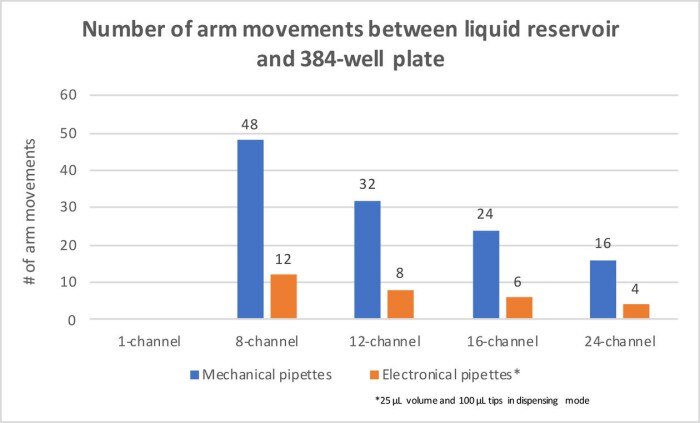
- Using multichannel pipettes instead of single-channel pipettes - if available 16 or 24-channel pipettes
a. For instance, arm movement can be reduced from 48 movements with an 8-channel pipette to 16 movements with a 24-channel pipette (=> reduces arm movement by 67%) - The use of multichannel electronic pipettes in dispensing mode further reduces arm movement significantly, as shown in Figure 1.
- The use of electronic 24-channel pipettes in dispensing mode represents the ultimate solution as only between 1 and 16 arm movements are needed, depending on the volume used.
a. For instance, when dispensing a volume of 25 µL with a 100 µL tip, 4 arm movements are needed per plate, saving additional 75% compared to 16 movements with mechanical 24-channel pipettes
b. Thus, compared to mechanical 8-channel pipettes you can save 92% of arm movements with electronic 24-channel pipette in dispensing mode
In summary, a higher number of channels has a direct impact on the number of movements required to dispense liquids into plates. With a 16 or 24-channel pipette, the number of movements is decreased, especially with electronic models used in dispensing mode, reducing significantly the risk of repetitive strain injury appearance.
Read more
Related links
Read more