MENU
IT | EUR
-
-
-
- Pichia 2026
- Future Labs Live 2026
- BioProScale Sympposium 2026
- ASGCT 2026
- Eppendorf Automation Forum 2026
- ECB 2026
- WoTS 2026
- ELRIG Drug Discovery 2026
- 75th JAMT Congress & IFBLS2026
- JASIS2026
- GSCN 2026
- BPI EAST 2026
- Bioprocess Days 2026
- Bioprocess Day 2026, Texas, USA
- Bioprocess Day 2026, Philadelphia, USA
- Cell 2026
- FPP x CMS Amsterdam
-

-
-
-
- Pichia 2026
- Future Labs Live 2026
- BioProScale Sympposium 2026
- ASGCT 2026
- Eppendorf Automation Forum 2026
- ECB 2026
- WoTS 2026
- ELRIG Drug Discovery 2026
- 75th JAMT Congress & IFBLS2026
- JASIS2026
- GSCN 2026
- BPI EAST 2026
- Bioprocess Days 2026
- Bioprocess Day 2026, Texas, USA
- Bioprocess Day 2026, Philadelphia, USA
- Cell 2026
- FPP x CMS Amsterdam
-
IT | EUR
-
- All Pipettes, Dispensers & Automated Liquid Handlers
- All Micropipettes
- Mechanical Pipettes
- Electronic Pipettes
- Multi-Channel Pipettes
- Positive Displacement Pipettes & Dispensers
- Bottle-Top Dispensers
- Pipette Controllers
- Dispenser & Pipette Accessories
- Automated Pipetting
- Automation Consumables
- Automation Accessories
- Liquid Handler & Pipette Services
Sorry, we couldn't find anything on our website containing your search term.
Sorry, we couldn't find anything on our website containing your search term.
- Home
- Lab Academy
- Topics, Methods & Technology
- Pipetting & Dispensing
- Electronic pipetting –Time to rise to the challenge
Electronic Pipetting –Time to Rise to The Challenge
Dr Ulrike Gast Lab Academy
- Biotechnology
- Pharma
- Molecular Biology
- PCR
- Liquid Handling
- Ergonomics
- Efficiency
- Pipettes
- Essay
Do you pipette difficult liquids like ethanol, glycerol or detergents with air-cushion pipettes? Then you should double-check your pipetting technique, if you want to get the best out of your pipetting. The smaller the volume, the more significant the error. As a professional you would use positive-displacement pipettes and dispensers. If an air-cushion pipette is your only option, you should at least know how to perform reverse pipetting. What not enough people know is that reverse pipetting challenging liquids is easier with electronic air-cushion pipettes, and will help achieve far higher precision and reproducibility!
Examples are easy to name: An ELISA with foaming BSA solution, DNA extraction with liquids dripping out of the tip, or the preparation of glycerol stocks with liquid sticking inside the pipette tip. For the accurate transfer of challenging liquids, a clear recommendation exists: Use a positive displacement system like the Multipette®/Repeater® . You do not have one at hand? Then you are probably using an air-cushion system: the pipette. Why not using the electronic one?
Electronic pipettes are more robust than you would think and offer a bunch of advantages in terms of precision (repeatability), ergonomics, or mode variety. So far, so good. But why choose the electronic pipette for challenging liquids? Because it offers convenience. Let’s check this out along with the example of transferring a foaming liquid.
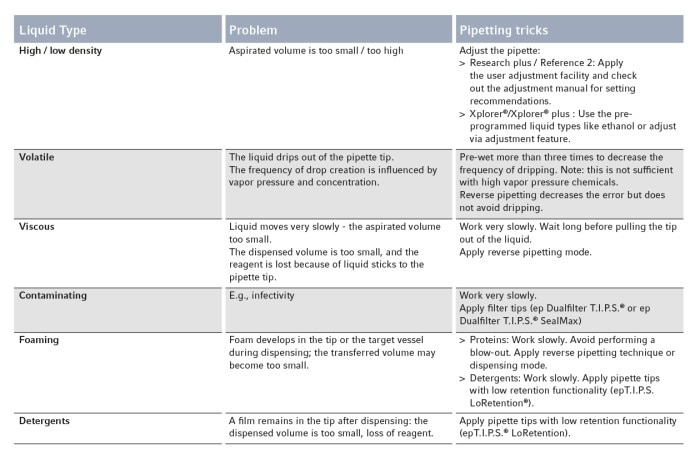
Of course, there exist more challenging liquids than this one. The overview below outlines how to deal with the other ones. For more detailed information, please refer to “Pipetting Challenging Liquids.”
Electronic pipettes are more robust than you would think and offer a bunch of advantages in terms of precision (repeatability), ergonomics, or mode variety. So far, so good. But why choose the electronic pipette for challenging liquids? Because it offers convenience. Let’s check this out along with the example of transferring a foaming liquid.
Of course, there exist more challenging liquids than this one. The overview below outlines how to deal with the other ones. For more detailed information, please refer to “Pipetting Challenging Liquids.”
Read more
General overview over tricks to transfer challenging liquids by air-cushion systems
These recommendations help to decrease the pipetting error. Note that the best choice for transferring these types of liquid would be a positive displacement system like the Multipette®/ Repeater® M4, E3, or E3x.Read more
Three tips for mastering the transfer of foaming liquids
It is a typical example: You perform an ELISA and add the BSA solution preventing non-specific binding of antigens. In the tips of your multi-channel pipette, foam is formed, and with every pipetting step, the foam builds up higher. It is impossible to get rid of it. Tip no. 1: Advantages of electronic pipettes when transferring foaming liquidsIt would help if you always took care to perform a slow and uniform piston movement with foaming liquids, leading to a uniform and slow liquid movement in your tip. Here, an electronic pipette can be of great help because the piston movement is naturally uniform, and you can set slow piston speeds. The risk of working too fast becomes avoided.
Tip no. 2: Reverse pipetting technique and dispensing mode and their advantages with foaming liquids
A helpful pipetting technique for mastering foaming liquids is the reverse pipetting. When performing this pipetting technique, the piston is first moved to the lowest possible position. Normally you would reach this position only when performing the blow-out. With the piston being in this position, the tip is immersed into the liquid, and the piston is then moved upwards: The blow-out volume plus the target volume are aspirated into the tip. In consequence, a higher volume is aspirated than needed. This additional liquid volume is called the “dead liquid volume.” You can now dispense the target volume in the first row of your plate. But do not dispense all liquid! The dead liquid volume stays in the tip: It keeps, so to say, the error when dispensing viscous, volatile, or, as described in this example, foaming liquids. You can now proceed with the next row on your plate.
You see, the reverse pipetting is a backward use of the individual operational steps of pipetting. You refill the pipette tip after every dispensing. In contrast, the dispensing mode of electronic pipettes like the Xplorer®/Xplorer® plus dispenses a series of partial volumes with one tip filling. This mode is reserved for electronic pipettes because they have an electronically controlled piston to make defined stops at every position of the piston stroke. This mode not only increases your working speed when filling plates. It also decreases foam creation.
Now, as it is clear how the reverse pipetting technique and the dispensing mode are working, let’s have a closer look at the advantages of the reverse pipetting and the dispensing modes of the electronic pipette:
1) Blow-out:
Both pipetting techniques are performed without any blow-out. Why is this advantageous? Besides the speed of the liquid movement, the blow-out is the second important factor in foam creation. When leaving out the blow-out, you avoid creating foam bubbles.
Read more
Try it Yourself
You can easily try it yourself: Fill some dishwashing solution in a reaction tube (e.g., Eppendorf Tubes® 5.0 mL) and fill up with water, mix, or let dissolve. Now take your mechanical pipette. Aspirate the mix and dispense with blow-out (being a correct forward pipetting!). Repeat with leaving out the blow-out. Read more
2) Workflow efficiency:
Leaving out the blow-out makes you working faster when serial dispensing is to be performed. The dispensing mode is naturally the best choice for increasing efficiency.
Good on you when having an Xplorer® or Xplorer® plus pipette: You can perform the reverse pipetting technique simply by using the rockers – just like you know it from your mechanical pipette:
In case you are processing a workflow being pre-programmed on your electronic pipette, the Xplorer® plus also offers you the option to include the reverse pipetting into the protocol.
The dispensing mode needs short programming to set the volume of the consecutive dispensing steps. The rest, again, is performed intuitively by the rockers.
Tip no. 3: A special type of foaming liquids: Detergents – How to leverage the electronic pipette to accurate transfer of this liquid type
When working with detergents, foaming can be avoided by the recommendations stated above. But detergents tend to foam and pose a second challenge: They create a film inside the tip. A residue that belongs to the dispensed volume is discarded together with your tips! Especially operators in molecular biology experience this in their daily routine since detergents are an ingredient of most master mixes. Thus, there is a need to prepare more reactions than samples to be amplified. Here, pipetting techniques do not help solely. But for these cases, a special type of pipette tips exists. The low retention tips ( epT.I.P.S.® LoRetention ). These tips are ultra-hydrophobic, compensating the lowered surface tension of detergent containing liquids*.
The beneficial effect of the system “electronic pipette with low retention tips” on the reproducibility of results has been widely proven. Find an example from NGS here where this system has been shown to master these challenging tasks and liquids.
The next time you come across challenging liquids, do not get stressed. If no Multipette®/Repeater® is available, check-in the general overview above how to deal with it and let your electronic pipette solve the problem for you.
* Make sure only to use these tips with detergent containing liquids. Transferring aqueous liquids with these tips can lead to a lower aspirated volume due to the hydrophobic surface. By bigger volumes, the effect is neglectable but should be considered by smaller volumes.
Leaving out the blow-out makes you working faster when serial dispensing is to be performed. The dispensing mode is naturally the best choice for increasing efficiency.
Good on you when having an Xplorer
- Press “rocker down” to move the piston into the lowest position.
- Immerse the tip into the liquid and press “rocker up” to take up the liquid. You have now aspirated the target volume plus the dead liquid volume.
- To dispense the target volume, press “rocker down” once. The blow-out will not be performed before pressing “rocker down” again, and you can…
- Directly aspirate liquid, again.
In case you are processing a workflow being pre-programmed on your electronic pipette, the Xplorer® plus also offers you the option to include the reverse pipetting into the protocol.
The dispensing mode needs short programming to set the volume of the consecutive dispensing steps. The rest, again, is performed intuitively by the rockers.
Tip no. 3: A special type of foaming liquids: Detergents – How to leverage the electronic pipette to accurate transfer of this liquid type
When working with detergents, foaming can be avoided by the recommendations stated above. But detergents tend to foam and pose a second challenge: They create a film inside the tip. A residue that belongs to the dispensed volume is discarded together with your tips! Especially operators in molecular biology experience this in their daily routine since detergents are an ingredient of most master mixes. Thus, there is a need to prepare more reactions than samples to be amplified. Here, pipetting techniques do not help solely. But for these cases, a special type of pipette tips exists. The low retention tips ( epT.I.P.S.® LoRetention ). These tips are ultra-hydrophobic, compensating the lowered surface tension of detergent containing liquids*.
The beneficial effect of the system “electronic pipette with low retention tips” on the reproducibility of results has been widely proven. Find an example from NGS here where this system has been shown to master these challenging tasks and liquids.
The next time you come across challenging liquids, do not get stressed. If no Multipette®/Repeater® is available, check-in the general overview above how to deal with it and let your electronic pipette solve the problem for you.
Summary
Air-cushion pipettes often reach their limits in the wide field of challenging liquids with their different mixtures and concentrations. The best choice for accurate liquid transfer of challenging liquids is the positive displacement system like the Multipette®/Repeater® . However, there are ways to manage such liquids with air-cushion pipettes. As shown by the example of foaming liquids, the use of electronic pipettes like the Xplorer®/Xplorer® plus can help avoid the foam creation and thus raise the workflow efficiency and the reproducibility. Additionally, equipped with special pipette tips, this system can give the best molecular biology results like in NGS applications.* Make sure only to use these tips with detergent containing liquids. Transferring aqueous liquids with these tips can lead to a lower aspirated volume due to the hydrophobic surface. By bigger volumes, the effect is neglectable but should be considered by smaller volumes.
Read more