MENU
BE | EUR
-
-
-
- Pichia 2026
- Future Labs Live 2026
- BioProScale Sympposium 2026
- ASGCT 2026
- Eppendorf Automation Forum 2026
- ECB 2026
- WoTS 2026
- ELRIG Drug Discovery 2026
- 75th JAMT Congress & IFBLS2026
- JASIS2026
- GSCN 2026
- BPI EAST 2026
- Bioprocess Days 2026
- Bioprocess Day 2026, Texas, USA
- Bioprocess Day 2026, Philadelphia, USA
- Cell 2026
- FPP x CMS Amsterdam
-

-
-
-
- Pichia 2026
- Future Labs Live 2026
- BioProScale Sympposium 2026
- ASGCT 2026
- Eppendorf Automation Forum 2026
- ECB 2026
- WoTS 2026
- ELRIG Drug Discovery 2026
- 75th JAMT Congress & IFBLS2026
- JASIS2026
- GSCN 2026
- BPI EAST 2026
- Bioprocess Days 2026
- Bioprocess Day 2026, Texas, USA
- Bioprocess Day 2026, Philadelphia, USA
- Cell 2026
- FPP x CMS Amsterdam
-
BE | EUR
-
- All Pipettes, Dispensers & Automated Liquid Handlers
- All Micropipettes
- Mechanical Pipettes
- Electronic Pipettes
- Multi-Channel Pipettes
- Positive Displacement Pipettes & Dispensers
- Bottle-Top Dispensers
- Pipette Controllers
- Dispenser & Pipette Accessories
- Automated Pipetting
- Automation Consumables
- Automation Accessories
- Liquid Handler & Pipette Services
Sorry, we couldn't find anything on our website containing your search term.
Sorry, we couldn't find anything on our website containing your search term.
- Home
- Lab Academy
- Topics, Methods & Technology
- Pipetting & Dispensing
- The Art of Correct Pipetting
The Art of Correct Pipetting
Lab Academy
- Cell Biology
- Pharma
- Reproducibility
- Liquid Handling
- Efficiency
- Pipettes
- Essay
InCelligence is an independent training portal that educates professionals and provides information about cell culture, PCR, ELISA and GMP. The company specializes in advanced training, courses and consulting services that focus on all aspects of assay optimization and troubleshooting.
The use of pipettes is a part of scientists’ lab routines around the world. Pipetting techniques are generally passed down from seasoned colleagues to newcomers. But differences in pipetting techniques can also have a significant impact on the replicability of scientific findings. For this reason, an expert introduction to the correct handling and use of pipettes for various pipetting methods should be a fundamental aspect of every lab training program. But “old hands in the lab” can also profit demonstrably from guidance about optimal pipetting techniques, the essence of daily lab work. After all, even the smallest application failures can significantly impact the accuracy and replicability of findings.
But flawless pipetting techniques are not the only key factor in lab work. The right tools as well as the quality and frequency of their maintenance and calibration play a critical role as well. This is a lesson Dr. Nicole Kühl, the owner of InCelligence, an independent life-science training portal, has also learned. Driven by the desire to get to the bottom of things, to have an impact and to help people, the scientist established the information and training platform InCelligence in 2012. Together with her team of cell and molecular biologists, BTAs, MTAs and pharmacists, she has been tirelessly working since then to compile a base of knowledge about laboratory methods and tools, cell culture, quality management (GMP), PCR/RT-PCR, sequencing, NGS, protein analysis, ELISA and much more as well as to share this knowledge on her information platform and in special training courses. This work also includes independent comparisons of such products as pipettes , pipette tips , incubators , microscopes and cell-culture consumables. InCelligence rounds out its profile by offering comprehensive assistance with troubleshooting and standardization through SOPs as well as consulting and advisory services on the establishment of bioassays and testing in a regulated environment.
But flawless pipetting techniques are not the only key factor in lab work. The right tools as well as the quality and frequency of their maintenance and calibration play a critical role as well. This is a lesson Dr. Nicole Kühl, the owner of InCelligence, an independent life-science training portal, has also learned. Driven by the desire to get to the bottom of things, to have an impact and to help people, the scientist established the information and training platform InCelligence in 2012. Together with her team of cell and molecular biologists, BTAs, MTAs and pharmacists, she has been tirelessly working since then to compile a base of knowledge about laboratory methods and tools, cell culture, quality management (GMP), PCR/RT-PCR, sequencing, NGS, protein analysis, ELISA and much more as well as to share this knowledge on her information platform and in special training courses. This work also includes independent comparisons of such products as pipettes , pipette tips , incubators , microscopes and cell-culture consumables. InCelligence rounds out its profile by offering comprehensive assistance with troubleshooting and standardization through SOPs as well as consulting and advisory services on the establishment of bioassays and testing in a regulated environment.
Read more

InCelligence clients profit from the extensive experience of the company’s trainers in such areas as PCR and cell-based assays
“We speak the language of scientists and lab technicians”
The company offers both a wide range of standard courses and tailored training programs designed to meet a client’s specific needs. The courses, designed for lab workers who range from beginners to highly experienced professionals, are taught by experts who explore both the theoretical and practical aspects of their subjects. The courses are held preferably at the client’s place of business or in training locations across Germany. The company’s clients come primarily from the pharmaceutical industry and about 10% from university research organizations. Surprisingly, the courses are largely attended by researchers who have 10 to 20 years of professional experience and who want to learn particular methods. The single exception: cell-culture production These courses are frequently attended by very young people due to the higher rate of employee turnover. Dr. Kühl herself teaches the cell-culture courses, in particular the areas of aseptic and hygienic procedures, as well as the bioassay course that covers such fundamental topics as correct pipette selection and pipetting techniques. Highly experienced specialists teach the heavily demanded subject areas of optimization and troubleshooting of analytic methods like PCR, q-PCR, sequencing, NGS, ELISA development and, since 2020, coronavirus testing.
The key: Pipettes and pipette tips from a single source!
Selecting the correct pipette is one of Dr. Kühl’s passions, a fact that can be traced back to the beginnings of her consulting work on cell-based assays at several pharmaceutical companies. This work ultimately led to the development of her extremely popular bioassay course. She describes this work as an “amazingly mind-boggling example” of the repercussions that can arise if fundamental things like pipetting are not monitored. Such oversights can cause an entire experiment to fail – and these were certainly not isolated cases. Instrument quality also plays a significant role in lab work. Dr. Kühl swears by high-quality equipment made in Germany, including the pipettes and pipette tips produced by Eppendorf, a company that has been a true guardian angel for many of her customers. This is particularly the case in the selection of the correct pipette tip. Many companies use inexpensive tips in cell-based assays to lower costs. But companies doing this tend to overlook that pipettes and pipette tips are actually a homogeneous system that should be made by the same company in order to achieve the desired results. It is a fact of life that Dr. Kühl sees over and over again during her courses and consulting work.
The company offers both a wide range of standard courses and tailored training programs designed to meet a client’s specific needs. The courses, designed for lab workers who range from beginners to highly experienced professionals, are taught by experts who explore both the theoretical and practical aspects of their subjects. The courses are held preferably at the client’s place of business or in training locations across Germany. The company’s clients come primarily from the pharmaceutical industry and about 10% from university research organizations. Surprisingly, the courses are largely attended by researchers who have 10 to 20 years of professional experience and who want to learn particular methods. The single exception: cell-culture production These courses are frequently attended by very young people due to the higher rate of employee turnover. Dr. Kühl herself teaches the cell-culture courses, in particular the areas of aseptic and hygienic procedures, as well as the bioassay course that covers such fundamental topics as correct pipette selection and pipetting techniques. Highly experienced specialists teach the heavily demanded subject areas of optimization and troubleshooting of analytic methods like PCR, q-PCR, sequencing, NGS, ELISA development and, since 2020, coronavirus testing.
The key: Pipettes and pipette tips from a single source!
Selecting the correct pipette is one of Dr. Kühl’s passions, a fact that can be traced back to the beginnings of her consulting work on cell-based assays at several pharmaceutical companies. This work ultimately led to the development of her extremely popular bioassay course. She describes this work as an “amazingly mind-boggling example” of the repercussions that can arise if fundamental things like pipetting are not monitored. Such oversights can cause an entire experiment to fail – and these were certainly not isolated cases. Instrument quality also plays a significant role in lab work. Dr. Kühl swears by high-quality equipment made in Germany, including the pipettes and pipette tips produced by Eppendorf, a company that has been a true guardian angel for many of her customers. This is particularly the case in the selection of the correct pipette tip. Many companies use inexpensive tips in cell-based assays to lower costs. But companies doing this tend to overlook that pipettes and pipette tips are actually a homogeneous system that should be made by the same company in order to achieve the desired results. It is a fact of life that Dr. Kühl sees over and over again during her courses and consulting work.
Read more

Precise dispensing results play an important role, particularly in XTT and WST-8 assays, in measuring the viability and proliferation of cells
“Many problems can be solved if high-quality German products are used!”
She also notes that the correct pipetting technique plays a significant role as well. Dr. Kühl estimates that low-quality products are to blame for about 30% of erroneous results and that incorrect techniques or application mistakes by lab workers are responsible for about 70%. The reason: Many aspects of lab work have changed over the years. For example, the use of cell cultures has been gaining ground over recent years in the pharmaceutical industry in general and in medication production and GMP testing in particular. Bioassays, 3D models and tissue engineering are playing an ever-growing role in industrial and test labs as well. Cell cultures are also becoming an increasingly important test system used to measure the effectiveness, concentration and toxicity of active ingredients and medications.
The problem: Many companies and their employees have worked with ELISA for years and frequently forget that cell cultures must be pipetted differently from, for instance, chemicals. This does not mean their approach is fundamentally flawed. But modifying existing protocols and methods can significantly improve results or make them more reliable or replicable in most cases. For this reason, cell-culture and cell-analysis courses are also certainly worthwhile in particular for “old pros” in the pharmaceutical industry. These particular individuals may have developed suboptimal routines and techniques over the years or become attached to a particular pipette that may not be the best choice for every type of application. Many customers are surprised to learn about the added value that electronic pipettes or reusable dispensers can bring to the cell culture.
The basics matter the most
Many of Dr. Kühl’s courses initially focus on the fundamentals. Drawing on examples from test series, they highlight the tremendous and simple improvements that can be achieved by eliminating typical application errors. The courses then move on to special questions or offer ideas about particular workflows. This is important because especially the practical test series conducted by the courses’ students frequently produce incredible results. Many students attending the courses learn one lesson in particular: The quality of pipetting systems (pipettes and tips) used in pipetting for qPCR, ELISA and bioassays certainly does play a critically important role in efforts to ensure replicability of results and to prevent cross-contamination. But the particular user’s technique plays an even greater role. “Most users are amazed to see the difference that certain things can make, including the kind of pipette or dispenser they use, how and when they mix the sample, the angle and depth at which they immerse the pipette tip, and if the manufacturer of the tip they use is made by a no-name provider – or by a high-quality company like Eppendorf,” Dr. Kühl says. “The deviation can quickly add up to more than 15%. When you’re talking about complex assays, it’s frequently the small things that we give little thought to.”
She also notes that the correct pipetting technique plays a significant role as well. Dr. Kühl estimates that low-quality products are to blame for about 30% of erroneous results and that incorrect techniques or application mistakes by lab workers are responsible for about 70%. The reason: Many aspects of lab work have changed over the years. For example, the use of cell cultures has been gaining ground over recent years in the pharmaceutical industry in general and in medication production and GMP testing in particular. Bioassays, 3D models and tissue engineering are playing an ever-growing role in industrial and test labs as well. Cell cultures are also becoming an increasingly important test system used to measure the effectiveness, concentration and toxicity of active ingredients and medications.
The problem: Many companies and their employees have worked with ELISA for years and frequently forget that cell cultures must be pipetted differently from, for instance, chemicals. This does not mean their approach is fundamentally flawed. But modifying existing protocols and methods can significantly improve results or make them more reliable or replicable in most cases. For this reason, cell-culture and cell-analysis courses are also certainly worthwhile in particular for “old pros” in the pharmaceutical industry. These particular individuals may have developed suboptimal routines and techniques over the years or become attached to a particular pipette that may not be the best choice for every type of application. Many customers are surprised to learn about the added value that electronic pipettes or reusable dispensers can bring to the cell culture.
The basics matter the most
Many of Dr. Kühl’s courses initially focus on the fundamentals. Drawing on examples from test series, they highlight the tremendous and simple improvements that can be achieved by eliminating typical application errors. The courses then move on to special questions or offer ideas about particular workflows. This is important because especially the practical test series conducted by the courses’ students frequently produce incredible results. Many students attending the courses learn one lesson in particular: The quality of pipetting systems (pipettes and tips) used in pipetting for qPCR, ELISA and bioassays certainly does play a critically important role in efforts to ensure replicability of results and to prevent cross-contamination. But the particular user’s technique plays an even greater role. “Most users are amazed to see the difference that certain things can make, including the kind of pipette or dispenser they use, how and when they mix the sample, the angle and depth at which they immerse the pipette tip, and if the manufacturer of the tip they use is made by a no-name provider – or by a high-quality company like Eppendorf,” Dr. Kühl says. “The deviation can quickly add up to more than 15%. When you’re talking about complex assays, it’s frequently the small things that we give little thought to.”
Read more
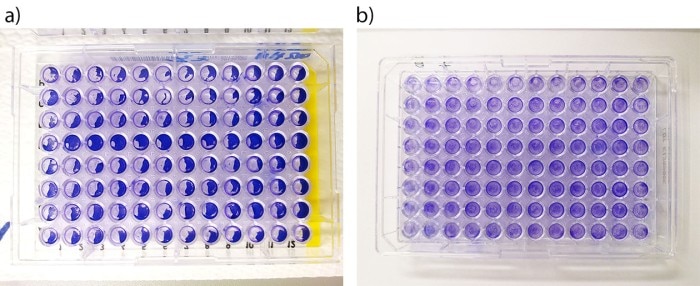
Model assay results of a pharmaceutical customer before (a) and after (b) the consulting work by InCelligence
Quality pays off, even for consumables
If you take a closer look at the manufacturing process Eppendorf uses to produce pipette tips , you will quickly understand why this is so: “I had a chance a few years ago to tour Eppendorf’s production halls in Oldenburg in Holstein,” Dr. Kühl says. “It was an incredibly fascinating experience. “I also had an opportunity to see how the company checks the quality of its pipette tips. Every tip is photographed with the help of a robot arm to determine whether the tip meets the company’s high quality standards. If a tip fails, it’s rejected and replaced by another tip.”Dr. Kühl remembers one customer success story in particular: “This was a quality-control consulting job at a major pharmaceutical company. The main focus involved the setup of a bioassay for the approval testing of a medication. The lab staff was highly experienced and had performed ELISA for years. But once they started to conduct their first cell-based assay, errors kept creeping up. We ultimately determined that they had not only selected the wrong plastic, but were also using ELISA-optimized pipetting techniques. With this knowledge in hand, the sources of the errors could be eliminated and the assay successfully conducted.”
Just how good is your knowledge about selecting the correct pipetting solution and your pipetting technique? Are you simply a rookie or a seasoned pipetting pro?
Use our selection chart to size yourself up or check out our how-to videos and pipetting tips on Eppendorf’s YouTube channel .
You will become a true pipetting master in no time at all when you do this!
If you take a closer look at the manufacturing process Eppendorf uses to produce pipette tips , you will quickly understand why this is so: “I had a chance a few years ago to tour Eppendorf’s production halls in Oldenburg in Holstein,” Dr. Kühl says. “It was an incredibly fascinating experience. “I also had an opportunity to see how the company checks the quality of its pipette tips. Every tip is photographed with the help of a robot arm to determine whether the tip meets the company’s high quality standards. If a tip fails, it’s rejected and replaced by another tip.”Dr. Kühl remembers one customer success story in particular: “This was a quality-control consulting job at a major pharmaceutical company. The main focus involved the setup of a bioassay for the approval testing of a medication. The lab staff was highly experienced and had performed ELISA for years. But once they started to conduct their first cell-based assay, errors kept creeping up. We ultimately determined that they had not only selected the wrong plastic, but were also using ELISA-optimized pipetting techniques. With this knowledge in hand, the sources of the errors could be eliminated and the assay successfully conducted.”
Just how good is your knowledge about selecting the correct pipetting solution and your pipetting technique? Are you simply a rookie or a seasoned pipetting pro?
Use our selection chart to size yourself up or check out our how-to videos and pipetting tips on Eppendorf’s YouTube channel .
You will become a true pipetting master in no time at all when you do this!
Read more

Dr. Nicole Kühl