MENU
FJ | FJD

FJ | FJD
-
- All Pipettes, Dispensers & Automated Liquid Handlers
- All Micropipettes
- Mechanical Pipettes
- Electronic Pipettes
- Multi-Channel Pipettes
- Positive Displacement Pipettes & Dispensers
- Bottle-Top Dispensers
- Pipette Controllers
- Dispenser & Pipette Accessories
- Automated Pipetting
- Automation Consumables
- Automation Accessories
- Liquid Handler & Pipette Services
Sorry, we couldn't find anything on our website containing your search term.
You are about to leave this site.
Please be aware that your current cart is not saved yet and cannot be restored on the new site nor when you come back. If you want to save your cart please login in into your account.
Sorry, we couldn't find anything on our website containing your search term.
- Home
- Lab Academy
- Applied Industries
- Bioprocessing
- Introduction to Bioprocessing
- Bioprocess Monitoring and Control
- Process Analytical Technology
Process Analytical Technology in Bioprocessing
What is PAT
Eppendorf solutions for PAT
PAT application examples
Turn bioprocess data into real-time control
Your bioprocess data is valuable
During an upstream bioprocess, process analytical technology (PAT) provides valuable insights into critical process parameters, including temperature, pH, nutrient concentrations, cell status, and product formation. This data is essential for understanding, monitoring, and controlling your process.Common challenges in using bioprocess data
When sensors, connected analyzers, and offline analyzers operate in separate systems, data must be collected and reconciled manually. This makes data management labor-intensive and often too slow to support decisions during an active process. Transferring a process from development to manufacturing can create additional challenges. Monitoring and control strategies may need to be rebuilt, slowing progress and increasing the risk of process variation between runs.How our bioprocess solutions help
Our software solutions help you unlock the full value of your bioprocess data. They enable you to:- Integrate process analytical technology
- Consolidate the data from all your runs in a central, accessible location
- Use bioprocess data for real-time process control
- Replicate monitoring and control strategies across scales
Read more
Automated glucose control for better results and less manual work
Discover PAT application examples in our webinar:
- Find out how scientists at Merck KGaA held the glucose concentration in a CHO cell culture bioprocess constant for three days without manual intervention.
- Discover an example for the automation of E. coli culture feeding
- Learn about bioreactor software features enabling sensor integration
What is PAT and how to use it in bioprocessing
What is PAT?
PAT is the abbreviation for Process Analytical Technology. In bioprocessing, this is a general term for technologies which are used for bioprocess monitoring and control .
Read more
How can PAT help improve upstream bioprocessing?
PAT helps you monitor your bioprocess in real time and use the sensor data to automate process control. The benefits include:
- Less manual work
- Gain the data you need to identify critical process parameters
- Use data for automated process control
- Improved process understanding and control result in better process performance, higher consistency, and better product quality
Read more
How can PAT be used to turn measurements into process control?
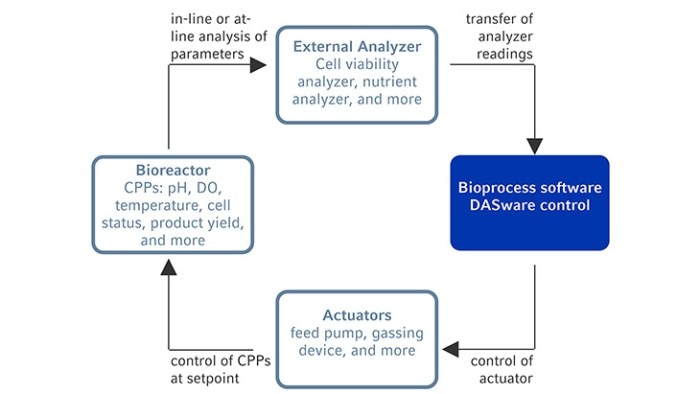
With DASware® control SCADA software from Eppendorf, measurements from a connected analyzer can be used directly in a control loop. For example, a value such as glucose concentration can set the feed pump rate without an operator step. Sensor integration via DASware control enables two-way communication. Measurements from the connected device can drive feedback control loops for nutrients, biomass or product concentration, for example. DASware control software also enables scheduled and event-triggered sampling with the Bioprocess Autosampler .
Read more
How does PAT support Quality by Design (QbD)?
Using PAT helps with the goal of Quality by Design (QbD), whereby the process itself is designed to ensure the desired product quality. Instead of just testing product quality at the end of the process, parameters are controlled in real time to improve the productivity and quality of the bioprocess and its product. PAT helps you gain a better understanding of the process and as a result improve process performance, for example by improving the viable cell density, controlling protein glycosylation patterns, or monitoring production rates.
Read more
How Eppendorf bioprocess solutions support PAT
Connect analyzers: The Eppendorf Bioprocess solutions enable the in-line and at-line integration of process analytical technology through DASware ® control SCADA software.
Understand your data: DASware control and BioNsight® cloud software let you bring online, offline, and calculated process parameters together in one central record for easier analysis and comparison.
Control your process: Use the measurements from a connected analyzer directly in an automated control loop. For example, a value such as glucose concentration can set the feed pump rate without an operator step.
Understand your data: DASware control and BioNsight® cloud software let you bring online, offline, and calculated process parameters together in one central record for easier analysis and comparison.
Control your process: Use the measurements from a connected analyzer directly in an automated control loop. For example, a value such as glucose concentration can set the feed pump rate without an operator step.
Read more
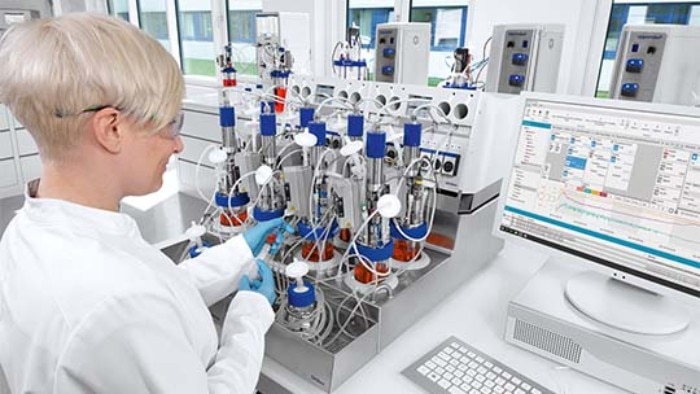
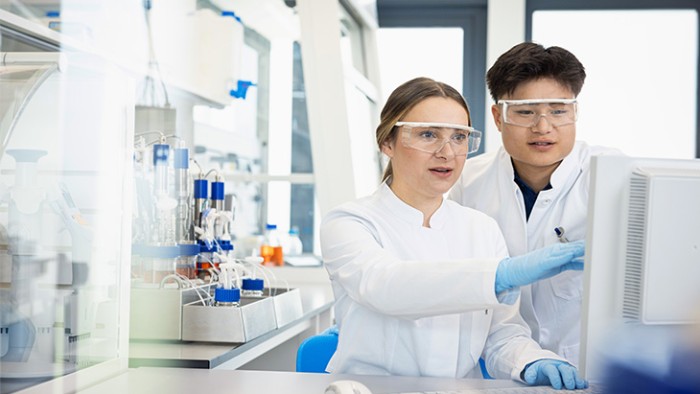
Discover our bioprocess software solutions for process monitoring, control, and analytics!
Which parameters can be monitored with PAT
PAT is routinely used to monitor critical process parameters (CPPs), including pH, dissolved oxygen (DO) and temperature. However, PAT can also be used to assess additional parameters such as nutrients, biomass, cell viability, the metabolic state of the culture, as well as product formation. To do so, different components of the system are measured, such as the medium, the cells, and the exhaust. Various sensor types exist, which apply different measuring principles, including spectroscopic methods (like Raman-, fluorescence-, and infrared spectroscopy), mass spectrometry, electrochemistry, and permittivity. Our solutions support the integration of analyzers and sampling devices, such as
Tell us what you would like to connect!
- Nutrient analyzers
- Cell counters
- Biomass monitors
- HPLC
- Mass spectrometers
- Raman sensors
- Autosampler
Tell us what you would like to connect!
Read more
Discover PAT application examples


Contact us
We have been building and supporting software for upstream bioprocess for more than three decades. Fill out our contact form to learn more about our bioprocess software solutions and talk with us about your specific needs. You can also email us directly at bioprocess-info@eppendorf.com.