-
-
-
- Pichia 2026
- Future Labs Live 2026
- BioProScale Sympposium 2026
- ASGCT 2026
- Eppendorf Automation Forum 2026
- ECB 2026
- WoTS 2026
- ELRIG Drug Discovery 2026
- 75th JAMT Congress & IFBLS2026
- JASIS2026
- GSCN 2026
- BPI EAST 2026
- Bioprocess Days 2026
- Bioprocess Day 2026, Texas, USA
- Bioprocess Day 2026, Philadelphia, USA
- Cell 2026
- FPP x CMS Amsterdam
-

-
-
-
- Pichia 2026
- Future Labs Live 2026
- BioProScale Sympposium 2026
- ASGCT 2026
- Eppendorf Automation Forum 2026
- ECB 2026
- WoTS 2026
- ELRIG Drug Discovery 2026
- 75th JAMT Congress & IFBLS2026
- JASIS2026
- GSCN 2026
- BPI EAST 2026
- Bioprocess Days 2026
- Bioprocess Day 2026, Texas, USA
- Bioprocess Day 2026, Philadelphia, USA
- Cell 2026
- FPP x CMS Amsterdam
-
-
- All Pipettes, Dispensers & Automated Liquid Handlers
- All Micropipettes
- Mechanical Pipettes
- Electronic Pipettes
- Multi-Channel Pipettes
- Positive Displacement Pipettes & Dispensers
- Bottle-Top Dispensers
- Pipette Controllers
- Dispenser & Pipette Accessories
- Automated Pipetting
- Automation Consumables
- Automation Accessories
- Liquid Handler & Pipette Services
- Home
- Lab Academy
- Applied Industries
- Bioprocessing
- Introduction to Bioprocessing
- Bioprocessing Scale Up
Bioprocessing Scale Up
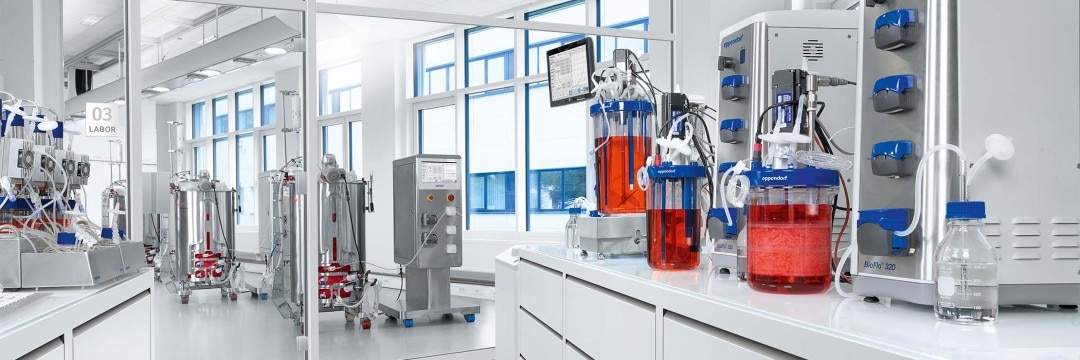
Bioprocess scale up strategies
Eppendorf products for bioprocess scale up
Customer success stories
Read more
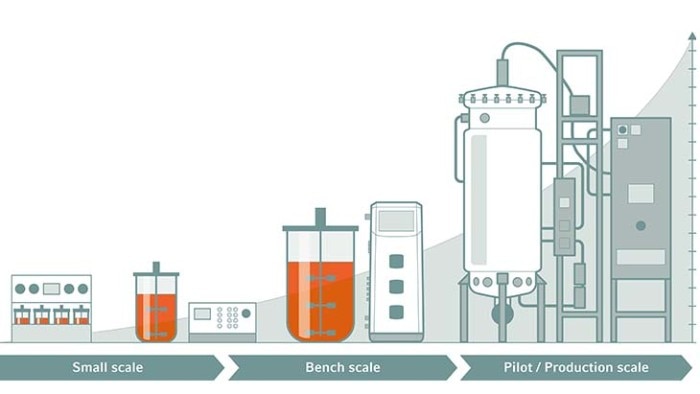
Bioprocess scale up strategies
An established strategy when transitioning to larger working volumes is to monitor and control a single parameter. However, keeping one process parameter constant will change others; therefore, the cells’ growth environment can only be partly reproduced at different scales. Bioengineers must identify the parameters which influence cell growth and productivity most, to decide, which scale up strategy is the most suitable. Although bioprocessing scale up strategies that control several criteria are the most powerful, those that control singular parameters can still be effective, and are historically the most widely used due to their simplicity. Read on to learn more about common singular parameters to control.
Constant power input per liquid volume
Definition of power input per liquid volume (P/V)
- Np: the impeller power number (also known as Newton number),
- ρ: DI water density (kg/m3 ),
- N: agitation speed (rps),
- D: impeller outer diameter (m)
- V: full working volume (m3 ).
Read more
How P/V influences the bioprocess:
Read more
How to calculate P/V in bioprocessing:
Read more
Constant tip speed
Definition: The impeller tip speed equals π x d x N, with
- D: impeller outer diameter (m)
- N: agitation speed (rps)
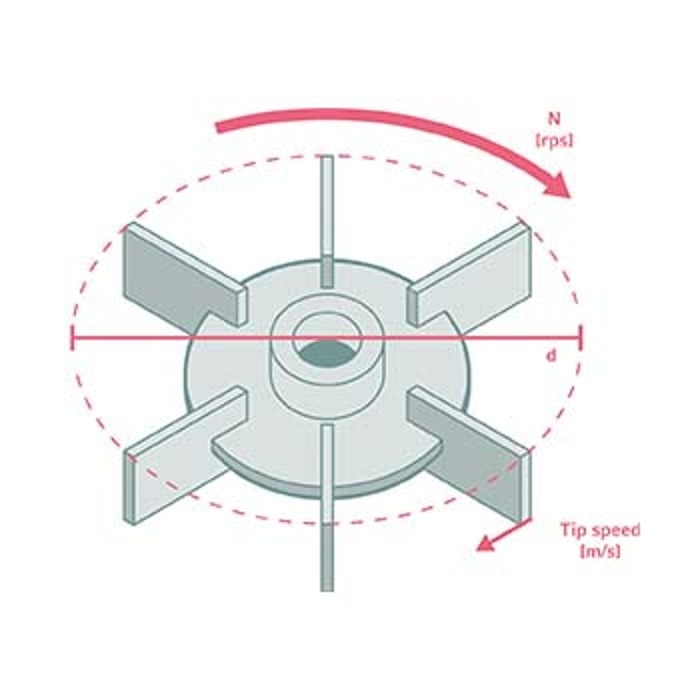
How the tip speed influences the bioprocess:
Read more
How to calculate tip speed:
Read more
Constant kLa
Definition of kLa
Read more
How the kLa influences the bioprocess
Read more
How to determine the kLa
Find a practical example of kLa determination in bioreactors from our application experts!
Read more
Constant mixing time
Definition of mixing time in bioprocessing
Read more
How the mixing time influences the bioprocess:
Read more
How to determine mixing time in bioprocessing
Read more
Bioprocess scale-up from R&D to manufacturing
Find out more about cell culture scale-up in single-use bioreactors:
- Learn about bioprocess scale-up strategies
- Discover a scale-up workflow for scaling up mAB production in CHO cells
- Learn about the Scale Up Assist software feature
Eppendorf offers solutions for powerful bioprocessing scale up
Read more
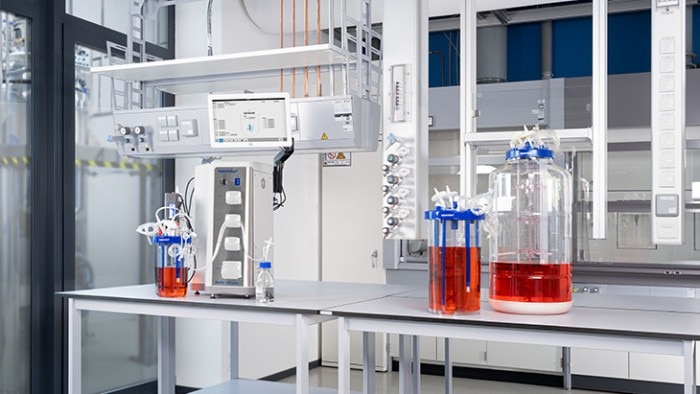
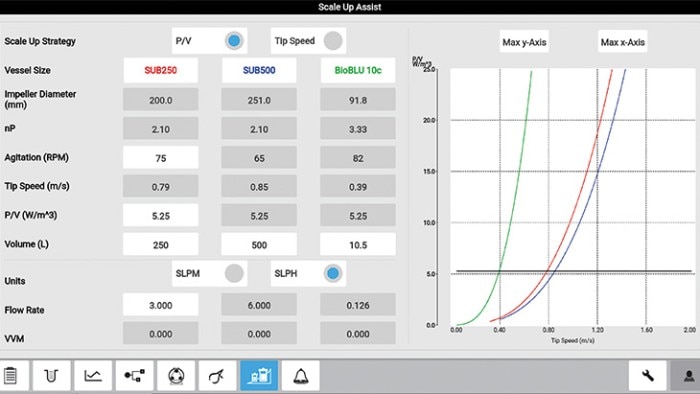
Eppendorf bioreactors for bioprocessing scale up
Bioreactors for cell culture scale up
- Single-use bioreactors: The BioBLU® c Single-Use Bioreactor portfolio covers working volumes from 100 mL to 40 L. To make the progression from bench-scale to production-scale, the BioFlo® 720 is a bioreactor control system which is compatible with Thermo Scientific HyPerforma® 5:1 Single-Use Bioreactors with working volumes up to 500 L.
- Glass bioreactors: Eppendorf glass bioreactors for cell culture applications cover working volumes from 60 mL to 10.5 L and are compatible with the small and bench scale Eppendorf bioprocess systems .
Read more
Bioreactors for fermentation scale up
- Glass bioreactors: Eppendorf glass bioreactors for microbial applications cover working volumes from 60 mL to 10.5 L and are compatible with the small and bench-scale Eppendorf bioprocess systems .
- Single-use bioreactors: The BioBLU® f Single-Use Bioreactor portfolio covers working volumes from 65 mL to 3.75 L. These stirred-tank bioreactors fully address the specific needs of fermentation.
Read more about the scalability of E. coli fermentation in BioBLU® f Single-Use Bioreactors.
Read more
How our customers use our products
Read more


Moving to a bioreactor
Read more