MENU
LT | EUR
-
-
-
- Pichia 2026
- Future Labs Live 2026
- BioProScale Sympposium 2026
- ASGCT 2026
- Eppendorf Automation Forum 2026
- ECB 2026
- WoTS 2026
- ELRIG Drug Discovery 2026
- 75th JAMT Congress & IFBLS2026
- JASIS2026
- GSCN 2026
- BPI EAST 2026
- Bioprocess Days 2026
- Bioprocess Day 2026, Texas, USA
- Bioprocess Day 2026, Philadelphia, USA
- Cell 2026
- FPP x CMS Amsterdam
-

-
-
-
- Pichia 2026
- Future Labs Live 2026
- BioProScale Sympposium 2026
- ASGCT 2026
- Eppendorf Automation Forum 2026
- ECB 2026
- WoTS 2026
- ELRIG Drug Discovery 2026
- 75th JAMT Congress & IFBLS2026
- JASIS2026
- GSCN 2026
- BPI EAST 2026
- Bioprocess Days 2026
- Bioprocess Day 2026, Texas, USA
- Bioprocess Day 2026, Philadelphia, USA
- Cell 2026
- FPP x CMS Amsterdam
-
LT | EUR
-
- All Pipettes, Dispensers & Automated Liquid Handlers
- All Micropipettes
- Mechanical Pipettes
- Electronic Pipettes
- Multi-Channel Pipettes
- Positive Displacement Pipettes & Dispensers
- Bottle-Top Dispensers
- Pipette Controllers
- Dispenser & Pipette Accessories
- Automated Pipetting
- Automation Consumables
- Automation Accessories
- Liquid Handler & Pipette Services
Sorry, we couldn't find anything on our website containing your search term.
Sorry, we couldn't find anything on our website containing your search term.
- Home
- Company & Careers
- Scientific Awards
- Eppendorf & Science Prize for Neurobiology
- All Prize Winners & Finalists
- 2021 Prize Winner Dr. Amber L. Alhadeff
Monell Chemical Senses Center and University of Pennsylvania USA
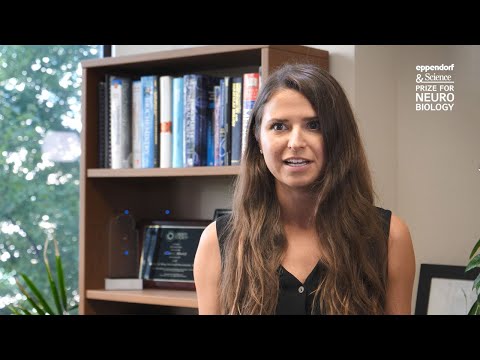
Amber L. Alhadeff received her bachelor degree and Ph.D. from the University of Pennsylvania, where she worked with Harvey Grill and Matthew Hayes to investigate the effects of hindbrain neuroendocrine signaling on food intake control. After receiving her Ph.D., Amber Alhadeff joined the laboratory of Dr. J. Nicholas Betley at Penn where she explored hypothalamic signaling and its effects on feeding and other survival behaviors. In her lab at the Monell Chemical Senses Center, she is interested in gut-brain signaling pathways underlying motivated behavior, and is passionate about mentorship and facilitating the advancement of diverse and underrepresented scientists.
Interoceptive Sensing and Control of Behavior by Hunger Neurons
Why do we behave differently when we haven’t eaten? How do we know when to stop eating? And how do the foods we eat influence our brain activity? Dr. Amber L. Alhadeff began to work on these questions as a postdoc under the mentorship of Dr. J. Nicholas Betley, and in her own lab has continued to investigate how peripheral signals, particularly those arising from the gut, influence neural activity in the brain. To determine how hunger influences perception, Dr. Alhadeff first asked how food deprivation influences responses to sensory stimuli. She discovered that hunger activates a specific population of hypothalamic neurons in the brain to dampen responses to noxious sensory information. This work demonstrated how neural circuits can filter interoceptive information to prioritize hunger – for example, by weakening other signal inputs to enable food seeking. How does information from the gut impact neural activity in these hunger circuits? Dr. Alhadeff’s work went on to show that nutrients in the gut rapidly inhibit activity in hypothalamic hunger neurons. Further, different types of food (e.g., fat and sugar) engage different gut-brain pathways to communicate with these neurons. Overall, this work has advanced our understanding of how the brain integrates interoceptive signals to influence our physiology and behavior.
Interoceptive Sensing and Control of Behavior by Hunger Neurons
Why do we behave differently when we haven’t eaten? How do we know when to stop eating? And how do the foods we eat influence our brain activity? Dr. Amber L. Alhadeff began to work on these questions as a postdoc under the mentorship of Dr. J. Nicholas Betley, and in her own lab has continued to investigate how peripheral signals, particularly those arising from the gut, influence neural activity in the brain. To determine how hunger influences perception, Dr. Alhadeff first asked how food deprivation influences responses to sensory stimuli. She discovered that hunger activates a specific population of hypothalamic neurons in the brain to dampen responses to noxious sensory information. This work demonstrated how neural circuits can filter interoceptive information to prioritize hunger – for example, by weakening other signal inputs to enable food seeking. How does information from the gut impact neural activity in these hunger circuits? Dr. Alhadeff’s work went on to show that nutrients in the gut rapidly inhibit activity in hypothalamic hunger neurons. Further, different types of food (e.g., fat and sugar) engage different gut-brain pathways to communicate with these neurons. Overall, this work has advanced our understanding of how the brain integrates interoceptive signals to influence our physiology and behavior.
Read more
Videos not loading, because cookies have been rejected. Change your

Read more
Downloads

PDF 0.28 MB
Research on Hunger Wins 2021 Eppendorf & Science Prize
JPG 0.23 MB
Amber L. Alhadeff (Photo credit: Happy Hour Headshot Philadelphia)
PDF 4.55 MB