-
-
-
- Service pour Mastercycler
- Service pour systèmes d’automatisation
- Service pour congélateurs
- Service pour incubateurs
- Service pour agitateurs
- Service de contrôle de la température et de l’agitation
- Service pour pipette
- Services pour bioprocédés
- Service pour centrifugeuses et rotors
- Étalonnage pour pipette neuve
-

-
-
-
- Service pour Mastercycler
- Service pour systèmes d’automatisation
- Service pour congélateurs
- Service pour incubateurs
- Service pour agitateurs
- Service de contrôle de la température et de l’agitation
- Service pour pipette
- Services pour bioprocédés
- Service pour centrifugeuses et rotors
- Étalonnage pour pipette neuve
-
-
- Pipettes, distributeurs et dispositifs de manipulation de liquides automatisée
- Toutes les micropipettes
- Pipettes mécaniques
- Pipettes électroniques
- Pipettes multicanaux
- Pipettes et distributeurs à déplacement positif
- Distributeurs sur flacon
- Auxiliaires de pipetage
- Accessoires pour pipettes et distributeurs
- Pipetage automatisé
- Consommables d’automatisation
- Accessoires d’automatisation
- Services pour pipettes et distributeurs
- Bioprocessing Scale Up
Bioprocessing Scale Up
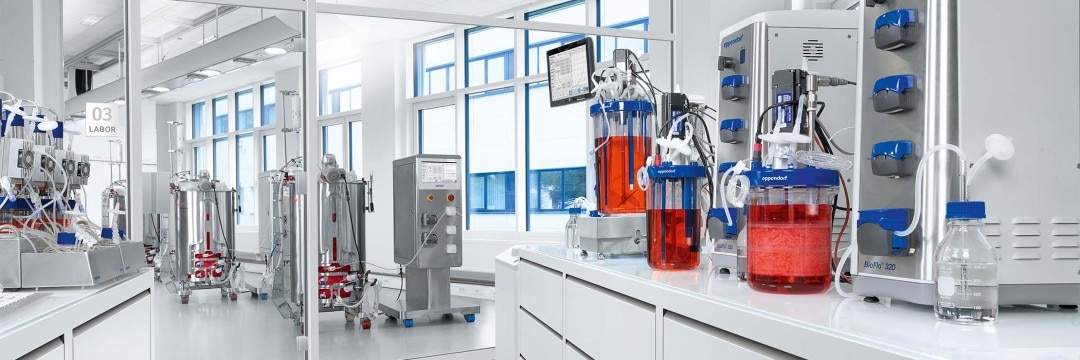
Bioprocess scale up strategies
Eppendorf products for bioprocess scale up
Customer success stories
Lire la suite
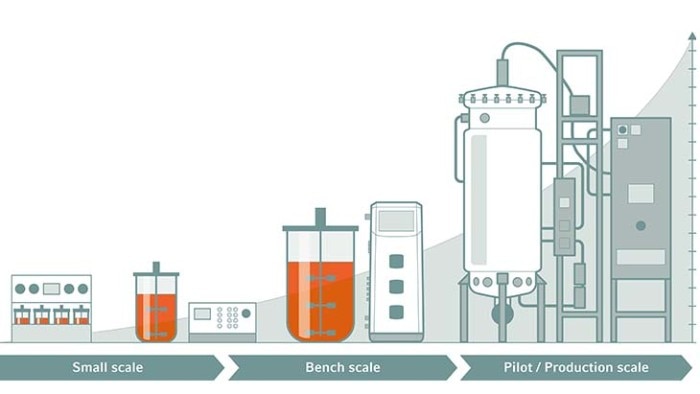
Bioprocess scale up strategies
An established strategy when transitioning to larger working volumes is to monitor and control a single parameter. However, keeping one process parameter constant will change others; therefore, the cells’ growth environment can only be partly reproduced at different scales. Bioengineers must identify the parameters which influence cell growth and productivity most, to decide, which scale up strategy is the most suitable. Although bioprocessing scale up strategies that control several criteria are the most powerful, those that control singular parameters can still be effective, and are historically the most widely used due to their simplicity. Read on to learn more about common singular parameters to control.
Constant power input per liquid volume
Definition of power input per liquid volume (P/V)
- Np: the impeller power number (also known as Newton number),
- ρ: DI water density (kg/m3 ),
- N: agitation speed (rps),
- D: impeller outer diameter (m)
- V: full working volume (m3 ).
Lire la suite
How P/V influences the bioprocess:
Lire la suite
How to calculate P/V in bioprocessing:
Lire la suite
Constant tip speed
Definition: The impeller tip speed equals π x d x N, with
- D: impeller outer diameter (m)
- N: agitation speed (rps)
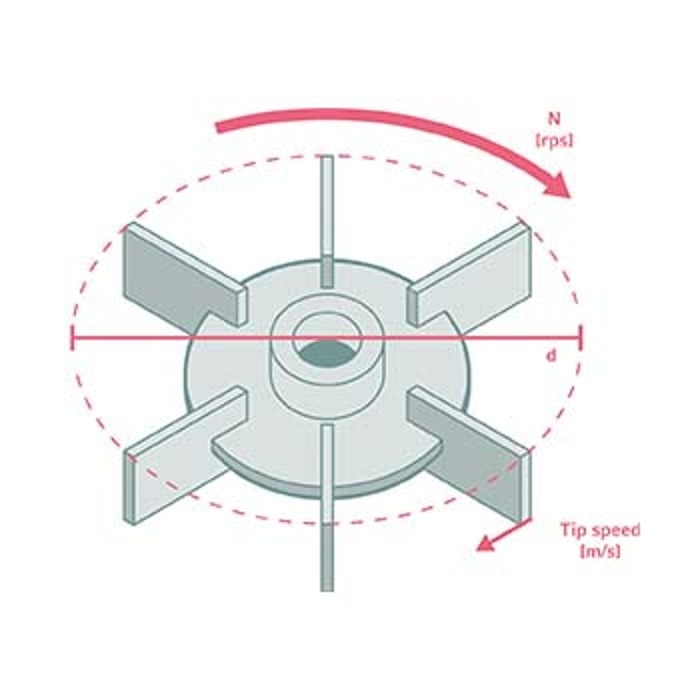
How the tip speed influences the bioprocess:
Lire la suite
How to calculate tip speed:
Lire la suite
Constant kLa
Definition of kLa
Lire la suite
How the kLa influences the bioprocess
Lire la suite
How to determine the kLa
Find a practical example of kLa determination in bioreactors from our application experts!
Lire la suite
Constant mixing time
Definition of mixing time in bioprocessing
Lire la suite
How the mixing time influences the bioprocess:
Lire la suite
How to determine mixing time in bioprocessing
Lire la suite
Bioprocess scale-up from R&D to manufacturing
Find out more about cell culture scale-up in single-use bioreactors:
- Learn about bioprocess scale-up strategies
- Discover a scale-up workflow for scaling up mAB production in CHO cells
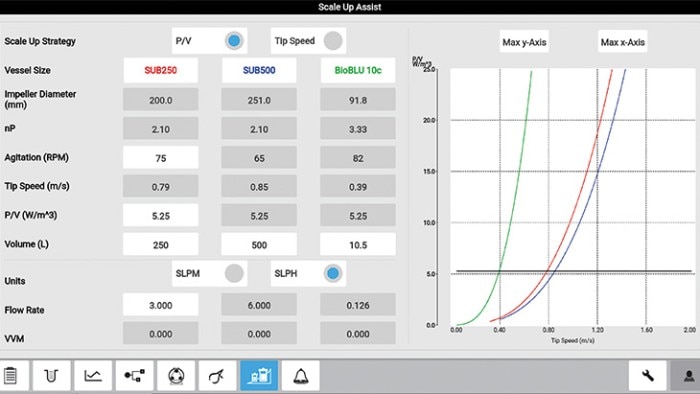
- Learn about the Scale Up Assist software feature
Eppendorf offers solutions for powerful bioprocessing scale up
Lire la suite
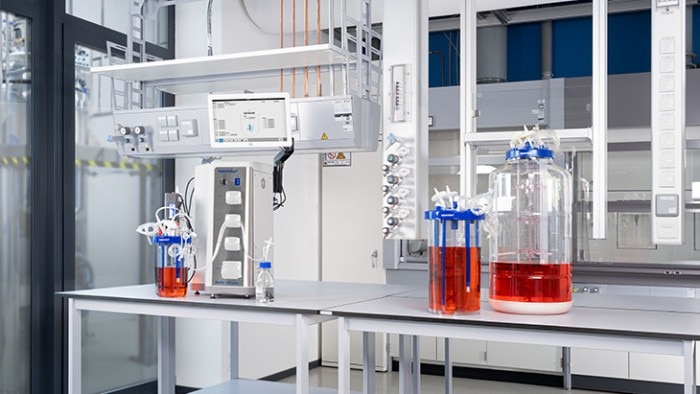
Eppendorf bioreactors for bioprocessing scale up
Bioreactors for cell culture scale up
- Single-use bioreactors: The BioBLU® c Single-Use Bioreactor portfolio covers working volumes from 100 mL to 40 L. To make the progression from bench-scale to production-scale, the BioFlo® 720 is a bioreactor control system which is compatible with Thermo Scientific HyPerforma® 5:1 Single-Use Bioreactors with working volumes up to 500 L.
- Glass bioreactors: Eppendorf glass bioreactors for cell culture applications cover working volumes from 60 mL to 10.5 L and are compatible with the small and bench scale Eppendorf bioprocess systems .
Lire la suite
Bioreactors for fermentation scale up
- Glass bioreactors: Eppendorf glass bioreactors for microbial applications cover working volumes from 60 mL to 10.5 L and are compatible with the small and bench-scale Eppendorf bioprocess systems .
- Single-use bioreactors: The BioBLU® f Single-Use Bioreactor portfolio covers working volumes from 65 mL to 3.75 L. These stirred-tank bioreactors fully address the specific needs of fermentation.
Read more about the scalability of E. coli fermentation in BioBLU® f Single-Use Bioreactors.
Lire la suite
How our customers use our products
Lire la suite


Moving to a bioreactor
Lire la suite