MENÜ
CH | CHF

CH | CHF
-
- Alle Pipetten, Dispenser und automatischen Liquid-Handling-Systeme
- Alle Mikropipetten
- Mechanische Pipetten
- Elektronische Pipetten
- Mehrkanalpipetten
- Direktverdrängerpipetten und Dispenser
- Flaschendispenser
- Pipettierhilfen
- Zubehör für Dispenser und Pipetten
- Automatisches Pipettieren
- Verbrauchsartikel für die Automation
- Zubehör für die Automation
- Services für Liquid-Handling-Geräte und Pipetten
Sorry, we couldn't find anything on our website containing your search term.
Sorry, we couldn't find anything on our website containing your search term.
- Home
- Lab Academy
- Applied Industries
- Bioprocessing
- Introduction to Bioprocessing
- Bioprocess Development
Bioprocess Development

Upstream bioprocess development aims to maximize the yield and quality of the desired end product while reducing development time and production costs. Our bioprocessing solutions help you achieve these goals. Eppendorf supports you on your bioprocess development journey by providing bioprocess hardware, software solutions, and services, all orchestrated to accelerate upstream process development, streamline scale-up, and harness the power of data. Read on to learn more about them and to get some inspiration for advancing bioprocess development.
Let’s talk development. Let’s talk progress. We're here to help you develop strategies for your bioprocess development journey !
Let’s talk development. Let’s talk progress. We're here to help you develop strategies for your bioprocess development journey !
Mehr erfahren
Identify critical process parameters
Automate tasks
Enable your team
Scale from R&D to production
Secure batches
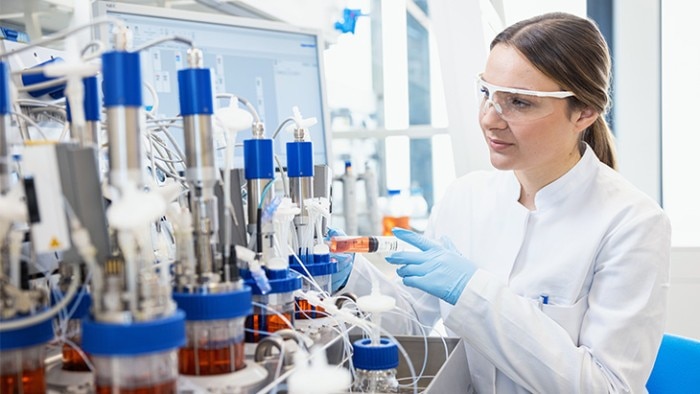
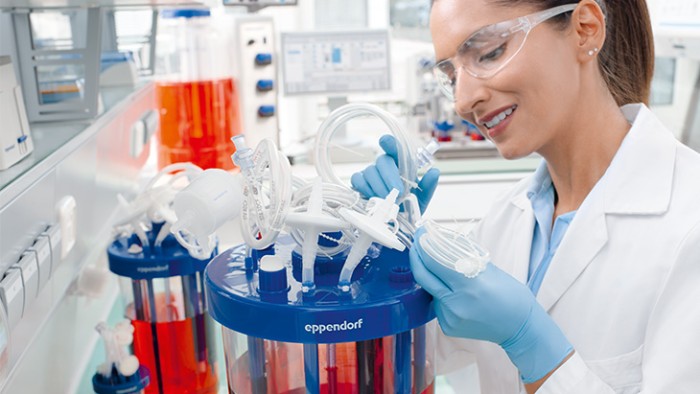

Let’s talk development. Let’s talk progress. We're here to help you find inspiration to identify critical process parameters faster.
Mehr erfahren
Resources and expert insights to identify critical process parameters faster
How to monitor and control bioprocessing parameters?
Visit our bioprocess monitoring and control web page to learn how to monitor bioprocess parameters, which parameters are relevant, and how to control process parameters using feedback loops.
Mehr erfahren
Which bioprocess parameters are relevant and which setpoints I should use for my upstream development project?
The critical process parameters and setpoints will depend on the type of organism you cultivate. Visit our website for more detailed information about cell culture in bioreactors , stem cell bioprocessing , bacterial fermentation , and yeast fermentation .
Mehr erfahren
How can I test different experimental conditions in bioprocessing more quickly?
A good way to speed up bioprocess development is the use of parallel bioprocess systems like the DASbox Mini Bioreactor System or the DASGIP Parallel Bioreactor System . They facilitate multiple experiments to be run simultaneously and like this saving time and resources. Are you interested in an example? Then have a look at this application note from the Zuerich University for Applied Sciences . The researchers used a DASbox Mini Bioreactor System to run four CHO cell culture runs in parallel and reached highly reproducible results.
Mehr erfahren
What is Desing of Experiments (DoE)?
The use of parallel bioprocessing enables a Design of Experiments (DoE) approach, which aims to uncover the complex relationships between process parameters in bioprocess development, through altering a number of variables simultaneously. Not only does this provide fundamental details on a variety of parameters, it also analyzes their potential interactions, and identifies which parameters have the largest effects on the final outcome. Combining DoE and parallel bioprocessing provides a powerful and efficient way to optimize cell cultivation using a minimal number of experiments.
Find out more about the DoE approach in our article:
Find out more about the DoE approach in our article:
Mehr erfahren

PDF 0.2 MB
An introduction to the Design of Experiments (DoE) approach in bioprocess development
How to systematically optimize process parameters and what are the benefits?
For a great example of systematic optimization of process parameters in bioprocess development, we recommend you take a look at this application note from a team at the Medical University of Hannover . It describes how systematic optimization of process parameters, including pH, DO and feeding strategy, led to a more than 10-fold increase in cell density compared to uncontrolled conditions.
Optimizing process parameters requires analysis of bioprocess data from different runs. For an example of how powerful software can simplify this, we recommend an application note on pH setpoint optimization from our laboratory. This clearly shows how BioNsight cloud software can simplify the comparison of bioprocess runs.
Optimizing process parameters requires analysis of bioprocess data from different runs. For an example of how powerful software can simplify this, we recommend an application note on pH setpoint optimization from our laboratory. This clearly shows how BioNsight cloud software can simplify the comparison of bioprocess runs.
Mehr erfahren
How can AI-based tools help increase efficiency in bioprocess development?
A wide variety of sensors and analyzers generate a vast amount of bioprocess data. The challenge is to efficiently analyze the data and turn it into insights. AI-based tools can help increase efficiency in bioprocess development by reducing the experimental effort per project, reducing time and cost, and increasing development capacity. They help increase the effectiveness of bioprocess development by providing better insights and process knowledge, enabling higher productivity and the development of more robust processes. For further reading, we recommend the resources of DataHow , a company at the forefront of applying a new generation of AI technologies to bioprocessing and one of our partners. Find information on how AI-based tools can reduce wet-lab experiments , what is model-based upstream process optimization , and more.
Find out how the Eppendorf BioNsight cloud software solutions streamlines the use of your bioprocess data for the analysis with DataHow’s AI-based tools.
Find out how the Eppendorf BioNsight cloud software solutions streamlines the use of your bioprocess data for the analysis with DataHow’s AI-based tools.
Mehr erfahren
Customer Webinar: Precise Bioprocessing through Modelling
In this webinar, our customers at the National Institute for Bioprocessing Research and Training (NIBRT) in Irleand explain how bioprocess modelling is powering precision in biomanufacturing.
- They create a digital copy of their cells and use advanced models to optimize processes in silico.
- Model predictions are then validated in bioreactors.
- Model-supported process optimization requires less wet-lab experiments and less trial and error and is therefore faster and more cost-effective than traditional optimization in the lab.

Automate routine tasks in bioprocess development to focus on your valuable research
Automating routine tasks allows scientists to focus on valuable research and reduces the risk of human error. Our solutions empower you to increase bioprocess development efficiency through automating manual steps in the laboratory, process control, and data handling.
- Automate sampling: The Bioprocess Autosampler facilitates sampling 24/7 in regular, short intervals, helping you obtain strong datasets and freeing up time for other tasks.
- Automate bioprocess control: DASware control software enables you to automate process control by implementing tailored feedback loops to reduce manual work and make process control more precise.
- Automate data handling: DASware control software and BioNsight cloud provide automated data management in a central location for easy access from anywhere and in-depth analysis.
Mehr erfahren
Resources and expert insights to automate tasks in bioprocessing

Let’s talk development. Let’s talk progress. We're here to help you find inspiration how to automate tasks in bioprocess development.
Mehr erfahren
How to automate sampling in bioprocess development to reduce manual labor?
For an example of automated bioprocess sampling, we recommend you take a look at this application note from one of our customers . It describes how the Bioprocess Autosampler from Eppendorf took samples from eight bioreactors which were operated in parallel, at various time points during an E. coli fermentation run.
If you are interested in automated bioreactor sampling in cell culture bioprocesses, then take a look at this application note from our lab.
If you are interested in automated bioreactor sampling in cell culture bioprocesses, then take a look at this application note from our lab.
Mehr erfahren
How to use process analytical technology (PAT) to reduce manual labor and automate process control?
Visit our website on process analytical technology to find application examples, in which the use of PAT and automated process control improved the bioprocess by automating glucose control, monitoring cell density, or monitoring the product.
Mehr erfahren
Enable your team to perform at their best

Parallel and scalable bioreactor systems, single-use bioreactors, and software solutions are all tools that can be used in the context of upstream bioprocess development. However, it is the individuals who utilize these tools who can elevate your process development to new heights. Through Eppendorf bioprocess trainings, you can drive improved outcomes and better performance in your laboratory by ensuring that your staff is well-prepared and understands their bioprocess systems and software in depth, enabling them to use these tools efficiently.
Mehr erfahren
Efficiently advance from process development to production
The advancement of your process from R&D to production often includes an increase in working volume. Our solutions enable you to scale up your process while maintaining quality and yield.
- Scalable bioreactor systems: The Eppendorf portfolio of bioprocess controllers supports working volumes from 60 mL to 500 L, and many bioprocess systems have a wide working volume range for 10-fold scale-up and more on a single platform.
- Scale Up Assist software: We have developed software to streamline the scale-up process. The Scale Up Assist software feature on selected systems assists you with the calculation of scale-up relevant process parameters transition from process development to production.
- Data comparison across scales: Our BioNsight cloud software enables you to easily compare behavior and performance of your processes at different scales and to transfer your data of your scale-up test runs to the cloud to leverage the power of AI-based analysis.
- Move from R&D to commercial manufacturing: Eppendorf offers an integrated solution of bioprocess controllers, bioreactors, software and services allowing you to conduct and scale both R&D and manufacturing processes on a unified platform while supporting compliance with GMP requirements.
Mehr erfahren
Resources and expert insights to move from R&D to production
Let’s talk development. Let’s talk progress. We're here to help you find inspiration to advance from R&D to production.
Mehr erfahren
How to scale-up my bioprocess?
Visit our website on bioprocessing scale-up to learn more about scale up strategies and to find some application examples of how Eppendorf customers used our products for bioprocessing scale up and scale down.
Mehr erfahren
How to choose between batch, fed-batch, and perfusion and how to develop such processes?
Visit our website on bioprocess operation modes: batch, fed-batch, and continuous culture to learn more about the respective advantages and disadvantages, how to select the right process mode for your application, find out more about perfusion cell culture, and more.
Mehr erfahren
What to consider when choosing bioprocess equipment to move from R&D to production?
We recommend our White Paper to find out more about bioprocess equipment requirements for clinical and commercial production.
- It provides examples for bioreactor documentation requirements to help their qualification for use in clinical and commercial manufacturing.
- It introduces the BioBLU HNQ Single-Use Bioreactors and their product-specific Validation Guides.
- It discusses bioprocess controller and software requirements for work in clinical and commercial manufacturing.
Mehr erfahren

Secure your resources with successful batches
Batch failures can result in significant financial and time losses in upstream process development. Our bioprocess solutions adopt a multifaceted approach to mitigate risks:
- Our bioprocess systems are compatible with single-use bioreactors to minimize contamination and cross-contamination risks.
- Our bioprocess controllers and software offer precise control of your culture's growth environment.
- They are designed to be user-friendly with built-in guided workflows to reduce handling errors.
- Our comprehensive training programs are designed to empower users, ensuring they can maximize the capabilities of bioprocess equipment.
Mehr erfahren
Resources and expert insights to secure batches

How to improve the reproducibility of my bioprocess?
Cells, culture medium, and a bioprocess control system all can be a source of variability and affect cell growth, viability, product formation, and product quality. In our ebook: Increasing the Reproducibility of Cell Culture Bioprocesses you find valuable information on how to identify factors which can contribute to inconsistent results and how to keep bioprocess conditions consistent between runs.
Mehr erfahren
How to test the biocompatibility of single-use bioreactors?
We have performed biocompatibility studies on CHO cell culture in BioBLU Single-Use bioreactors according to the DECHEMA recommendation for leachables studies .
We found that during normal use there is no negative influence of the BioBLU material on CHO cell culture according to the DECHEMA guidelines.
Find all the details in our application note .
We found that during normal use there is no negative influence of the BioBLU material on CHO cell culture according to the DECHEMA guidelines.
Find all the details in our application note .
Mehr erfahren
How to reduce the contamination risk in bioprocessing?
Measures to reduce contamination and cross-contamination risks in bioprocesses include:
- Use of presterilized single-use bioreactors
- Non-invasive sensor technology
- Use of sealed magnetic bearings
Mehr erfahren
Contact us
Contact us to learn more about the Eppendorf upstream bioprocess development solutions.
Mehr erfahren