MENU
PT | EUR
-
-
-
- Pichia 2026
- Future Labs Live 2026
- BioProScale Sympposium 2026
- ASGCT 2026
- Eppendorf Automation Forum 2026
- ECB 2026
- WoTS 2026
- ELRIG Drug Discovery 2026
- 75th JAMT Congress & IFBLS2026
- JASIS2026
- GSCN 2026
- BPI EAST 2026
- Bioprocess Days 2026
- Bioprocess Day 2026, Texas, USA
- Bioprocess Day 2026, Philadelphia, USA
-

-
-
-
- Pichia 2026
- Future Labs Live 2026
- BioProScale Sympposium 2026
- ASGCT 2026
- Eppendorf Automation Forum 2026
- ECB 2026
- WoTS 2026
- ELRIG Drug Discovery 2026
- 75th JAMT Congress & IFBLS2026
- JASIS2026
- GSCN 2026
- BPI EAST 2026
- Bioprocess Days 2026
- Bioprocess Day 2026, Texas, USA
- Bioprocess Day 2026, Philadelphia, USA
-
PT | EUR
-
- All Pipettes, Dispensers & Automated Liquid Handlers
- All Micropipettes
- Mechanical Pipettes
- Electronic Pipettes
- Multi-Channel Pipettes
- Positive Displacement Pipettes & Dispensers
- Bottle-Top Dispensers
- Pipette Controllers
- Dispenser & Pipette Accessories
- Automated Pipetting
- Automation Consumables
- Automation Accessories
- Liquid Handler & Pipette Services
Sorry, we couldn't find anything on our website containing your search term.
Sorry, we couldn't find anything on our website containing your search term.
- Home
- Beyond Science
- Off the Bench
- Bright Minds
- A Cheerful Pessimist
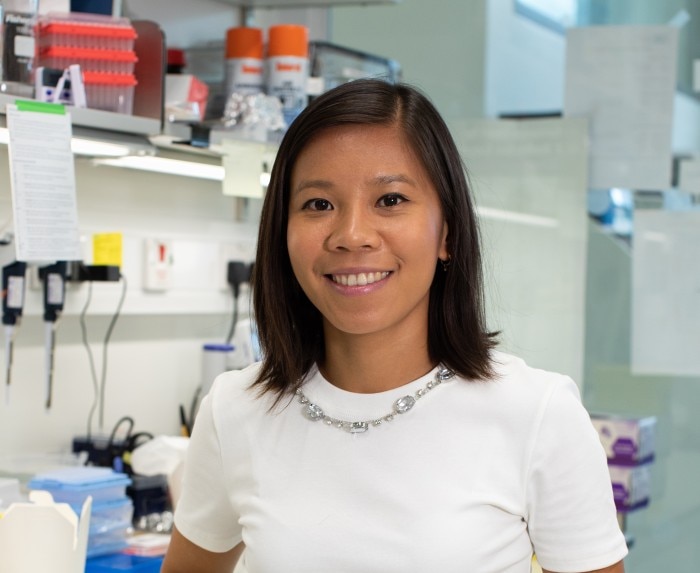
A “Cheerful Pessimist”
Beyond Science
- Off the Bench
- Off the Bench
- Bright Minds
Kelly Nguyen likes to explore new paths and is often surprised by her own success. Just recently, the molecular biologist presented groundbreaking therapy options for the fight against cancer and aging.
The time just before a breakthrough can be tough. Kelly Nguyen has difficulty sleeping – she is completely absorbed, and she would prefer to work nonstop. Finally, the time has come. In the laboratory, the pieces of the puzzle, collected over many years of work, come together naturally. Looking at it this way, it is probably a good thing that her work is slow and arduous, instead of robbing her of her sleep on a weekly basis.Finding the inner core – taking one good look deep inside the cell and understanding what makes such a system tick – Kelly Nguyen is practically gripped by this mission. Since she began working on her doctoral thesis in 2010, the now 34-year-old has been pursuing the visualization of biological molecules. The technological breakthroughs in the cryo-electron microscopy field in 2013 meant to her what the invention of the telescope in the 17th century must have meant to astronomers: a milestone, and the basis for entirely new insights.
Two genius discoveries
In 2015, it helped her achieve her first large breakthrough: she was able to determine the three-
dimensional structure of a major part of the spliceosome. Thus far, this complex molecule had only been partially explored. Inside the cell, the molecule plays a role during the complicated RNA splicing process. And recently, in her most recent breakthrough, she successfully visualized the enzyme telomerase. In human cells, it restores the ends of the chromosomes – the telomeres. More on both topics later.This discovery has the potential to benefit many future patients suffering from cancer or from illnesses related to premature aging. “This new knowledge about the three-
dimensional structure will allow, for example, the development of more precise medications for cancer”, hopes Nguyen. After all, telomerase plays a role in 85 to 90 percent of all cancers whereas a telomerase deficiency is connected to syndromes of premature aging.
Two genius discoveries
In 2015, it helped her achieve her first large breakthrough: she was able to determine the three-
dimensional structure of a major part of the spliceosome. Thus far, this complex molecule had only been partially explored. Inside the cell, the molecule plays a role during the complicated RNA splicing process. And recently, in her most recent breakthrough, she successfully visualized the enzyme telomerase. In human cells, it restores the ends of the chromosomes – the telomeres. More on both topics later.This discovery has the potential to benefit many future patients suffering from cancer or from illnesses related to premature aging. “This new knowledge about the three-
dimensional structure will allow, for example, the development of more precise medications for cancer”, hopes Nguyen. After all, telomerase plays a role in 85 to 90 percent of all cancers whereas a telomerase deficiency is connected to syndromes of premature aging.
Read more
I don’t start out expecting a good result – regardless of how it turns out, I am a happy person.”
Kelly Nguyen

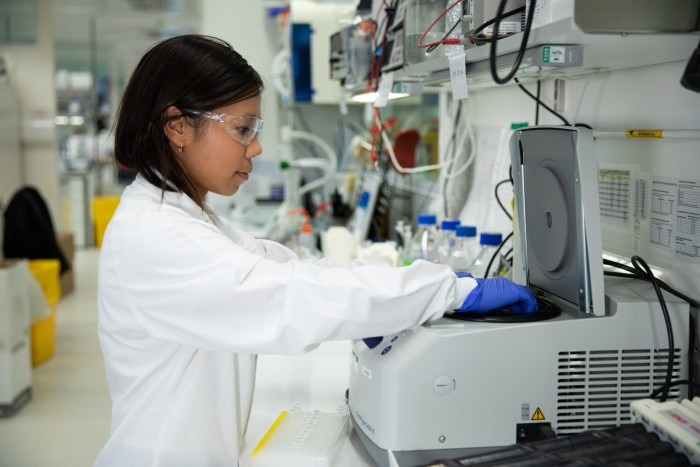
Career ingredient: education
Kelly’s path leading up to this success story was long, and it asked a lot of her. It all began with a gold medal at the 2003 South Vietnam Math Olympics. To her, this was a signal for departure. A year later, the world beckoned, and at the young age of 16, Thi Hoang Duong Nguyen heeded the call. Alone. Her family, her parents and her two sisters live in Vietnam to this day. Kelly, the name she uses abroad, received an opportunity to attend High School in New Zealand. A foreign environment with a foreign language. “This was where I learned to adapt to new environments quickly and maintain a positive attitude even if things are difficult.”
A time-lapse summary of her career: at the age of 18, she entered the Australian National University in Canberra, and at 22 she began her doctoral work at the University of Cambridge. She was 28 when she moved to the US to conduct research and 31 when she returned to Cambridge in 2019 to start her own group which currently comprises five laboratory members. What had made the deepest impression on her throughout these years? Above all, “it was my parents’ strong work ethic”, and the high value they place on education. It was these values that carried her around the world and that allowed her to pursue a career that she loves.
By now, the researcher, who describes herself as being curious, organized, thorough and systematic, has a number of prestigious awards to show for herself – for example, she recently received the Eppendorf Award for Young European Investigators 2022, worth 20,000 euros. While the “cheerful pessimist” is not afraid of new challenges, she is occasionally prone to self-doubt. “I don’t start out expecting a good result – regardless of how it turns out, I am a happy person.”
Kelly’s path leading up to this success story was long, and it asked a lot of her. It all began with a gold medal at the 2003 South Vietnam Math Olympics. To her, this was a signal for departure. A year later, the world beckoned, and at the young age of 16, Thi Hoang Duong Nguyen heeded the call. Alone. Her family, her parents and her two sisters live in Vietnam to this day. Kelly, the name she uses abroad, received an opportunity to attend High School in New Zealand. A foreign environment with a foreign language. “This was where I learned to adapt to new environments quickly and maintain a positive attitude even if things are difficult.”
A time-lapse summary of her career: at the age of 18, she entered the Australian National University in Canberra, and at 22 she began her doctoral work at the University of Cambridge. She was 28 when she moved to the US to conduct research and 31 when she returned to Cambridge in 2019 to start her own group which currently comprises five laboratory members. What had made the deepest impression on her throughout these years? Above all, “it was my parents’ strong work ethic”, and the high value they place on education. It was these values that carried her around the world and that allowed her to pursue a career that she loves.
By now, the researcher, who describes herself as being curious, organized, thorough and systematic, has a number of prestigious awards to show for herself – for example, she recently received the Eppendorf Award for Young European Investigators 2022, worth 20,000 euros. While the “cheerful pessimist” is not afraid of new challenges, she is occasionally prone to self-doubt. “I don’t start out expecting a good result – regardless of how it turns out, I am a happy person.”
Read more
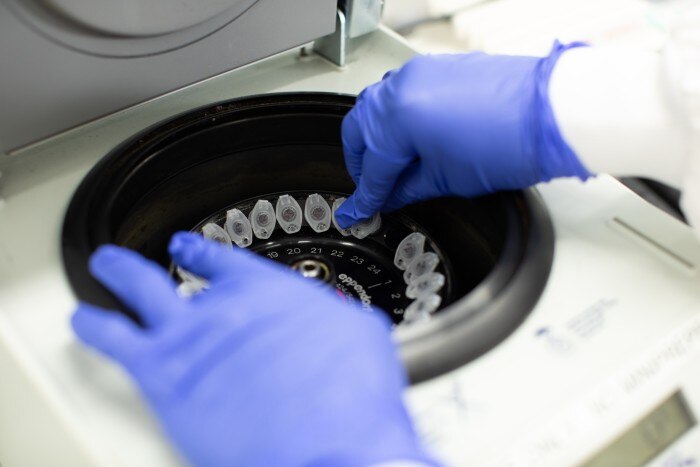
All or nothing
“My work has clearly defined goals, and very often, it is about all or nothing”, says Kelly as she discusses the topic of innovative technologies and the modern laboratory instruments without which her discoveries would not have been possible: centrifuges, vitrobots for the preparation of cryo-EM samples, the Typhoon imager and many more. “We often work for a very long time before we get to lay eyes on our molecule of interest.”
And thus, she dedicated five years and her doctoral thesis to the spliceosome, an RNA-protein complex located inside the cell nucleus that plays an important role in gene expression. Prior to 2015, when its three-dimensional structure, reminiscent of a gel-like coral structure, was visualized, the spliceosome could only be analyzed in parts. Since 2016, Nguyen has also been studying telomerase which maintains the caps of the chromosomes. “When I started working on this, we knew very little about what this molecule comprises and what it looks like.”
Spliceosome and telomerase – how are they connected? Indeed, Nguyen discovered a number of similarities: “Both belong to a family of macromolecules we call ribonucleoproteins.” Both are large – at least by macromolecular standards – and flexible. They are difficult to produce in large quantities in the laboratory, which is why they had remained elusive to researchers for so long.
Unexpected discovery
These novel visualizations from inside the human cell nucleus were the key to her groundbreaking success. In addition, Nguyen detected unexpected components of telomerase: histones. Until now, biochemists were under the impression that histones were only involved in the packaging of DNA. The fact that they are also found in telomerase indicates a new role.
Nguyen will continue to pursue her research in this direction, and she will especially encourage and support young women “in the same way that I experienced support and encouragement from my parents and mentors.” And if her head does occasionally spin from all the laboratory work, she will turn to her passion, baking, and listen to audio books – preferably biographies – or she will go for a run and explore the beautiful walking paths around Cambridge
“My work has clearly defined goals, and very often, it is about all or nothing”, says Kelly as she discusses the topic of innovative technologies and the modern laboratory instruments without which her discoveries would not have been possible: centrifuges, vitrobots for the preparation of cryo-EM samples, the Typhoon imager and many more. “We often work for a very long time before we get to lay eyes on our molecule of interest.”
And thus, she dedicated five years and her doctoral thesis to the spliceosome, an RNA-protein complex located inside the cell nucleus that plays an important role in gene expression. Prior to 2015, when its three-dimensional structure, reminiscent of a gel-like coral structure, was visualized, the spliceosome could only be analyzed in parts. Since 2016, Nguyen has also been studying telomerase which maintains the caps of the chromosomes. “When I started working on this, we knew very little about what this molecule comprises and what it looks like.”
Spliceosome and telomerase – how are they connected? Indeed, Nguyen discovered a number of similarities: “Both belong to a family of macromolecules we call ribonucleoproteins.” Both are large – at least by macromolecular standards – and flexible. They are difficult to produce in large quantities in the laboratory, which is why they had remained elusive to researchers for so long.
Unexpected discovery
These novel visualizations from inside the human cell nucleus were the key to her groundbreaking success. In addition, Nguyen detected unexpected components of telomerase: histones. Until now, biochemists were under the impression that histones were only involved in the packaging of DNA. The fact that they are also found in telomerase indicates a new role.
Nguyen will continue to pursue her research in this direction, and she will especially encourage and support young women “in the same way that I experienced support and encouragement from my parents and mentors.” And if her head does occasionally spin from all the laboratory work, she will turn to her passion, baking, and listen to audio books – preferably biographies – or she will go for a run and explore the beautiful walking paths around Cambridge
Read more