-
-
-
- Pichia 2026
- Future Labs Live 2026
- BioProScale Sympposium 2026
- ASGCT 2026
- Eppendorf Automation Forum 2026
- ECB 2026
- WoTS 2026
- ELRIG Drug Discovery 2026
- 75th JAMT Congress & IFBLS2026
- JASIS2026
- GSCN 2026
- BPI EAST 2026
- Bioprocess Days 2026
- Bioprocess Day 2026, Texas, USA
- Bioprocess Day 2026, Philadelphia, USA
- Cell 2026
- FPP x CMS Amsterdam
-

-
-
-
- Pichia 2026
- Future Labs Live 2026
- BioProScale Sympposium 2026
- ASGCT 2026
- Eppendorf Automation Forum 2026
- ECB 2026
- WoTS 2026
- ELRIG Drug Discovery 2026
- 75th JAMT Congress & IFBLS2026
- JASIS2026
- GSCN 2026
- BPI EAST 2026
- Bioprocess Days 2026
- Bioprocess Day 2026, Texas, USA
- Bioprocess Day 2026, Philadelphia, USA
- Cell 2026
- FPP x CMS Amsterdam
-
-
- All Pipettes, Dispensers & Automated Liquid Handlers
- All Micropipettes
- Mechanical Pipettes
- Electronic Pipettes
- Multi-Channel Pipettes
- Positive Displacement Pipettes & Dispensers
- Bottle-Top Dispensers
- Pipette Controllers
- Dispenser & Pipette Accessories
- Automated Pipetting
- Automation Consumables
- Automation Accessories
- Liquid Handler & Pipette Services
- Home
- Lab Academy
- Life Science
- Molecular Biology
- Adapting Centrifugation Time
Adapting Centrifuge Time and Speed
Lab Academy
- Molecular Biology
- Centrifugation
- Efficiency
- Centrifuges & Rotors
- Essay
What can you do if your centrifuge and rotor provide, e.g., only lower g × force than your protocol requires? You can centrifuge for an appropriate longer length of time. But what centrifuge time and speed will be required? And how do you calculate this? The answer: by using the k-factor, a measure of the sedimentation distance. This will tell you how long it will take the particles to settle at the bottom of the test tube.
The k-factor represents the pelleting efficiency of a centrifugation system at maximum rotational speed. You can download our Centrifuge Family Overview to find out the maximum speed of your Eppendorf centrifuge.
The k-factor is a measure of the sedimentation distance in a test tube; it depends on the difference between the longest and the shortest distance between the sample and rotor axis. The shorter the sedimentation distance, the shorter the centrifugation time. In addition, the angle of the tubes within the rotor influences the sedimentation distance.
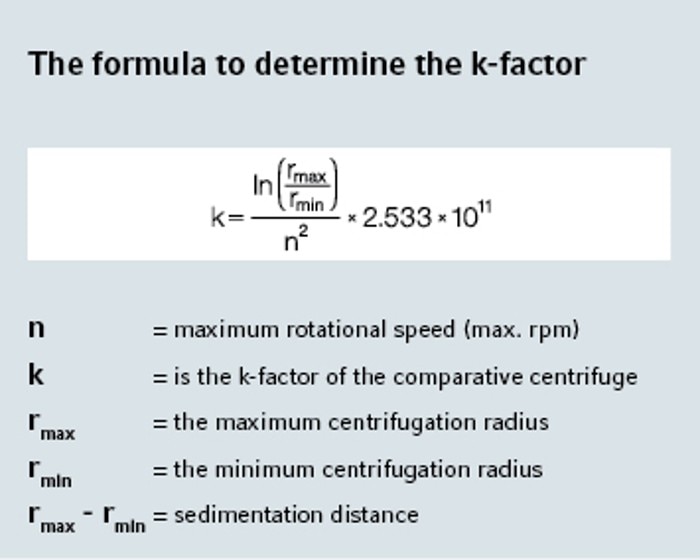
The k-factor is a measure of the sedimentation distance and tells us how long it will take until the particles settle at the bottom of the test tube.
The smaller the k-factor, the better the pelleting efficiency.
Read more
The formula for calculating the k-factor considers these parameters:
- Maximum rotor radius
- Minimum rotor radius
- Speed
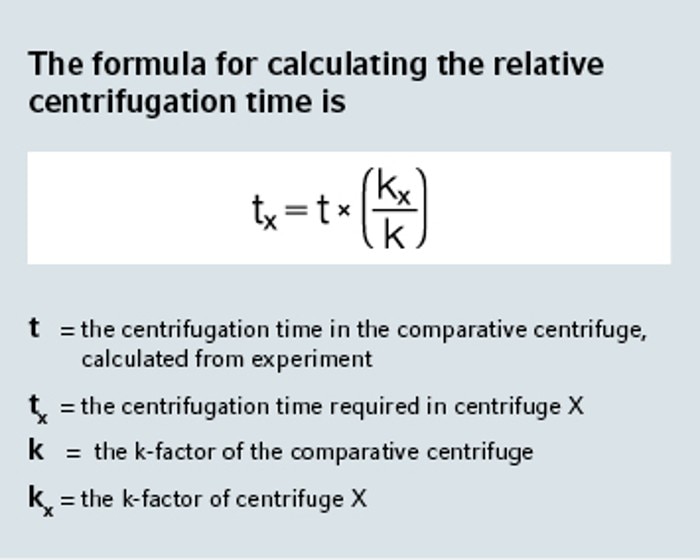
To achieve the same sedimentation result and compensate for not having g × force, you can calculate how much longer to centrifuge using a formula based on the k-factors of both rotors and the centrifugation time of the rotor originally used.
Is adjusting your centrifuge speed and time getting in the way of your experiments? You can also use our calculation tool to measure the required rotational speed and relative centrifugal force, using the rotor diameter.
Learn more basics in centrifugation
Read more