MENU
CH | CHF
-
-
-
- WHX Labs Dubai 2026
- analytica 2026
- Forum Labo 2026
- SLAS Europe 2026
- Forum Labo 2026 Bioprocess
- Bioprocessing Summit Europe 2026
- BioProcess International 2026
- Swiss Biotech Day 2025
- ISCT 2026
- Pichia 2026
- Future Labs Live 2026
- BioProScale Sympposium 2026
- ASGCT 2026
- Eppendorf Automation Forum 2026
- ESACT 2026
- ELRIG Drug Discovery 2026
-

-
-
-
- WHX Labs Dubai 2026
- analytica 2026
- Forum Labo 2026
- SLAS Europe 2026
- Forum Labo 2026 Bioprocess
- Bioprocessing Summit Europe 2026
- BioProcess International 2026
- Swiss Biotech Day 2025
- ISCT 2026
- Pichia 2026
- Future Labs Live 2026
- BioProScale Sympposium 2026
- ASGCT 2026
- Eppendorf Automation Forum 2026
- ESACT 2026
- ELRIG Drug Discovery 2026
-
CH | CHF
-
- Pipettes, distributeurs et dispositifs de manipulation de liquides automatisée
- Toutes les micropipettes
- Pipettes mécaniques
- Pipettes électroniques
- Pipettes multicanaux
- Pipettes et distributeurs à déplacement positif
- Distributeurs sur flacon
- Auxiliaires de pipetage
- Accessoires pour pipettes et distributeurs
- Pipetage automatisé
- Consommables d’automatisation
- Accessoires d’automatisation
- Services pour pipettes et distributeurs
Sorry, we couldn't find anything on our website containing your search term.
Sorry, we couldn't find anything on our website containing your search term.
When You Think about Pipetting Liquids, Think Twice
Lab Academy
- Biologie cellulaire
- Digitalization
- Pipettes
- Test
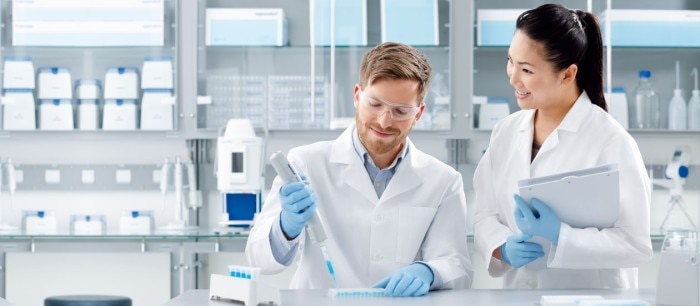
Starting an experiment means asking many questions. Which material is needed? Which samples are used? Which conditions are necessary, e.g., growth? How long is the whole application? Do I have to check on the experiment at weekends, or at night? One question is often forgotten, but is of no less importance. Which liquids are used during the application and how are they pipetted?
Since pipetting liquids is daily business and if the liquid aspirated is also dispensed, we usually don’t spend too much time and effort on this topic. But it makes sense to think twice about the liquid and pipette tool used.
Liquids can be categorized in five main categories: aqueous, viscous (incl. detergents), volatile, dense and infectious or toxic. Improper handling of these liquid categories has a tremendous influence on the pipetting result. While pipetting aqueous solutions like most buffers is fairly simple and mainly done with classic air-cushion pipettes, difficulties may arise when pipetting volatile liquids like acetone. Volatile liquids have a high vapor pressure causing evaporation into the air-cushion and thereby droplet formation. In the end, this means sample or reagent loss without the correct pipetting technique. When pipetting volatile liquids, pre-wetting of the pipette tip (repeated aspiration and dispensing cycles to humidify the air inside the tip) is mandatory to increase pipetting accuracy. A completely different liquid category includes viscous liquids such as glycerol. These have a very slow flow behavior due to a high inner friction of molecules leading to air bubble aspiration, residues in the tip and sample or reagent loss. A special pipetting technique called reverse pipetting is recommended when using classic air-cushion pipettes. But even better is usage of a different pipetting tool, a positive displacement device with a syringe-like tip working without an air cushion between the sample and the piston inside the tip. Liquid can be aspirated faster and easier with these tools. When dispensing a viscous liquid, the complete volume can be dispensed without residues in the tip.
So, thinking about the liquid before starting an experiment can simplify and improve your workflow and results. An overview of the liquid categories, their challenges and recommendations on proper pipetting techniques and pipetting tools are shown on our poster. You may download the poster to have a printable version for your lab.
Liquids can be categorized in five main categories: aqueous, viscous (incl. detergents), volatile, dense and infectious or toxic. Improper handling of these liquid categories has a tremendous influence on the pipetting result. While pipetting aqueous solutions like most buffers is fairly simple and mainly done with classic air-cushion pipettes, difficulties may arise when pipetting volatile liquids like acetone. Volatile liquids have a high vapor pressure causing evaporation into the air-cushion and thereby droplet formation. In the end, this means sample or reagent loss without the correct pipetting technique. When pipetting volatile liquids, pre-wetting of the pipette tip (repeated aspiration and dispensing cycles to humidify the air inside the tip) is mandatory to increase pipetting accuracy. A completely different liquid category includes viscous liquids such as glycerol. These have a very slow flow behavior due to a high inner friction of molecules leading to air bubble aspiration, residues in the tip and sample or reagent loss. A special pipetting technique called reverse pipetting is recommended when using classic air-cushion pipettes. But even better is usage of a different pipetting tool, a positive displacement device with a syringe-like tip working without an air cushion between the sample and the piston inside the tip. Liquid can be aspirated faster and easier with these tools. When dispensing a viscous liquid, the complete volume can be dispensed without residues in the tip.
So, thinking about the liquid before starting an experiment can simplify and improve your workflow and results. An overview of the liquid categories, their challenges and recommendations on proper pipetting techniques and pipetting tools are shown on our poster. You may download the poster to have a printable version for your lab.
Lire la suite
Related Document
- PDF Poster: Master your challenging liquids
Lire la suite