-
-
-
- Services pour bioprocédés
- Services pour centrifugeuse et rotors
- Services pour Mastercycler
- Services pour automates de pipetage
- Services pour congélateurs
- Services pour incubateurs
- Services pour agitateurs
- Services pour appareils de photométrie
- Service de contrôle de la température et de l’agitation
- Service pour pipette
-

-
-
-
- Services pour bioprocédés
- Services pour centrifugeuse et rotors
- Services pour Mastercycler
- Services pour automates de pipetage
- Services pour congélateurs
- Services pour incubateurs
- Services pour agitateurs
- Services pour appareils de photométrie
- Service de contrôle de la température et de l’agitation
- Service pour pipette
-
-
- Toutes les centrifugeuses
- Centrifugeuses de paillasse
- Centrifugeuses au sol
- Centrifugeuses réfrigérées
- Microcentrifugeuses
- Centrifugeuses polyvalentes
- Centrifugeuses haute vitesse
- Ultracentrifugeuses
- Concentrateur
- Produits IVD
- Consommables pour centrifugeuses haute vitesse et ultracentrifugeuses
- Tubes à centrifuger
- Plaques de centrifugeuse
- Logiciel de gestion d’appareils
- Gestion des échantillons et des informations
-
- Pipettes, distributeurs et dispositifs de manipulation de liquides automatisée
- Pipettes mécaniques
- Pipettes électroniques
- Pipettes multicanaux
- Pipettes et distributeurs à déplacement positif
- Pointes de pipette
- Distributeurs sur flacon
- Auxiliaires de pipetage
- Accessoires pour pipettes et distributeurs
- Pipetage automatisé
- Consommables d’automatisation
- Accessoires d’automatisation
- Services pour pipettes et distributeurs
Vous vous apprêtez à quitter ce site.
Veuillez noter que votre panier actuel n’est pas encore enregistré et ne pourra pas être affiché sur le nouveau site ou lors de votre prochaine visite. Si vous souhaitez enregistrer votre panier, veuillez vous connecter sur votre compte.
_700.png)
Improve Yield and Specificity of Your PCR Using the 2D-Gradient Function
Lab Academy
- Biotechnologie
- Biologie moléculaire
- Amplification et PCR
- Cyclers PCR
- Test
The optimal annealing temperature (TA) of a PCR is primer-dependent and sometimes hard to predict. Determination of the optimal annealing temperature generally involves much time-consuming trial and error. Thermal cyclers with gradient function can simultaneously provide multiple different temperatures across the thermoblock at a certain PCR step. When used at the annealing step, this function can thus reduce the time and effort needed to optimize the annealing temperature of primers.
As mentioned above PCR optimization, typically by finding the right TA using a gradient function, is an established technique. Optimization of the denaturation temperature (TD) is less commonly done and typically limited to applications dealing with long or GC-rich DNA templates as well as mastermixes with high salt content. In addition, optimizing the denaturation temperature is usually not a focus because the impact of the annealing temperature optimization is considered bigger. Still, an optimized denaturation temperature can lead to a higher yield and thus should be kept in mind, especially for applications requiring large amounts of DNA such as cloning or sequencing. Testing both, a range of annealing and denaturation temperatures, however, is a laborious endeavor.
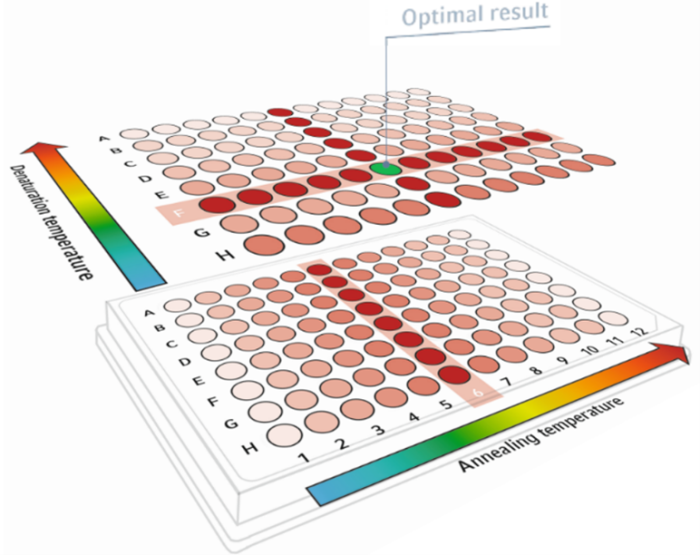
A 2D-Gradient speeds up simultaneous TA and TD optimization significantly by providing two temperature gradients; one along the x-axis and one along the y-axis of the PCR cyclers’ thermoblock (Figure 1). This enables quick testing of 96 TA and TD combinations in one run to screen for the optimal temperature combination to eliminate unspecific signals and increase product yield.
Lire la suite
The optimization of both temperatures offers improved specificity and yield (Figure 2) resulting in several advantages. The optimal temperature combination can be selected according to the needs of your workflow.
Lire la suite
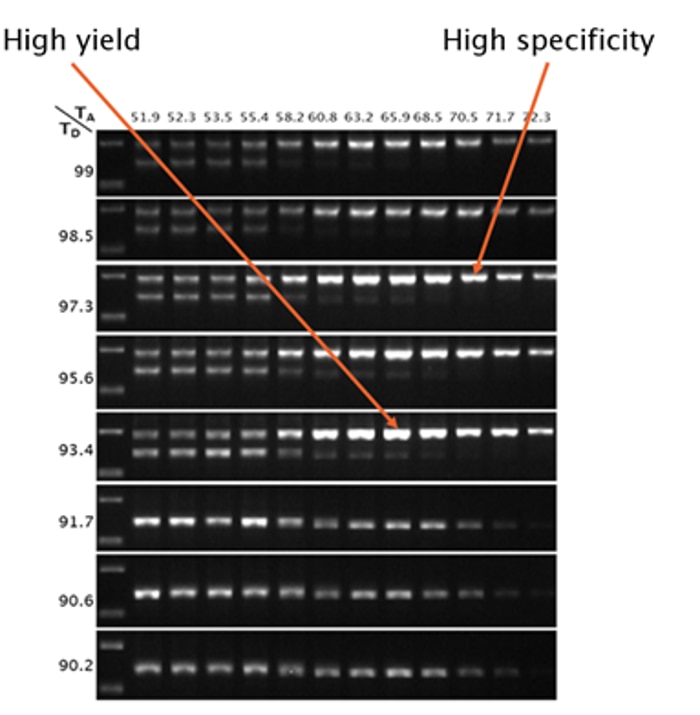
• Clearer gel bands for publications
• Specific target DNA for post-PCR processing
• Less false-positive (unspecific) results
Improved yield:
• Faster PCR-protocol possible -> save time
• Lower reaction volume possible -> save money
• Can work with less template -> save money & work
• More DNA for downstream applications possible -> efficient workflow
• Get sufficient yield in difficult assays -> process stability
Lire la suite
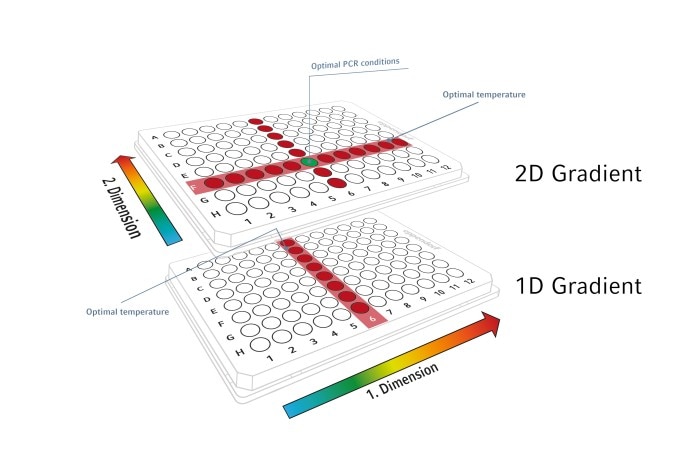
As described above, the 2D-Gradient function enables testing of 96 temperature combinations in a single PCR run. The optimization of ß-actin gene amplification shown in Figure 2 may have required eight PCR runs when using a thermal cycler with a 1D-Gradient function. Thus, the 2D-Gradient function helps to save time labor, reagents, consumables, and energy for temperature optimization. Furthermore, the results are more comparable as only a single mastermix, PCR plate, and sealing are needed when using the 2D-Gradient function (see Figure 3).
Lire la suite
Lire la suite
Links to Application Notes