-
- Alle Pipetten, Dispenser und automatischen Liquid-Handling-Systeme
- Alle Mikropipetten
- Mechanische Pipetten
- Elektronische Pipetten
- Mehrkanalpipetten
- Direktverdrängerpipetten und Dispenser
- Flaschendispenser
- Pipettierhilfen
- Zubehör für Dispenser und Pipetten
- Automatisches Pipettieren
- Verbrauchsartikel für die Automation
- Zubehör für die Automation
- Services für Liquid-Handling-Geräte und Pipetten
- Home
- Unternehmen & Karriere
- Scientific Awards
- Eppendorf & Science Prize for Neurobiology
Eppendorf & Science Prize for Neurobiology
Eppendorf and Science/AAAS established this international prize in 2002. It acknowledges the increasing importance of Neurobiology in advancing our understanding of how the brain and nervous system function. It is awarded annually to one young scientist for the most outstanding neurobiological research based on experimental methods of molecular, cellular, systems, or organismic biology conducted by him/her during the past three years.
About this prize
Prize money: 25,000 USD
Additional benefits:
- The prize winner‘s essay is published in Science and on Science Online
- The prize is announced and presented at a ceremony in conjunction with the Annual
- Meeting of the Society for Neuroscience. Eppendorf provides full support to attend this event
- Besides the grand prize winner the jury may appoint up to three finalists each year
Mehr erfahren
Eppendorf & Science Prize Winner 2025
Congratulations to Cheng Lyu, Ph.D., Postdoctoral Fellow at the University Stanford, California, USA, on winning the 2025 Eppendorf & Science Prize.
Dr. Lyu won the Prize for his work on rewiring the olfactory neural circuit in fruit flies, which alters the animal’s courtship behavior.
Cheng Lyu’s research uncovered how the fly’s olfactory circuit reduces a seemingly intractable 3D wiring problem into simpler 1D choices. By systematically tracing, quantifying, and perturbing neuron development across many cell types, Cheng and his colleagues revealed that partner selection occurs along constrained trajectories, greatly simplifying the molecular codes for specificity.

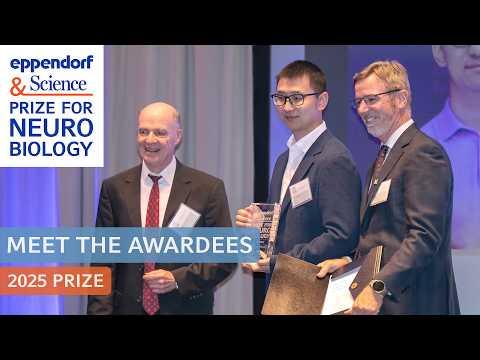
Meet the awardees
Mehr erfahren
Videos not loading, because cookies have been rejected. Change your