MENU
FR | EUR
-
-
-
- Service pour Mastercycler
- Service pour systèmes d’automatisation
- Service pour congélateurs
- Service pour incubateurs
- Service pour agitateurs
- Service de contrôle de la température et de l’agitation
- Service pour pipette
- Services pour bioprocédés
- Service pour centrifugeuses et rotors
- Étalonnage pour pipette neuve
-
-
- WHX Labs Dubai 2026
- analytica 2026
- Forum Labo 2026
- SLAS Europe 2026
- Forum Labo 2026 Bioprocess
- Bioprocessing Summit Europe 2026
- BioProcess International 2026
- Swiss Biotech Day 2025
- ISCT 2026
- Pichia 2026
- Future Labs Live 2026
- BioProScale Sympposium 2026
- ASGCT 2026
- Eppendorf Automation Forum 2026
- ESACT 2026
- ECB 2026
- WoTS 2026
- SIMB Annual Meeting 2026
- ELRIG Drug Discovery 2026

-
-
-
- Service pour Mastercycler
- Service pour systèmes d’automatisation
- Service pour congélateurs
- Service pour incubateurs
- Service pour agitateurs
- Service de contrôle de la température et de l’agitation
- Service pour pipette
- Services pour bioprocédés
- Service pour centrifugeuses et rotors
- Étalonnage pour pipette neuve
-
-
- WHX Labs Dubai 2026
- analytica 2026
- Forum Labo 2026
- SLAS Europe 2026
- Forum Labo 2026 Bioprocess
- Bioprocessing Summit Europe 2026
- BioProcess International 2026
- Swiss Biotech Day 2025
- ISCT 2026
- Pichia 2026
- Future Labs Live 2026
- BioProScale Sympposium 2026
- ASGCT 2026
- Eppendorf Automation Forum 2026
- ESACT 2026
- ECB 2026
- WoTS 2026
- SIMB Annual Meeting 2026
- ELRIG Drug Discovery 2026
FR | EUR
-
- Pipettes, distributeurs et dispositifs de manipulation de liquides automatisée
- Toutes les micropipettes
- Pipettes mécaniques
- Pipettes électroniques
- Pipettes multicanaux
- Pipettes et distributeurs à déplacement positif
- Distributeurs sur flacon
- Auxiliaires de pipetage
- Accessoires pour pipettes et distributeurs
- Pipetage automatisé
- Consommables d’automatisation
- Accessoires d’automatisation
- Services pour pipettes et distributeurs
Sorry, we couldn't find anything on our website containing your search term.
Sorry, we couldn't find anything on our website containing your search term.
Temperatures for PCR: How to Select Optimal Over- and Undershoot
Lab Academy
- Biologie moléculaire
- PCR
- Reproductibilité
- Cyclers PCR
- Test
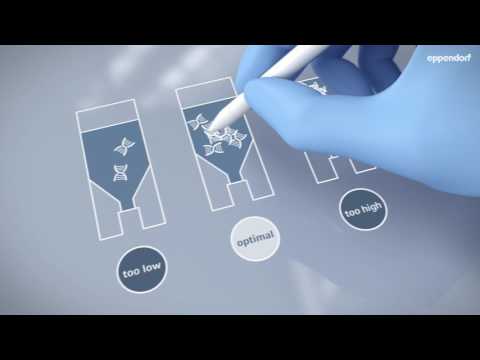
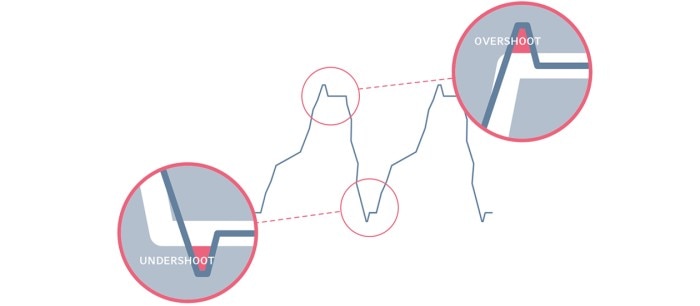
Temperature overshoot and undershoot is a necessary part of temperature cycling in PCR because it allows the whole reaction liquid in the PCR vessel to quickly reach the desired temperature. Therefore, when deciding how much to overshoot and undershoot in your PCR temperature cycles, this naturally means that the critical dependent factor is the reaction volume involved.
Too high or too low temperatures for PCR will have adverse effects on your results. When you have too high overshoot, especially for PCR denaturation temperatures, you run the risk of killing off some enzyme activity (Figure 1B: Thermal cycler B with overshoot of more than 10°C). Such reduction in enzyme half-life (especially when it happens repetitively at every PCR temperature cycle) can decrease the total PCR yield.
Similarly, when you have a “high” undershoot (large dip in temperatures for PCR), especially when applied to going down from denaturation step to annealing step, it is effectively lowering the stringency of specific primer annealing. For example, if you set annealing to 65°C, but it stays at 5°C below that temperature for many seconds due to undershoot, it can increase the chances of non-specific amplification during that period of time (Figure 1).
Similarly, when you have a “high” undershoot (large dip in temperatures for PCR), especially when applied to going down from denaturation step to annealing step, it is effectively lowering the stringency of specific primer annealing. For example, if you set annealing to 65°C, but it stays at 5°C below that temperature for many seconds due to undershoot, it can increase the chances of non-specific amplification during that period of time (Figure 1).
Lire la suite
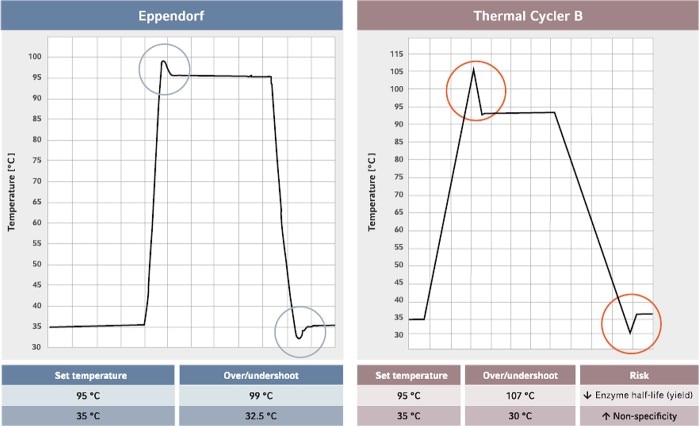
Figure 1: Temperature profiles of Eppendorf Mastercycler and Thermal cycler B. Their respective over-shoot PCR denaturation temperatures, and undershoot algorithms for annealing temperatures are shown.
Top tip: Look at your thermal cycler settings!
Some thermal cycler manufacturers set a high degree of over-/undershoot in their temperatures for PCR profile, while others use sample volume prediction algorithms to change the degree of over/under-shoot required. However, this neglects the characteristics of different DNA templates. DNA templates with higher GC-content require higher energy for breaking the bonds and hence require a higher PCR denaturation temperature at the same sample volume.
How to optimize the degree of over- and undershooting in your PCR temperature cycles
The proprietary temperature control algorithm in Eppendorf thermocyclers, including Mastercycler® X50 (Figure 2), helps ensure that the degree of overshoot and undershoot is within the optimal range of the set point temperature. This allows fast heat transfer without the associated deleterious effects.
Some thermal cycler manufacturers set a high degree of over-/undershoot in their temperatures for PCR profile, while others use sample volume prediction algorithms to change the degree of over/under-shoot required. However, this neglects the characteristics of different DNA templates. DNA templates with higher GC-content require higher energy for breaking the bonds and hence require a higher PCR denaturation temperature at the same sample volume.
How to optimize the degree of over- and undershooting in your PCR temperature cycles
The proprietary temperature control algorithm in Eppendorf thermocyclers, including Mastercycler® X50 (Figure 2), helps ensure that the degree of overshoot and undershoot is within the optimal range of the set point temperature. This allows fast heat transfer without the associated deleterious effects.
Lire la suite
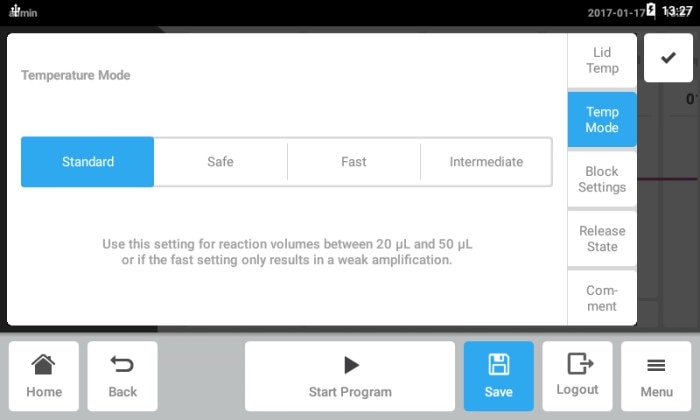
Figure 2: The four temperature control modes of Mastercycler® X50 caters for different reaction volumes and/or GC-content of the DNA template and the algorithm uniquely match the suitable degree of overshoot and undershoot necessary for the entire liquid volume to reach set point temperature homogenously in the shortest time.
In other words, optimal temperature overshoot is good for fast transfer of energy from thermal block to sample in reaction vessel, leading to fast PCR completion and optimal yield and specificity. Too high overshoot or undershoot will reduce PCR yield and increase the risk of mispriming.
Want more tips to help you optimize your PCRs?
When setting up your PCRs, we understand how there are many different elements to consider! Learn how you can take your experiments to the next level by exploring our lab academy. You can also visit our Eppendorf Youtube channel for further PCR tips and tricks.
Want more tips to help you optimize your PCRs?
When setting up your PCRs, we understand how there are many different elements to consider! Learn how you can take your experiments to the next level by exploring our lab academy. You can also visit our Eppendorf Youtube channel for further PCR tips and tricks.
Lire la suite
Videos not loading, because cookies have been rejected. Change your