-
-
-
- WHX Labs Dubai 2026
- analytica 2026
- Forum Labo 2026
- SLAS Europe 2026
- Forum Labo 2026 Bioprocess
- Bioprocessing Summit Europe 2026
- BioProcess International 2026
- Swiss Biotech Day 2025
- ISCT 2026
- Pichia 2026
- Future Labs Live 2026
- BioProScale Sympposium 2026
- ASGCT 2026
- Eppendorf Automation Forum 2026
- ESACT 2026
- ECB 2026
- WoTS 2026
- SIMB Annual Meeting 2026
- ELRIG Drug Discovery 2026
-
-
- Service pour Mastercycler
- Service pour systèmes d’automatisation
- Service pour congélateurs
- Service pour incubateurs
- Service pour agitateurs
- Service de contrôle de la température et de l’agitation
- Service pour pipette
- Services pour bioprocédés
- Service pour centrifugeuses et rotors
- Étalonnage pour pipette neuve

-
-
-
- WHX Labs Dubai 2026
- analytica 2026
- Forum Labo 2026
- SLAS Europe 2026
- Forum Labo 2026 Bioprocess
- Bioprocessing Summit Europe 2026
- BioProcess International 2026
- Swiss Biotech Day 2025
- ISCT 2026
- Pichia 2026
- Future Labs Live 2026
- BioProScale Sympposium 2026
- ASGCT 2026
- Eppendorf Automation Forum 2026
- ESACT 2026
- ECB 2026
- WoTS 2026
- SIMB Annual Meeting 2026
- ELRIG Drug Discovery 2026
-
-
- Service pour Mastercycler
- Service pour systèmes d’automatisation
- Service pour congélateurs
- Service pour incubateurs
- Service pour agitateurs
- Service de contrôle de la température et de l’agitation
- Service pour pipette
- Services pour bioprocédés
- Service pour centrifugeuses et rotors
- Étalonnage pour pipette neuve
-
- Pipettes, distributeurs et dispositifs de manipulation de liquides automatisée
- Toutes les micropipettes
- Pipettes mécaniques
- Pipettes électroniques
- Pipettes multicanaux
- Pipettes et distributeurs à déplacement positif
- Distributeurs sur flacon
- Auxiliaires de pipetage
- Accessoires pour pipettes et distributeurs
- Pipetage automatisé
- Consommables d’automatisation
- Accessoires d’automatisation
- Services pour pipettes et distributeurs
- Page d'accueil
- Entreprise et carrières
- Sustainability
- Environment
- Plastics
- Recycling used plastics
Recycling of used lab consumables?
Plastic is ubiquitous in our daily life – at home and in the laboratory. We as human beings use a lot of plastic. In 2019, 460 million tons of plastics were produced globally, and this is nearly twice the amount manufactured in 2000 (234 million tons). The manufacturing of plastic released 1.8 gigatons of CO2 into the atmosphere. Compared to all other emissions, plastic production alone accounts for 3.4 % of the global CO2 emissions. If you compare these numbers with the CO2 emissions of countries, global plastic production will rank as 5th place after China, the USA, EU-27, and Japan.
Collection and recycling of plastic is the key for future development. Laboratory plastic consumables are a challenge for recycling: Whatever enters the laboratory is defined as being contaminated. This contamination can be a biological, a chemical, or even radioactive one. To improve the efforts and finally the quality of the collected plastic material, dedicated collection boxes for specific material like PP, PE, or PC.
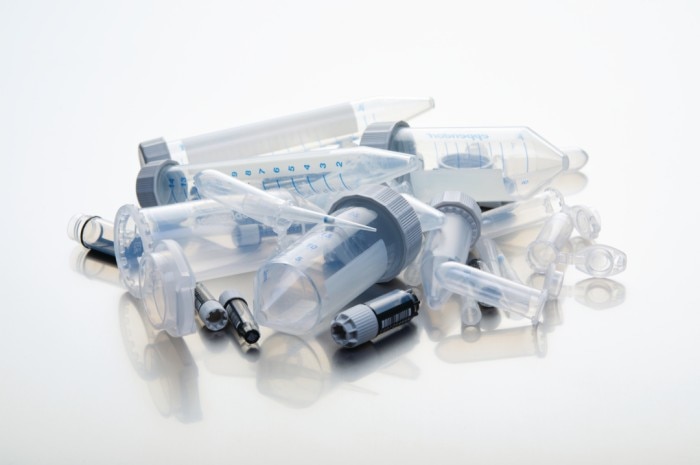
The material must be autoclaved prior shipment (although autoclavation is limited to killing germs, it does not clean the material from chemical load). Therefore, you may minimize the chemical load of your plasticware. Limit transportation, a shipment over thousands of kilometer/ miles for the next recycling facility will drastically reduce the benefit of plastic recycling due to the additional transportation impact.
Keep in mind legal restrictions, incineration of contaminated labware is set in many institutions due to safety reasons. Please check with your local biosafety and your local waste management team terms and conditions for any recycling of laboratory plastic.