MENU
BR | BRL

BR | BRL
-
- Todas as pipetas, dispensadores e equipamentos para manuseio de líquidos automatizados
- Todas as micropipetas
- Pipetas mecânicas
- Pipetas eletrônicas
- Pipetas multicanal
- Pipetas de deslocamento positivo e dispensadores
- Dispensadores de frascos
- Controladores de pipeta
- Acessórios para dispensadores e pipetas
- Pipetagem Automatizada
- Consumíveis de automação
- Acessórios de automação
- Serviços para pipetas e equipamentos para manuseio de líquidos
Sorry, we couldn't find anything on our website containing your search term.
Sorry, we couldn't find anything on our website containing your search term.

Photometric Quantification of Proteins in Aqueous Solutions – the Fluorometric Method
Lab Academy
- Photometry
- Photometers
- Essay
As a rule, the concentration of a protein is either measured directly using UV light or it is determined by employing a colorimetric assay. A further option involves harnessing a fluorescent dye for the purpose of quantification. This process is comparable to a colorimetric assay as the protein concentration is similarly determined in an indirect fashion, via the prior establishment of a standard curve.
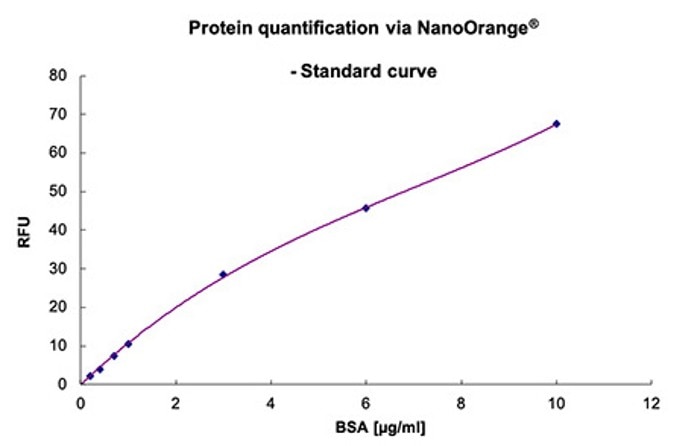
In a first step, protein standards of defined concentrations are generated followed by the addition of a fluorescent dye such as, for example, NanoOrange®, to all standards and samples (1). Quantification of the fluorescence of the standards and the samples then occurs following incubation at 90 °C for 10 minutes.
Which are the advantages and the disadvantages of fluorometric quantification of proteins compared to other methods (direct or colorimetric)? Table 1 shows the key arguments for and against the fluorescence method.
Table 1: Advantages and disadvantages of fluorescence methods for the purpose of protein quantification
Which are the advantages and the disadvantages of fluorometric quantification of proteins compared to other methods (direct or colorimetric)? Table 1 shows the key arguments for and against the fluorescence method.
Table 1: Advantages and disadvantages of fluorescence methods for the purpose of protein quantification
Ler mais
Advantages
- 10 times more sensitive than the colorimetric methods (limit of detection: >10 ng/mL)
- Low variability between proteins ensures that this method is suitable for protein mixtures
- Very stable fluorescent dye complex (up to 6 h)
- Less susceptible to influences by interfering substances in comparison with colorimetric assays
- Higher sensitivity: less amount of sample is required for quantification
(saves considerable amounts of valuable samples)
Ler mais
Disadvantages
- Depending on the method, preparation may be lengthy and complex (preparation time: 10 minutes of incubation at 90 °C
plus 20 min to allow for cooling
to room temperature, all steps must be protected from light) - Highly error-prone due to complex preparation procedure
- More expensive than the colorimetric or direct quantification methods
- Risk of injury through burns due to the high incubation temperature
- Use of toxic reagents
- Very sensitive; on the other hand, the measureable total concentration range is lower than the measureable total
concentration range of the colorimetric assays
Ler mais
Figure 1: Calibration curve for the quantification of protein using the NanoOrange assay
Under which conditions is it recommended to consider protein quantification via fluorescence?
First and foremost, the starting concentration of the sample must be taken into account. If enough sample material of sufficient concentration is available, the colorimetric or the direct quantification methods will be satisfactory. If this is not the case, it is advisable to consider the fluorometric method, despite the additional effort, as it requires considerably less sample material. Quantification of protein mixtures, in particular, will benefit from the low variability between proteins that is afforded by the fluorescence method.
Ler mais
[1] Operation manual: NanoOrange® Protein Quantitation Kit (Molecular Probes)
NanoOrange® is a registered trademark of Molecular Probes Inc., USA
NanoOrange® is a registered trademark of Molecular Probes Inc., USA
Ler mais