-
- Todas as pipetas, dispensadores e equipamentos para manuseio de líquidos automatizados
- Todas as micropipetas
- Pipetas mecânicas
- Pipetas eletrônicas
- Pipetas multicanal
- Pipetas de deslocamento positivo e dispensadores
- Dispensadores de frascos
- Controladores de pipeta
- Acessórios para dispensadores e pipetas
- Pipetagem Automatizada
- Consumíveis de automação
- Acessórios de automação
- Serviços para pipetas e equipamentos para manuseio de líquidos
- Home
- Empresa e Carreiras
- Sustainability
- Environment
- Plastics
- Carbon footprint
Carbon emissions during life cycle
Ler mais
| Tube | Carbon savings* ( raw material) cradle to gate per tube [CO2-eq.] |
|---|---|
| Eppendorf Tubes® Biobased 5.0 mL | 3.3 g |
| Eppendorf Tubes® Biobased 15 mL | 5.6 g |
| Eppendorf Tubes® Biobased 25 mL | 6.7 g |
| Eppendorf Tubes® Biobased 50 mL | 11.1 g |
Ler mais
Switching to 100% biobased 5 mL tubes manufactured from second-generation PP and 100% biobased HDPE can yield a 27% reduction in greenhouse gas emissions.
Learnings:
- Performing an LCA study is complex, even for seemingly “simple” products like tubes containing only two different materials (HDPE, PP). It will be even more complex for instruments which involve a lot more materials and extensive supply chains.
- Carrying out an LCA study is time-intensive due to the extensive data retrieval and the numerous review processes.
- LCA studies cannot be carried out for all products due to its complexity and time intensity. Instead, key products are primarily examined in order to draw general conclusions that apply to an entire product range.
Ler mais
With the complete dataset from the life cycle inventory, the impact assessment was conducted, revealing three key findings:
First finding: Raw materials of the product, distribution and end of life contribute the most to CO2eq. emissions. These are also the biggest levers for improvement.
Second finding: The goals of the study had to be slightly adapted - the decision was taken to focus only on greenhouse gas emissions and to skip other environmental impacts due to their inherent complexity and associated uncertainties. Moreover, CO2eq. emissions and their impact on global warming are widely acknowledged as the most important environmental impact. Secondly, a cradle-to-gate approach was analyzed in detail. Eppendorf has the biggest influence and potential for improvement in these first stages of the product life cycle. Furthermore, the data regarding end-of-life scenarios in different countries was incomplete and not comparable, as previously mentioned.
Third finding: Greenhouse gas emissions can be reduced by switching from fossil-sourced to biobased scenarios.
Global warming potential of selected scenarios from cradle-to-gate per unit (200x) for Eppendorf Tubes® 5.0mL
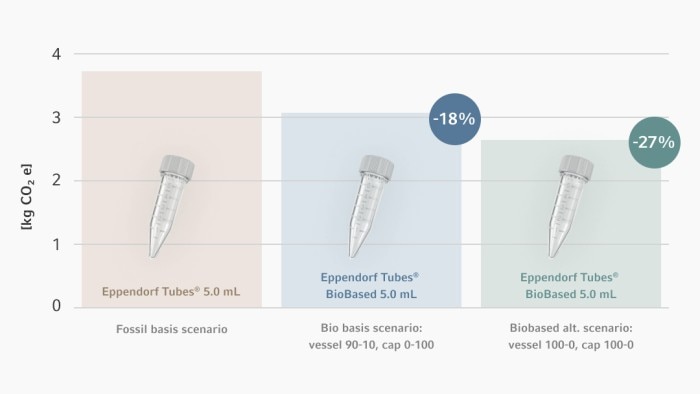
A detailed analysis of various cradle-to-gate scenarios demonstrated how much greenhouse gases are saved by using biobased material.
Today’s biobased 5 mL tubes already show a 17.8% decrease in greenhouse gas emissions compared to their fossil-sourced counterparts.
Based on the LCA of the 5 mL tubes, we calculated the CO2 savings for the other tube volumes regarding the biobased raw materials (cradle-to-gate).