MENU
BR | BRL

BR | BRL
-
- Todas as pipetas, dispensadores e equipamentos para manuseio de líquidos automatizados
- Todas as micropipetas
- Pipetas mecânicas
- Pipetas eletrônicas
- Pipetas multicanal
- Pipetas de deslocamento positivo e dispensadores
- Dispensadores de frascos
- Controladores de pipeta
- Acessórios para dispensadores e pipetas
- Pipetagem Automatizada
- Consumíveis de automação
- Acessórios de automação
- Serviços para pipetas e equipamentos para manuseio de líquidos
Sorry, we couldn't find anything on our website containing your search term.
Sorry, we couldn't find anything on our website containing your search term.
- Home
- Lab Academy
- Life Science
- Cell Biology
- Long-term storage in liquid nitrogen: Should I keep frozen cells in the liquid phase or in the vapor phase

Long-term storage in liquid nitrogen: Should I keep frozen cells in the liquid phase or in the vapor phase?
Lab Academy
- Cell Biology
- Cell Therapy
- Cell Culture Consumables
- FAQ
Answer by Dr. Jessica Wagener, Application Specialist Cell Handling at Eppendorf
This article was published first in "Inside Cell Culture" , the monthly newsletter for cell culture professionals. Find more interesting articles about CO2 incubators on our page "FAQs and material on CO2 incubators" .
Ler mais
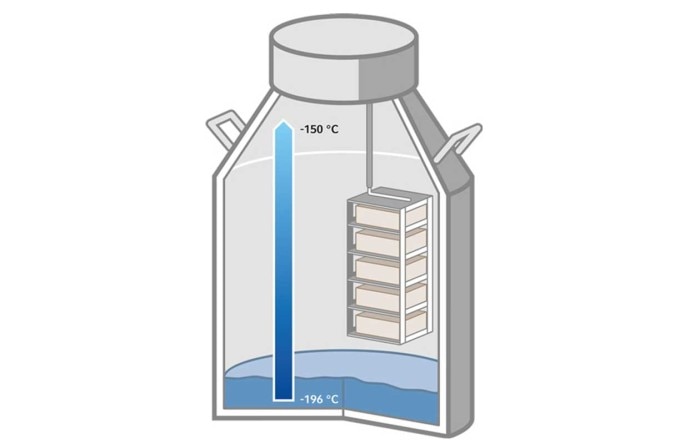
Cells can be stored in liquid nitrogen (LN2) for years without loss of cell viability. The storage temperature must be kept permanently below -130°C to prevent ice crystal formation inside the cells. It is recommended to store cryopreserved cells in the vapor phase of LN2. This method of storage reduces the risk of liquid nitrogen entering cryotubes which can result in the explosion of the tubes upon thawing. In addition, it has been described that contaminating organisms can be transferred from one cryotube to the other when the tubes are stored in the liquid phase of LN2 (1). Storage in the vapor phase reduces the risk of spreading existing contaminations, but it requires careful monitoring of the LN2 level in order to avoid the tank running empty. Cryostorage containers that are equipped with temperature and level indicator and/or are fitted with alarms support safe long-term storage of cell lines.
(1) Tedder RS et al. (1995) Hepatitis B transmission from contaminated cryopreservation tank. The Lancet. 346(8968): 137-40.
(1) Tedder RS et al. (1995) Hepatitis B transmission from contaminated cryopreservation tank. The Lancet. 346(8968): 137-40.
Ler mais
Related documents

White Paper 60
PDF
Application Note 437
PDF