MENÚ
AR | ARS

AR | ARS
-
- Todas las pipetas, dispensadores y manipuladores de líquidos automatizados
- Todas las micropipetas
- Pipetas mecánicas
- Pipetas electrónicas
- Pipetas multicanal
- Pipetas y dispensadores de desplazamiento positivo
- Dispensadores de botella
- Controladores de pipetas
- Accesorios para dispensadores y pipetas
- Pipeteo automatizado
- Consumibles para automatización
- Accesorios de automatización
- Servicios de manipulación de líquidos y pipetas
Sorry, we couldn't find anything on our website containing your search term.
Está a punto de abandonar este sitio.
Por favor, tenga en cuenta que su carro de la compra actual no ha sido guardado todavía y no podrá ser restablecido en el nuevo sitio ni cuando regrese. Si desea guardar su carro de la compra, inicie sesión en su cuenta.
Sorry, we couldn't find anything on our website containing your search term.
- Inicio
- Empresa y Carrera profesional
- Noticias y medios de comunicación
- Zasady i warunki
- Role of automation in advancing clinical diagnostics and genomic medicine
Role of automation in advancing clinical diagnostics and genomic medicine
news
- Comunicados de prensa
Mahesh Kalikiri, Automation Product and Application Manager at Eppendorf in Dubai, writing for Clinical Laboratory International
Driven by the convergence of high-throughput genomics, precision medicine, and an ever-increasing demand for rapid turnaround times for test results, laboratories are undergoing a fundamental shift, requiring novel solutions to increase capacity while maintaining reproducibility.
In the latest article in Clinical Laboratory International, Mahesh Kalikiri, Automation Product and Application Manager, discusses how automation is advancing clinical diagnostics and genomic medicine by offering a solution to support the rapid increase in demand for reliable and accurate sequencing.
The article explores how automated liquid handling systems are supporting wide-scale rollout of Next Generation Sequencing (NGS) workflows, accelerating time to diagnosis in clinical settings. These advanced automated workflows are enabling precision medicine in diseases such as cancer, facilitating detection of a patient’s specific disease-promoting mutations, informing targeted therapeutic options.
Another area where automation is providing novel insights is in whole-genome sequencing, which can identify associations between genomic variants and disease prevalence in a population. In the article, Mahesh explains how integrating automation can support advancement and scale-up of national genomic medicine initiatives while minimizing cost.
Visit the Clinical Laboratory International website to read the full article: https://clinlabint.com/role-of-automation-in-advancing-clinical-diagnostics-and-genomic-medicine/
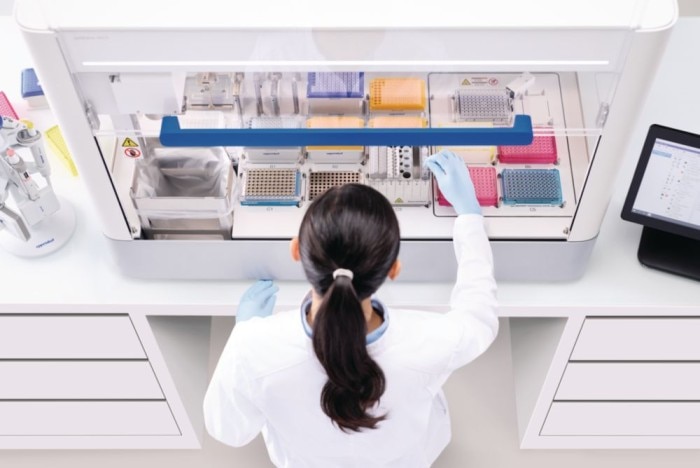
Eppendorf’s series of epMotion® liquid handling workstations are designed to support NGS workflows, automating reagent kits and standardized protocols which can be tedious, time-consuming, or error-prone when performed manually.
By integrating automation into NGS workflows, researchers are overcoming the technical challenges limiting wide-spread, rapid sequencing, increasing reproducibility, standardizing processes and increasing throughput.
Learn more about our epMotion solutions here: https://www.eppendorf.com/en/own-your-solution/epmotion-method-overview/
In the latest article in Clinical Laboratory International, Mahesh Kalikiri, Automation Product and Application Manager, discusses how automation is advancing clinical diagnostics and genomic medicine by offering a solution to support the rapid increase in demand for reliable and accurate sequencing.
The article explores how automated liquid handling systems are supporting wide-scale rollout of Next Generation Sequencing (NGS) workflows, accelerating time to diagnosis in clinical settings. These advanced automated workflows are enabling precision medicine in diseases such as cancer, facilitating detection of a patient’s specific disease-promoting mutations, informing targeted therapeutic options.
Another area where automation is providing novel insights is in whole-genome sequencing, which can identify associations between genomic variants and disease prevalence in a population. In the article, Mahesh explains how integrating automation can support advancement and scale-up of national genomic medicine initiatives while minimizing cost.
Visit the Clinical Laboratory International website to read the full article: https://clinlabint.com/role-of-automation-in-advancing-clinical-diagnostics-and-genomic-medicine/
Eppendorf’s series of epMotion® liquid handling workstations are designed to support NGS workflows, automating reagent kits and standardized protocols which can be tedious, time-consuming, or error-prone when performed manually.
By integrating automation into NGS workflows, researchers are overcoming the technical challenges limiting wide-spread, rapid sequencing, increasing reproducibility, standardizing processes and increasing throughput.
Learn more about our epMotion solutions here: https://www.eppendorf.com/en/own-your-solution/epmotion-method-overview/
Leer más