MENU
PL | PLN
-
-
-
-
- WHX Labs Dubai 2026
- analytica 2026
- Forum Labo 2026
- SLAS Europe 2026
- Forum Labo 2026 Bioprocess
- Bioprocessing Summit Europe 2026
- BioProcess International 2026
- Swiss Biotech Day 2025
- ISCT 2026
- Pichia 2026
- Future Labs Live 2026
- BioProScale Sympposium 2026
- ASGCT 2026
- Eppendorf Automation Forum 2026
- ESACT 2026
- ECB 2026
- WoTS 2026
- SIMB Annual Meeting 2026
- ELRIG Drug Discovery 2026

-
-
-
-
- WHX Labs Dubai 2026
- analytica 2026
- Forum Labo 2026
- SLAS Europe 2026
- Forum Labo 2026 Bioprocess
- Bioprocessing Summit Europe 2026
- BioProcess International 2026
- Swiss Biotech Day 2025
- ISCT 2026
- Pichia 2026
- Future Labs Live 2026
- BioProScale Sympposium 2026
- ASGCT 2026
- Eppendorf Automation Forum 2026
- ESACT 2026
- ECB 2026
- WoTS 2026
- SIMB Annual Meeting 2026
- ELRIG Drug Discovery 2026
PL | PLN
-
- Wszystkie pipety, dozowniki oraz automatyczne urządzenia do pracy z cieczami
- Wszystkie mikropipety
- Pipety mechaniczne
- Pipety elektroniczne
- Pipety wielokanałowe
- Pipety z wyporem bezpośrednim i dozowniki
- Dozowniki butelkowe
- Pipetory
- Dozowniki i akcesoria do pipet
- Pipetowanie automatyczne
- Materiały eksploatacyjne do urządzeń automatycznych
- Akcesoria do urządzeń automatycznych
- Systemy do pracy z cieczami i serwisowanie pipet
Sorry, we couldn't find anything on our website containing your search term.
Sorry, we couldn't find anything on our website containing your search term.
- Strona domowa
- Lab Academy
- Life Science
- Cell Biology
- Cell culture scale-up: moving from flask to bioreactor without losing reproducibility
Cell culture scale-up: moving from flask to bioreactor without losing reproducibility
Akademia laboratoryjna
- Biologia komórki
- Cell Therapy
- Cell Handling
- Bioprocesy
- Eksperyment
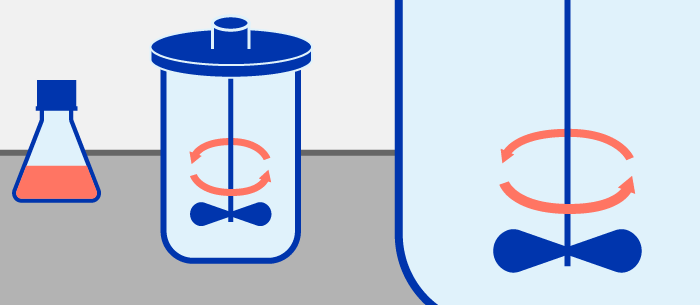
If your bioprocess runs cleanly in a shake flask or 3 L bioreactor, your next step may be preparing for scale-up. At this point, the challenge is not simply making the process bigger, but it’s recreating the same conditions. Some parameters should be kept the same, and some should be adjusted accordingly. For instance, when scaling from a 3 L to a 50 L vessel, keeping the agitation at the same rpm can result in a totally different culture: slower growth, lower viability, and a titre that no longer matches.
Holding rpm constant is a reasonable instinct. It's the number on the controller, so it looks like the setting you should carry across. However, it simply describes how fast one particular impeller turns in one particular vessel. Therefore, if you put a different impeller in a larger tank, the same rpm will produce a different mechanical environment.
The transition from shake flask to bioreactor presents a harder version of the same problem, because the mode of agitation changes completely. Orbital shaking and impeller stirring cannot be reconciled by adjusting a single number. Agitation is just the starting point: dissolved oxygen, pH, CO2, mixing and inoculum quality all shift as culture vessel size increases, and each requires careful consideration in your cell culture scale-up.
Precise settings don’t transfer well between labs, since vessels, cell lines, and working volumes differ broadly. In this article, we’ll explore which parameters do transfer, which do not, and how to establish what your own incubators, shakers and bioreactors are really doing.
Holding rpm constant is a reasonable instinct. It's the number on the controller, so it looks like the setting you should carry across. However, it simply describes how fast one particular impeller turns in one particular vessel. Therefore, if you put a different impeller in a larger tank, the same rpm will produce a different mechanical environment.
The transition from shake flask to bioreactor presents a harder version of the same problem, because the mode of agitation changes completely. Orbital shaking and impeller stirring cannot be reconciled by adjusting a single number. Agitation is just the starting point: dissolved oxygen, pH, CO2, mixing and inoculum quality all shift as culture vessel size increases, and each requires careful consideration in your cell culture scale-up.
Precise settings don’t transfer well between labs, since vessels, cell lines, and working volumes differ broadly. In this article, we’ll explore which parameters do transfer, which do not, and how to establish what your own incubators, shakers and bioreactors are really doing.
Warto przeczytać
Why agitation speed does not transfer across scales
Agitation speed is a property of the equipment, not of the culture. What’s important to the cells is how the fluid moves around them, including how fast it is travelling, and how much energy is going into it. Two key measurements characterize this, and both hold up across different vessel sizes:
- Impeller tip speed – the velocity at the outer edge of the blade, derived from impeller diameter and agitation speed. This is commonly used as a proxy for shear conditions, and also influences mixing time and oxygen transfer.
- Power per volume – the energy the impeller delivers to each unit of culture volume. Calculating this requires the vessel's power number, determined experimentally for a specific impeller and vessel geometry.
Warto przeczytać
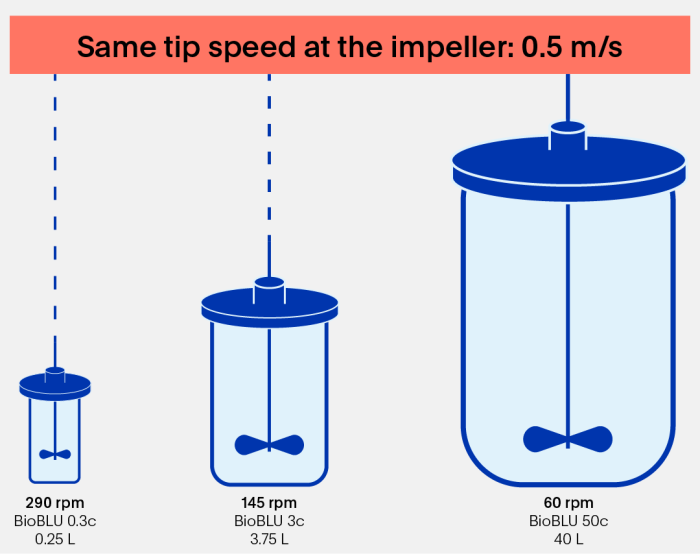
The same impeller tip speed requires a different agitation speed in each vessel size.
Working out your own numbers? Tip speed calculation requires only the impeller diameter and agitation speed. To work out power per volume, you’ll also need your vessel's power number. See how both are calculated here.
Warto przeczytać
Which parameters change between flask and bioreactor?
Shake flasks and bioreactors can support the same cells, but they do not expose them to the same environment. As you move between vessels, several process parameters can change in ways that affect your cell growth, productivity, and product quality:
Oxygen – Shake flasks rely on surface aeration, and the flask type, fill volume, and shaking speed determine how much oxygen reaches the culture. In contrast, a sparged bioreactor delivers oxygen through a gas stream and controls it against a setpoint. Dissolved oxygen shifts from a condition being imposed by flask geometry, to a process variable that can be measured and controlled. However, control alone does not guarantee optimal conditions.
Mixing – Mixing times are generally shorter in small-scale and bench-scale bioreactors than in production-scale vessels; consequently, mixing is less likely to be a process limitation in a 250 mL flask. Yet in larger vessels, prolonged mixing times can produce temperature, nutrient and oxygen gradients within the culture vessel. Additionally, pH or dissolved oxygen sensors sit at fixed positions, so a controlled pH of 7.0 describes the medium around the sensor, not necessarily the medium around every cell.
pH and CO2 – In a shake flask, pH control is entirely passive, relying on an equilibrium between the media buffer (typically sodium bicarbonate) and the incubator’s 5% to 10% controlled CO2 atmosphere. Opening the incubator door breaks this balance by causing the chamber CO2 concentration to drop. In a bioreactor, the medium is still buffered, but CO₂ becomes part of active pH control: CO₂ is added to bring pH down, and bicarbonate solution to bring it up. Cells also generate CO2 as they grow, and larger vessels are less able to release it. For cultures sensitive to CO2 levels, a dissolved CO2 sensor can track this, allowing the controller to respond if levels drift.
Shear – Flask cultures experience relatively uniform hydrodynamic conditions. A stirred vessel produces a range instead, with the highest fluid velocity at the impeller tip. Cells circulating through the vessel pass through that zone repeatedly, so an agitation rate that appears gentle overall can still expose part of the population to damaging shear forces. Impeller choice is key here: bioreactors can be fitted with different impeller types to match the shear sensitivity and oxygen demand of the cells being grown.
Inoculum quality – Unlike the parameters above, inoculum quality does not change character with scale, which is why it is easy to overlook. Cells harvested in log phase at a viability of 95% or above produce short lag phases in the vessel they seed, while passaging consistently during exponential growth reduces variability in downstream growth profiles. An inconsistent seed train can undermine even a well-controlled bioreactor process.
This speaks to a key difference between shake flasks and bioreactors: many conditions that are passively established in a flask become actively measured and controlled in a bioreactor. Although flask cultures are less instrumented than bioreactors, many modern incubators and incubator shakers can still record temperature, CO₂ and humidity throughout a run. Since the flask stage sets the starting condition for every subsequent scale-up step, environmental stability is just as important during inoculum preparation as during bioreactor cultivation.
Oxygen – Shake flasks rely on surface aeration, and the flask type, fill volume, and shaking speed determine how much oxygen reaches the culture. In contrast, a sparged bioreactor delivers oxygen through a gas stream and controls it against a setpoint. Dissolved oxygen shifts from a condition being imposed by flask geometry, to a process variable that can be measured and controlled. However, control alone does not guarantee optimal conditions.
Mixing – Mixing times are generally shorter in small-scale and bench-scale bioreactors than in production-scale vessels; consequently, mixing is less likely to be a process limitation in a 250 mL flask. Yet in larger vessels, prolonged mixing times can produce temperature, nutrient and oxygen gradients within the culture vessel. Additionally, pH or dissolved oxygen sensors sit at fixed positions, so a controlled pH of 7.0 describes the medium around the sensor, not necessarily the medium around every cell.
pH and CO2 – In a shake flask, pH control is entirely passive, relying on an equilibrium between the media buffer (typically sodium bicarbonate) and the incubator’s 5% to 10% controlled CO2 atmosphere. Opening the incubator door breaks this balance by causing the chamber CO2 concentration to drop. In a bioreactor, the medium is still buffered, but CO₂ becomes part of active pH control: CO₂ is added to bring pH down, and bicarbonate solution to bring it up. Cells also generate CO2 as they grow, and larger vessels are less able to release it. For cultures sensitive to CO2 levels, a dissolved CO2 sensor can track this, allowing the controller to respond if levels drift.
Shear – Flask cultures experience relatively uniform hydrodynamic conditions. A stirred vessel produces a range instead, with the highest fluid velocity at the impeller tip. Cells circulating through the vessel pass through that zone repeatedly, so an agitation rate that appears gentle overall can still expose part of the population to damaging shear forces. Impeller choice is key here: bioreactors can be fitted with different impeller types to match the shear sensitivity and oxygen demand of the cells being grown.
Inoculum quality – Unlike the parameters above, inoculum quality does not change character with scale, which is why it is easy to overlook. Cells harvested in log phase at a viability of 95% or above produce short lag phases in the vessel they seed, while passaging consistently during exponential growth reduces variability in downstream growth profiles. An inconsistent seed train can undermine even a well-controlled bioreactor process.
This speaks to a key difference between shake flasks and bioreactors: many conditions that are passively established in a flask become actively measured and controlled in a bioreactor. Although flask cultures are less instrumented than bioreactors, many modern incubators and incubator shakers can still record temperature, CO₂ and humidity throughout a run. Since the flask stage sets the starting condition for every subsequent scale-up step, environmental stability is just as important during inoculum preparation as during bioreactor cultivation.
Warto przeczytać
Not sure where your seed train is introducing variability? Our white paper on inoculum preparation in shake flasks and bioreactors works through passaging points, flask selection and aseptic transfer between vessels.
Warto przeczytać
Choosing which scale-up parameters to hold constant
In cell culture scale-up, it’s vital to know which conditions to keep the same. Tip speed, power per volume, and mixing time are the usual candidates, and each one describes something different about what happens inside the vessel.
All three parameters are linked. In a given bioreactor, the impeller speed determines tip speed, power per volume, and mixing time. Because of this, you can rarely keep all three constant during scale-up. Instead, you should typically choose the parameter that matters most for the process, and set the agitation speed accordingly. Once the agitation speed is fixed, the two remaining parameters can be calculated. For example, deciding to hold tip speed at 0.5 m/s in a given vessel sets the rpm, and the power per volume and mixing time follow from it.
When scaling up, keeping mixing time constant demands high power inputs. In larger vessels, maintaining a constant tip speed may result in insufficient agitation, creating oxygen delivery problems. To overcome this problem, constant power per volume is the most widely used approach. Shear, mixing, oxygen transfer and CO2 removal all depend on specific power input, but it means accepting that tip speed will rise as vessels get larger.
Selecting which parameters to maintain during scale-up requires identifying the conditions most critical to cell performance and carefully monitoring and evaluating those that are allowed to vary. An Eppendorf study on the BioBLU c single-use range illustrates what this looks like in practice. A CHO monoclonal antibody process was taken from 0.25 L ® 3.75 L ® 40 L at a constant power per volume of 10.9 W/m³. Agitation fell from 174 rpm to 69 rpm while tip speed rose from 0.30 to 0.58 m/s. Growth curves and antibody yields were comparable at all three scales.
Scaling on a single parameter only works when the vessels are proportionally similar, and the BioBLU c range is designed with this in mind: impeller diameter is half the vessel inner diameter and the measured power numbers sit between 2.52 and 2.56, which is why a single operating window covers all three sizes. Vessels from different families, or a mixed fleet assembled over time, will not share those relationships, and the values above will not transfer to them.
What does transfer is the method: identify the impeller diameter and power number for each vessel in your train, decide which parameter you are holding constant, and calculate the rest from there.
All three parameters are linked. In a given bioreactor, the impeller speed determines tip speed, power per volume, and mixing time. Because of this, you can rarely keep all three constant during scale-up. Instead, you should typically choose the parameter that matters most for the process, and set the agitation speed accordingly. Once the agitation speed is fixed, the two remaining parameters can be calculated. For example, deciding to hold tip speed at 0.5 m/s in a given vessel sets the rpm, and the power per volume and mixing time follow from it.
When scaling up, keeping mixing time constant demands high power inputs. In larger vessels, maintaining a constant tip speed may result in insufficient agitation, creating oxygen delivery problems. To overcome this problem, constant power per volume is the most widely used approach. Shear, mixing, oxygen transfer and CO2 removal all depend on specific power input, but it means accepting that tip speed will rise as vessels get larger.
Selecting which parameters to maintain during scale-up requires identifying the conditions most critical to cell performance and carefully monitoring and evaluating those that are allowed to vary. An Eppendorf study on the BioBLU c single-use range illustrates what this looks like in practice. A CHO monoclonal antibody process was taken from 0.25 L ® 3.75 L ® 40 L at a constant power per volume of 10.9 W/m³. Agitation fell from 174 rpm to 69 rpm while tip speed rose from 0.30 to 0.58 m/s. Growth curves and antibody yields were comparable at all three scales.
Scaling on a single parameter only works when the vessels are proportionally similar, and the BioBLU c range is designed with this in mind: impeller diameter is half the vessel inner diameter and the measured power numbers sit between 2.52 and 2.56, which is why a single operating window covers all three sizes. Vessels from different families, or a mixed fleet assembled over time, will not share those relationships, and the values above will not transfer to them.
What does transfer is the method: identify the impeller diameter and power number for each vessel in your train, decide which parameter you are holding constant, and calculate the rest from there.
Warto przeczytać
What your equipment is doing, and what the setpoint says
Every calculation in the previous section rests on an assumption: that the conditions you specified were the conditions your culture actually experienced.That assumption is rarely tested. An incubator set to 37 °C displays 37 °C. Whether it held that value overnight, over a weekend, or through a fortnight of a seed train is a different question, and one most labs cannot answer retrospectively. The same applies to CO2 concentration, relative humidity, and the speed a shaker platform was actually turning. In addition, door openings disturb CO2 and pH. This variability can limit reproducibility, and make scaling up harder.
This is even more important during cell culture scale-up than in routine culture: when a 40 L run does not match the 3 L run it was derived from, the physical parameters are the first thing examined. If the incubator hosting the seed train drifted for two days, that will not appear in the calculation, and the conclusion drawn about the scale-up strategy will be wrong.
Continuous monitoring changes what information is available to you during cell culture scale-up, and much of it already exists. Incubators and incubator shakers with built-in data and event logging keep a record of conditions such as temperature, CO₂ and door openings, which can be retrieved directly from the device. Cloud platforms such as VisioNize Lab Suite draw on that valuable logged data, bringing the history of multiple incubators and incubator shakers into one view so deviations can be spotted without checking each unit individually.
Eppendorf bioreactors have their own equivalents. DASware control and BioNsight cloud , designed exclusively for use with Eppendorf bioreactor systems, record process data and also allow runs to be analyzed and compared against previous experiments, helping you better understand your process and plan next steps. DASware control can also use programs to adjust bioreactor parameters automatically if a value moves outside its defined range.
Whichever system you use, these records provide the evidence needed to separate a suboptimal scale-up strategy from equipment that was not doing what you assumed.
This is even more important during cell culture scale-up than in routine culture: when a 40 L run does not match the 3 L run it was derived from, the physical parameters are the first thing examined. If the incubator hosting the seed train drifted for two days, that will not appear in the calculation, and the conclusion drawn about the scale-up strategy will be wrong.
Continuous monitoring changes what information is available to you during cell culture scale-up, and much of it already exists. Incubators and incubator shakers with built-in data and event logging keep a record of conditions such as temperature, CO₂ and door openings, which can be retrieved directly from the device. Cloud platforms such as VisioNize Lab Suite draw on that valuable logged data, bringing the history of multiple incubators and incubator shakers into one view so deviations can be spotted without checking each unit individually.
Eppendorf bioreactors have their own equivalents. DASware control and BioNsight cloud , designed exclusively for use with Eppendorf bioreactor systems, record process data and also allow runs to be analyzed and compared against previous experiments, helping you better understand your process and plan next steps. DASware control can also use programs to adjust bioreactor parameters automatically if a value moves outside its defined range.
Whichever system you use, these records provide the evidence needed to separate a suboptimal scale-up strategy from equipment that was not doing what you assumed.
Warto przeczytać
Working toward GxP or an IND? The same monitoring data underpins audit-ready documentation. Our article on cell culture documentation and audit readiness covers what regulated environments expect from equipment records.
Warto przeczytać
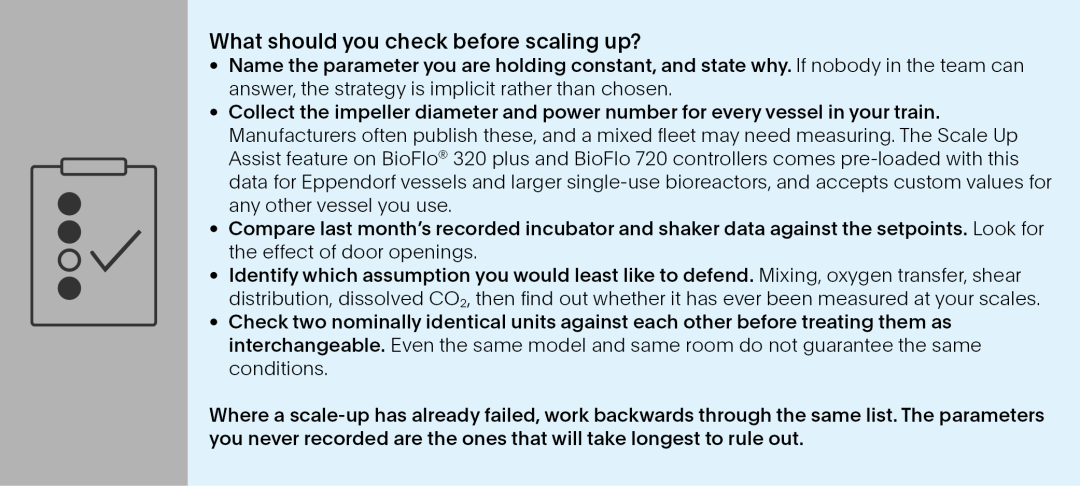
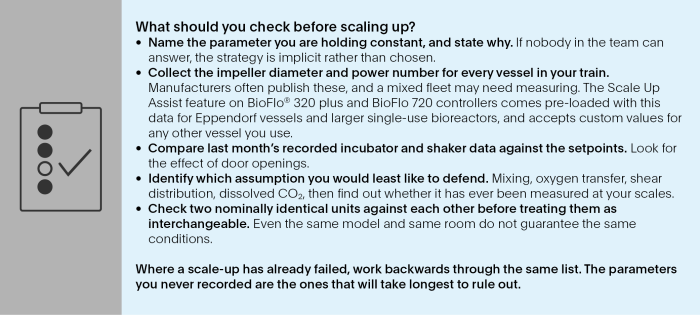
What did your last scale-up teach you?
Every cell culture scale-up is different, and the assumptions that cause trouble aren’t always the ones anyone predicted. If you have moved a process between scales recently and found something you did not expect, we are always happy to help – get in touch with our experts .
Warto przeczytać