MENU
PL | PLN
-
-
-
- WHX Labs Dubai 2026
- analytica 2026
- Forum Labo 2026
- SLAS Europe 2026
- Forum Labo 2026 Bioprocess
- Bioprocessing Summit Europe 2026
- BioProcess International 2026
- Swiss Biotech Day 2025
- ISCT 2026
- Pichia 2026
- Future Labs Live 2026
- BioProScale Sympposium 2026
- ASGCT 2026
- Eppendorf Automation Forum 2026
- ESACT 2026
- ECB 2026
- WoTS 2026
- SIMB Annual Meeting 2026
- ELRIG Drug Discovery 2026
-

-
-
-
- WHX Labs Dubai 2026
- analytica 2026
- Forum Labo 2026
- SLAS Europe 2026
- Forum Labo 2026 Bioprocess
- Bioprocessing Summit Europe 2026
- BioProcess International 2026
- Swiss Biotech Day 2025
- ISCT 2026
- Pichia 2026
- Future Labs Live 2026
- BioProScale Sympposium 2026
- ASGCT 2026
- Eppendorf Automation Forum 2026
- ESACT 2026
- ECB 2026
- WoTS 2026
- SIMB Annual Meeting 2026
- ELRIG Drug Discovery 2026
-
PL | PLN
-
- Wszystkie pipety, dozowniki oraz automatyczne urządzenia do pracy z cieczami
- Wszystkie mikropipety
- Pipety mechaniczne
- Pipety elektroniczne
- Pipety wielokanałowe
- Pipety z wyporem bezpośrednim i dozowniki
- Dozowniki butelkowe
- Pipetory
- Dozowniki i akcesoria do pipet
- Pipetowanie automatyczne
- Materiały eksploatacyjne do urządzeń automatycznych
- Akcesoria do urządzeń automatycznych
- Systemy do pracy z cieczami i serwisowanie pipet
Sorry, we couldn't find anything on our website containing your search term.
Sorry, we couldn't find anything on our website containing your search term.
- Strona domowa
- Lab Academy
- Life Science
- Cell Biology
- How to identify eukaryotic contamination in your cell culture
How to identify eukaryotic contamination in your cell culture
Akademia laboratoryjna
- Biologia komórki
- Cell Therapy
- Cell Culture Consumables
- Inkubatory CO2
- Eksperyment
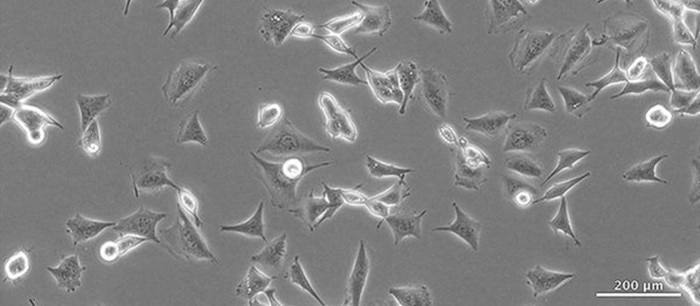
Eukaryotic contamination means that one cell line is contaminated with another cell line. There is no visible sign of a mixed culture.
The ICLAC (International cell line authentication committee) reports roughly 500 documented eukaryotic cell lines that are cross-contaminated with cells from other cell lines or misidentified. Current estimates assume that at least 15 % of all cell lines in use worldwide are cross-contaminated or identified as the wrong cell line. For these reasons, Good Cell Culture Practice documentation is paramount; not only to protect cells from contaminations such as bacteria and fungi, but also from each other. Misidentified and cross-contaminated cell lines can be detected by authentication testing. Short tandem repeat (STR) profiling is an accepted consensus method for authenticating human cell lines. Source: www.iclac.org
Find more about misidentified cell lines here .
Macroscopic detection
There are no means by which cross contamination can be detected macroscopically. Pay close attention if the growth rate of your cell line begins to differ from previous measurements/observations.Microscopic detection
Even with the help of a microscope it is difficult to detect cross contaminations with other eukaryotic cells. Sometimes the shape or dimension of the cell could provide a hint.The ICLAC (International cell line authentication committee) reports roughly 500 documented eukaryotic cell lines that are cross-contaminated with cells from other cell lines or misidentified. Current estimates assume that at least 15 % of all cell lines in use worldwide are cross-contaminated or identified as the wrong cell line. For these reasons, Good Cell Culture Practice documentation is paramount; not only to protect cells from contaminations such as bacteria and fungi, but also from each other. Misidentified and cross-contaminated cell lines can be detected by authentication testing. Short tandem repeat (STR) profiling is an accepted consensus method for authenticating human cell lines. Source: www.iclac.org
Find more about misidentified cell lines here .
Warto przeczytać
Related documents

PDF 2,10 MB
Related links
Warto przeczytać