-
-
-
- WHX Labs Dubai 2026
- analytica 2026
- Forum Labo 2026
- SLAS Europe 2026
- Forum Labo 2026 Bioprocess
- Bioprocessing Summit Europe 2026
- BioProcess International 2026
- Swiss Biotech Day 2025
- ISCT 2026
- Pichia 2026
- Future Labs Live 2026
- BioProScale Sympposium 2026
- ASGCT 2026
- Eppendorf Automation Forum 2026
- ESACT 2026
- ECB 2026
- WoTS 2026
- SIMB Annual Meeting 2026
- ELRIG Drug Discovery 2026
-

-
-
-
- WHX Labs Dubai 2026
- analytica 2026
- Forum Labo 2026
- SLAS Europe 2026
- Forum Labo 2026 Bioprocess
- Bioprocessing Summit Europe 2026
- BioProcess International 2026
- Swiss Biotech Day 2025
- ISCT 2026
- Pichia 2026
- Future Labs Live 2026
- BioProScale Sympposium 2026
- ASGCT 2026
- Eppendorf Automation Forum 2026
- ESACT 2026
- ECB 2026
- WoTS 2026
- SIMB Annual Meeting 2026
- ELRIG Drug Discovery 2026
-
-
- Wszystkie pipety, dozowniki oraz automatyczne urządzenia do pracy z cieczami
- Wszystkie mikropipety
- Pipety mechaniczne
- Pipety elektroniczne
- Pipety wielokanałowe
- Pipety z wyporem bezpośrednim i dozowniki
- Dozowniki butelkowe
- Pipetory
- Dozowniki i akcesoria do pipet
- Pipetowanie automatyczne
- Materiały eksploatacyjne do urządzeń automatycznych
- Akcesoria do urządzeń automatycznych
- Systemy do pracy z cieczami i serwisowanie pipet
- Strona domowa
- Lab Academy
- Pipetting Knowledge Hub
- Pipette tip technology
- Articles Pipette tip geometry
If you have any questions or would like to contact us, please visit the Support Center.
Pipetting knowledge hub
Warto przeczytać
Pipette tip geometry
Warto przeczytać
Optimized pipette tip geometry: How Eppendorf designs enhance accuracy, precision, and ergonomics
Pipette tips are deceptively simple tools whose shape has a strong influence on pipetting accuracy, sample integrity, and user comfort. Although many tips appear similar at first glance, important differences exist in cone angle, length, bore diameter, and the geometry of the tip opening. These features determine how well a tip fits the pipette, how liquid flows through it, and how effectively a droplet is dispensed.
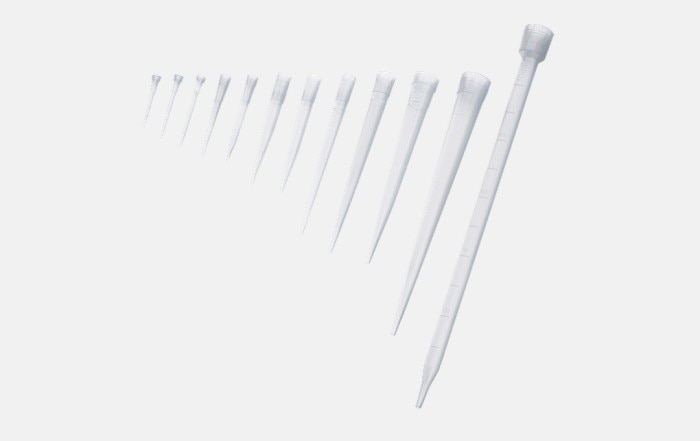
Standard conical tips, used for most aqueous solutions, have a straightforward narrowing cone that transitions to a small opening. This design is adequate for general tasks, but it can become limiting in specific applications. When working with deep or narrow vessels, extended or narrow tips are often preferred. These have a longer, slimmer body that allows access into microcentrifuge tubes, deepwell plates, or narrow vials. However, if the bore becomes too narrow, flow resistance can increase, making pipetting slightly harder and sometimes less gentle on sensitive samples.
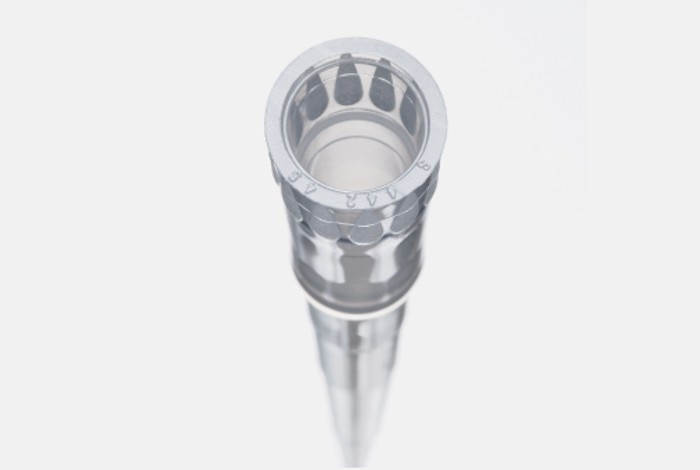
Within this landscape, Eppendorf pipette tips are designed as part of a matched system with Eppendorf pipettes. The shape of the tip cone is carefully coordinated with the pipette’s nosecone geometry. This optimized fit provides a reliable seal with lower mounting force. Because the plastic is not over-deformed when the tip is attached, the seal remains tight without excessive friction, and tips are easier to eject. This has two practical consequences: reduced strain on the user’s hand and more consistent pipetting performance due to a stable mechanical interface.
Inside the Eppendorf tip, the internal channel is shaped to support predictable fluid dynamics. The transition from the wider upper section to the narrow lower part is smooth, with minimal steps or dead volume. This promotes laminar flow and a stable air cushion, which is particularly important in air-displacement pipettes. Stable behavior of the air column leads to more accurate aspiration and dispensing, especially at the lower end of the pipette’s range and when handling viscous liquids.
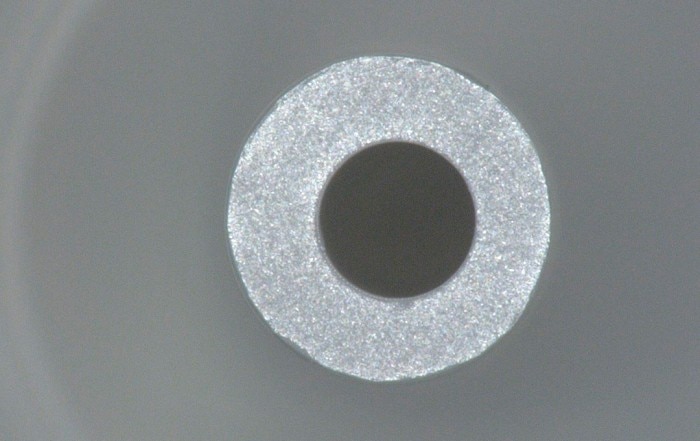
The geometry at the very end of the tip is equally important. The design and finish of the orifice determine how droplets form and detach. A well-formed tip end allows liquid to be dispensed cleanly, with minimal formation of hanging drops or liquid “strings.” This reduces the risk of under-delivery and improves the user’s control when touching off against the wall of a tube or well. In assays such as PCR or qPCR, where microliter or sub-microliter differences can be significant, this droplet behavior directly contributes to data quality.
Eppendorf epT.I.P.S.® LoRetention® combine this geometric optimization with a hydrophobic inner surface. The combination of surface properties and internal shape reduces the contact area and eliminates corners where liquid could remain trapped. As a result, more of the aspirated volume is actually delivered to the target vessel, which is particularly valuable when working with expensive enzymes, nucleic acids, or protein preparations.
In summary, the shape of pipette tips influences fit, flow, droplet formation, and sample recovery. Eppendorf pipette tips are beneficial because their geometry is specifically engineered to match their pipettes, giving a reliable seal with low mounting force, a smooth and predictable internal flow path, and a well-formed tip opening for clean dispensing. When combined with low-retention surfaces, this design improves accuracy, precision, user ergonomics, and the efficient use of valuable reagents in everyday laboratory work.
Read our Application Note: The tip of the iceberg
Did you know that pipette tip quality crucially influences lab accuracy? This application note highlights how tip design, material, and sterilization methods affect pipetting precision and consistency.