-
-
-
- WHX Labs Dubai 2026
- analytica 2026
- Forum Labo 2026
- SLAS Europe 2026
- Forum Labo 2026 Bioprocess
- Bioprocessing Summit Europe 2026
- BioProcess International 2026
- Swiss Biotech Day 2025
- ISCT 2026
- Pichia 2026
- Future Labs Live 2026
- BioProScale Sympposium 2026
- ASGCT 2026
- Eppendorf Automation Forum 2026
- ESACT 2026
- ELRIG Drug Discovery 2026
-

-
-
-
- WHX Labs Dubai 2026
- analytica 2026
- Forum Labo 2026
- SLAS Europe 2026
- Forum Labo 2026 Bioprocess
- Bioprocessing Summit Europe 2026
- BioProcess International 2026
- Swiss Biotech Day 2025
- ISCT 2026
- Pichia 2026
- Future Labs Live 2026
- BioProScale Sympposium 2026
- ASGCT 2026
- Eppendorf Automation Forum 2026
- ESACT 2026
- ELRIG Drug Discovery 2026
-
-
- Todas las pipetas, dispensadores y manipuladores de líquidos automatizados
- Todas las micropipetas
- Pipetas mecánicas
- Pipetas electrónicas
- Pipetas multicanal
- Pipetas y dispensadores de desplazamiento positivo
- Dispensadores de botella
- Controladores de pipetas
- Accesorios para dispensadores y pipetas
- Pipeteo automatizado
- Consumibles para automatización
- Accesorios de automatización
- Servicios de manipulación de líquidos y pipetas
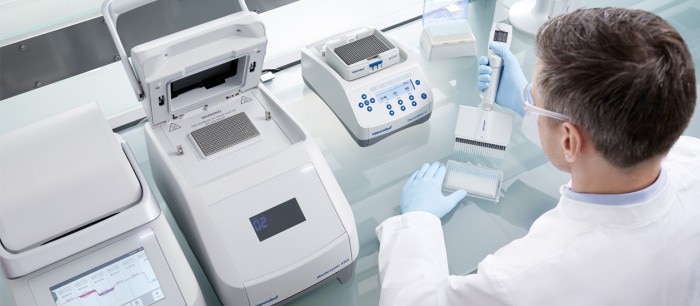
How to Reduce the Risk of RSI in 384-well Applications
Academia de laboratorio
- Salud y medicina
- Biología celular
- Reproducibilidad
- Ergonomía
- Eficiencia
- Puntas de pipeta
- Ensayo
With the advent of the high-throughput screening approach, the need for a microplate with a larger number of wells appeared and was quickly implemented as a consumable for plate assays. Applications performed in 384-well plates require repetitive liquid handling steps. Automated pipetting platforms represent an investment that smaller labs or companies often cannot afford. Then multi-channel pipettes are preferred. Thus, 16 or 24-channel pipettes designed to fit the 384-well microplate format are an alternative solution for scientists looking to increase their throughput. Compared to 8 or 12-channel pipettes, especially the electronic versions of 16 or 24-channel pipettes save pipetting time and reduce the risk of repetitive strain injuries (RSIs).
Reducing the number of arm movements help minimize the risk of RSI
Leer más
- Using multichannel pipettes instead of single-channel pipettes - if available 16 or 24-channel pipettes
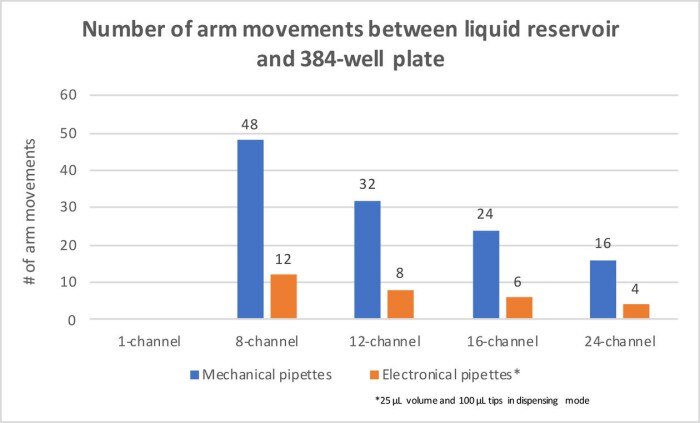
a. For instance, arm movement can be reduced from 48 movements with an 8-channel pipette to 16 movements with a 24-channel pipette (=> reduces arm movement by 67%) - The use of multichannel electronic pipettes in dispensing mode further reduces arm movement significantly, as shown in Figure 1.
- The use of electronic 24-channel pipettes in dispensing mode represents the ultimate solution as only between 1 and 16 arm movements are needed, depending on the volume used.
a. For instance, when dispensing a volume of 25 µL with a 100 µL tip, 4 arm movements are needed per plate, saving additional 75% compared to 16 movements with mechanical 24-channel pipettes
b. Thus, compared to mechanical 8-channel pipettes you can save 92% of arm movements with electronic 24-channel pipette in dispensing mode
In summary, a higher number of channels has a direct impact on the number of movements required to dispense liquids into plates. With a 16 or 24-channel pipette, the number of movements is decreased, especially with electronic models used in dispensing mode, reducing significantly the risk of repetitive strain injury appearance.
Leer más