MENU
IT | EUR
-
-
-
- WHX Labs Dubai 2026
- analytica 2026
- Forum Labo 2026
- SLAS Europe 2026
- Forum Labo 2026 Bioprocess
- Bioprocessing Summit Europe 2026
- BioProcess International 2026
- Swiss Biotech Day 2025
- ISCT 2026
- Pichia 2026
- Future Labs Live 2026
- BioProScale Sympposium 2026
- ASGCT 2026
- Eppendorf Automation Forum 2026
- ESACT 2026
- ECB 2026
- WoTS 2026
- SIMB Annual Meeting 2026
- ELRIG Drug Discovery 2026
-
-
- Assistenza per Mastercycler
- Assistenza per l'automazione
- Assistenza per ultracongelatori
- Assistenza per incubatori
- Assistenza per agitatori
- Assistenza per regolazione termica e miscelazione
- Assistenza per pipette
- Assistenza per bioprocessi
- Assistenza per centrifughe e rotori
- Calibrazione per pipette nuove

-
-
-
- WHX Labs Dubai 2026
- analytica 2026
- Forum Labo 2026
- SLAS Europe 2026
- Forum Labo 2026 Bioprocess
- Bioprocessing Summit Europe 2026
- BioProcess International 2026
- Swiss Biotech Day 2025
- ISCT 2026
- Pichia 2026
- Future Labs Live 2026
- BioProScale Sympposium 2026
- ASGCT 2026
- Eppendorf Automation Forum 2026
- ESACT 2026
- ECB 2026
- WoTS 2026
- SIMB Annual Meeting 2026
- ELRIG Drug Discovery 2026
-
-
- Assistenza per Mastercycler
- Assistenza per l'automazione
- Assistenza per ultracongelatori
- Assistenza per incubatori
- Assistenza per agitatori
- Assistenza per regolazione termica e miscelazione
- Assistenza per pipette
- Assistenza per bioprocessi
- Assistenza per centrifughe e rotori
- Calibrazione per pipette nuove
IT | EUR
-
- Tutte le pipette, i dispenser e i sistemi automatizzati per la manipolazione dei liquidi
- Tutte le micropipette
- Pipette meccaniche
- Pipette elettroniche
- Pipette multicanale
- Pipette a spostamento positivo e dispenser
- Dispenser per flaconi
- Ausili di pipettaggio
- Accessori per dispenser e pipette
- Pipettaggio automatizzato
- Consumabili per l'automazione
- Accessori per l'automazione
- Servizi per sistemi di manipolazione dei liquidi e pipette
Sorry, we couldn't find anything on our website containing your search term.
Sorry, we couldn't find anything on our website containing your search term.
- Home
- Azienda e opportunità di carriera
- Premi
- Eppendorf Award for Young European Investigators
- All Award Winners & Finalists
- 2026 Award Finalist Dr Sebastiaan De Schepper
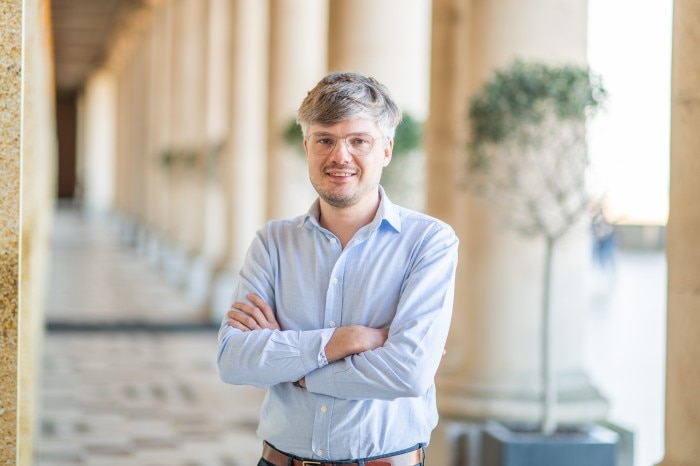
2026 Award Finalist Dr. Sebastiaan De Schepper
Sebastiaan De Schepper is Group Leader at the VIB-Center for Molecular Neurology and Research Professor at the University of Antwerp, Belgium. His research focuses on how peripheral immune systems shape vulnerability to neurodegenerative diseases through the gut–brain axis. His team uses advanced mouse models, human stem cell–derived systems and high-dimensional immune profiling, to unravel how tissue-resident and circulating immune cells regulate neuroinflammation and protein aggregation in disorders such as Parkinson’s disease. Before establishing his laboratory at VIB in 2025, he was a Sir Henry Wellcome Fellow at the UK Dementia Research Institute (UCL). He is the recipient of an ERC Starting Grant (2026) and an FWO Odysseus Fellowship (2025) supporting his research programme on neuroimmune mechanisms in neurodegeneration.
Synopsis of the research:
My research investigates how peripheral immune mechanisms contribute to the initiation and progression of Parkinson’s disease along the gut-brain axis. In my recent study (De Schepper et al., Nature, 2026), we demonstrate that intestinal immune responses can drive Parkinson’s disease–like neurodegeneration. Using patient-derived α-synuclein fibrils and in vivo models of gut-to-brain propagation, we show that intestinal macrophages (De Schepper et al., Cell 2018) take up pathological α-synuclein and activate infiltrating T cells in the intestinal wall. These activated T cells subsequently expand and migrate through the circulation to the brain, where they enter via the meninges and promote degeneration of dopaminergic neurons, the pathological hallmark of the disease. Blocking immune-cell trafficking significantly reduced α-synuclein spreading and neuronal loss, demonstrating a causal role for peripheral immune activation in disease propagation. Our findings challenge traditional brain-centric models of Parkinson’s disease by establishing immune mechanisms in the gut as drivers of pathology spreading toward the brain. They also highlight peripheral immune pathways as potential targets for early intervention in neurodegenerative disease.
Synopsis of the research:
My research investigates how peripheral immune mechanisms contribute to the initiation and progression of Parkinson’s disease along the gut-brain axis. In my recent study (De Schepper et al., Nature, 2026), we demonstrate that intestinal immune responses can drive Parkinson’s disease–like neurodegeneration. Using patient-derived α-synuclein fibrils and in vivo models of gut-to-brain propagation, we show that intestinal macrophages (De Schepper et al., Cell 2018) take up pathological α-synuclein and activate infiltrating T cells in the intestinal wall. These activated T cells subsequently expand and migrate through the circulation to the brain, where they enter via the meninges and promote degeneration of dopaminergic neurons, the pathological hallmark of the disease. Blocking immune-cell trafficking significantly reduced α-synuclein spreading and neuronal loss, demonstrating a causal role for peripheral immune activation in disease propagation. Our findings challenge traditional brain-centric models of Parkinson’s disease by establishing immune mechanisms in the gut as drivers of pathology spreading toward the brain. They also highlight peripheral immune pathways as potential targets for early intervention in neurodegenerative disease.
Approfondisci

PDF 0,25 MB
PDF 0,08 MB