-
-
-
- WHX Labs Dubai 2026
- analytica 2026
- Forum Labo 2026
- SLAS Europe 2026
- Forum Labo 2026 Bioprocess
- Bioprocessing Summit Europe 2026
- BioProcess International 2026
- Swiss Biotech Day 2025
- ISCT 2026
- Pichia 2026
- Future Labs Live 2026
- BioProScale Sympposium 2026
- ASGCT 2026
- Eppendorf Automation Forum 2026
- ESACT 2026
- ECB 2026
- WoTS 2026
- SIMB Annual Meeting 2026
- ELRIG Drug Discovery 2026
-
-
- Assistenza per Mastercycler
- Assistenza per l'automazione
- Assistenza per ultracongelatori
- Assistenza per incubatori
- Assistenza per agitatori
- Assistenza per regolazione termica e miscelazione
- Assistenza per pipette
- Assistenza per bioprocessi
- Assistenza per centrifughe e rotori
- Calibrazione per pipette nuove

-
-
-
- WHX Labs Dubai 2026
- analytica 2026
- Forum Labo 2026
- SLAS Europe 2026
- Forum Labo 2026 Bioprocess
- Bioprocessing Summit Europe 2026
- BioProcess International 2026
- Swiss Biotech Day 2025
- ISCT 2026
- Pichia 2026
- Future Labs Live 2026
- BioProScale Sympposium 2026
- ASGCT 2026
- Eppendorf Automation Forum 2026
- ESACT 2026
- ECB 2026
- WoTS 2026
- SIMB Annual Meeting 2026
- ELRIG Drug Discovery 2026
-
-
- Assistenza per Mastercycler
- Assistenza per l'automazione
- Assistenza per ultracongelatori
- Assistenza per incubatori
- Assistenza per agitatori
- Assistenza per regolazione termica e miscelazione
- Assistenza per pipette
- Assistenza per bioprocessi
- Assistenza per centrifughe e rotori
- Calibrazione per pipette nuove
-
- Tutte le pipette, i dispenser e i sistemi automatizzati per la manipolazione dei liquidi
- Tutte le micropipette
- Pipette meccaniche
- Pipette elettroniche
- Pipette multicanale
- Pipette a spostamento positivo e dispenser
- Dispenser per flaconi
- Ausili di pipettaggio
- Accessori per dispenser e pipette
- Pipettaggio automatizzato
- Consumabili per l'automazione
- Accessori per l'automazione
- Servizi per sistemi di manipolazione dei liquidi e pipette
- Home
- Lab Academy
- Applied Industries
- Bioprocessing
- Introduction to Bioprocessing
- Batch, Fed-batch, and Continuous Culture
Bioprocess Operation Modes: Batch, Fed-batch, and Continuous Culture
Overview
Feed automation
Perfusion
Approfondisci
What are the differences between batch, fed-batch, and continuous culture?
Approfondisci
Batch culture
In a batch culture, substrate is administered at the start of the bioprocess, with no further additions. The feed is gradually consumed by the culture and there is an accumulation of by-products over time. When the cells enter the stationary growth phase, the culture is harvested.
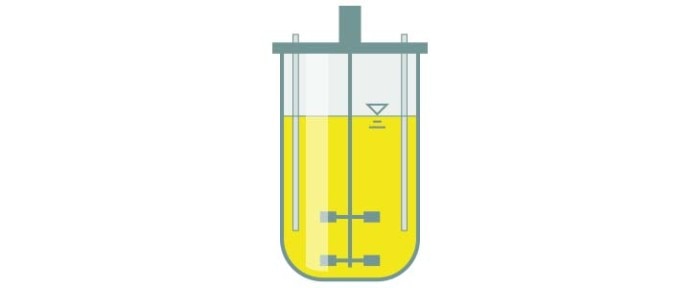
- Simple operation and low risk of contamination
- Suitable for the early stages of experimental design
- Relatively short duration
- Relatively low cell densities and yields
- Toxic by-products accumulate over time
Approfondisci
Fed-batch culture
In a fed-batch culture, batch bioprocessing is conducted for a certain period of time. Then, to counter any decline in cell growth or cell densities, additional substrate is added in increments throughout the rest of the bioprocess.
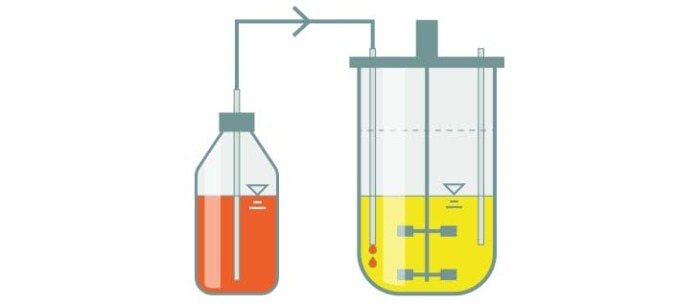
- The most widely used bioprocess mode
- Compared to batch fermentation:
- A higher cell density can be achieved
- Extended duration of the cell culture
- Less substrate overfeeding is required at the start of the culture, to decrease the accumulation of toxic by-products and improve cell growth
- Incremental feeding following the batch fermentation period increases the risk of contamination
- Harvesting is only carried out at the end of the process and so there is a lack of continuous by-product removal
Approfondisci
Continuous culture
In a continuous culture, substrate is continuously added to the culture, with the continuous harvesting of cells and culture medium. Like this, nutrients are replenished and by-products removed. The culture volume remains constant when feeding and harvesting are carried out at the same rate. This allows for a steady state to be achieved and maintains a constant environment and rate of cell growth.
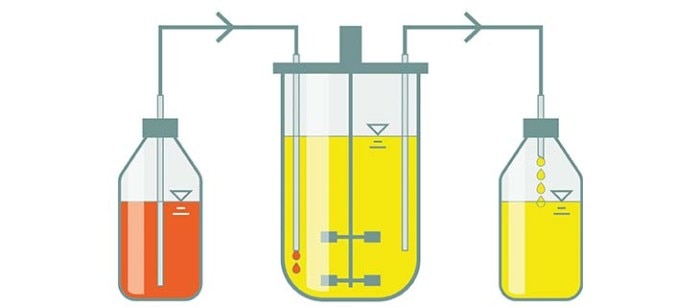
- A constant growth environment can be maintained, which can positively influence the product quality
- Steady state cultures can be maintained for up to several months to reduce the culture downtime
- Process operation is more challenging than in batch or fed-batch processes
- Increased risk of contamination due to the extended duration and continuous feeding and harvesting
- Limited traceability, as the culture suspensions aren’t harvested in batches
Approfondisci
Perfusion culture
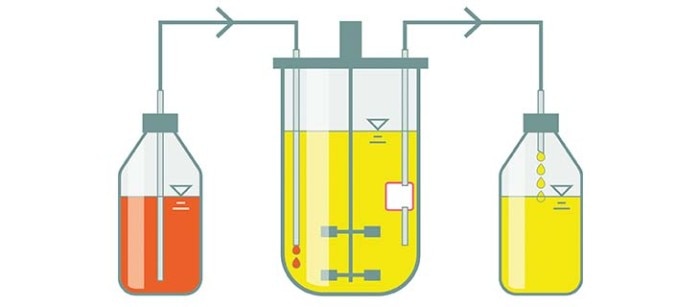
Perfusion culture is a type of continuous culture where cells are retained or recycled back into the bioreactor. Similar to other types of continuous culture, nutrients are replenished, and toxic by-products are removed to keep the culture in a steady state.
- Steady state cultures can be maintained for up to several months to reduce the culture downtime
- High cell densities - and subsequently high yields and volumetric productivity can be achieved
- Due to higher volumetric productivity the working volume and therefore equipment footprint can be reduced, compared to batch or fed-batch processes
- Process operation is more challenging than in batch or fed-batch processes
- Increased risk of contamination due to the extended duration and continuous feeding and harvesting
- Limited traceability, as the culture suspensions aren’t harvested in batches
Approfondisci
Which bioprocess mode is best suited for your application?
Approfondisci
Downloads
How can feed automation improve bioprocesses? And what is required to establish automated feeding?
Sensor integration
Approfondisci
Strategies for feed automation
Approfondisci
Perfusion cell culture: What are cell retention techniques for perfusion culture and which devices can be used for these?
Approfondisci
Filtration using spin filters
Filtration using spin filters
Approfondisci
Get more information on how a spin filter functions.

Approfondisci
Tangential flow filtration (ATF and TFF)
Approfondisci
Tangential flow filtration (TFF)
Approfondisci
Alternating tangential flow (ATF) filtration
Approfondisci
Perfusion process development at small scale
Approfondisci
- Using the DASbox® Mini Bioreactor System , ATF perfusion cultivation of CHO cells and HEK293 cells in a working volume as low as 230 mL was established.
Approfondisci
- Using a DASGIP® Parallel Bioreactor System , CHO cells were cultivated in perfusion in a working volume of 1 L.
Approfondisci
Packed-bed bioreactors
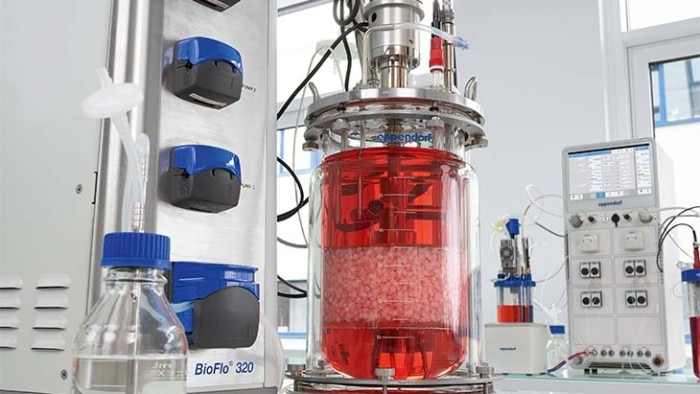
Packed-bed bioreactors are filled with a solid growth support on or in which the cells are immobilized. One such support are Fibra-Cel® discs . Fibra-Cel is a porous meshwork of polyester and polypropylene that provides a growth surface for adherent cells and entraps suspended cells. Immobilization of cells in the matrix facilitates the easy harvest of cell-free medium from the bioreactor. Furthermore, Fibra-Cel® offers a high surface to volume ratio and protects cells from damaging shear forces.
Approfondisci
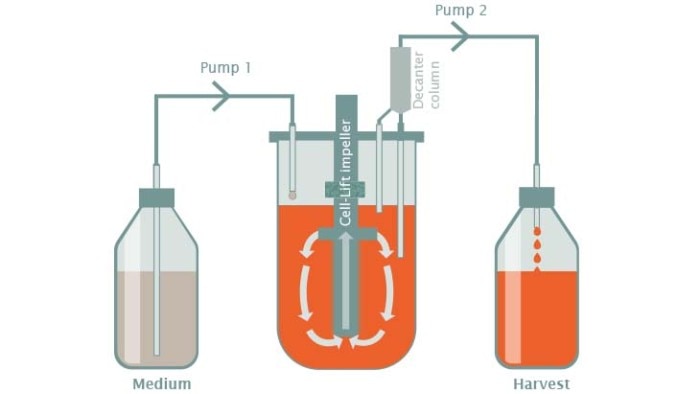
Cell-Lift impeller with decanter column
Cell-Lift impellers with decanter columns can be used for perfusion cultivation of cells grown on microcarriers. Cell-Lift impeller rotation creates a negative pressure in the hollow impeller tube causing medium to circulate uniformly in a closed loop. Cells and microcarriers are separated from the medium in the decanter column. The medium is harvested and the cells and microcarriers are transferred back to the bioreactor. Advantages of this system include reduced shear force, high mass transfer of nutrients, and a high oxygen transfer rate.
Approfondisci
Approfondisci