MENÚ
ES | EUR
-
-
-
-
- WHX Labs Dubai 2026
- analytica 2026
- Forum Labo 2026
- SLAS Europe 2026
- Forum Labo 2026 Bioprocess
- Bioprocessing Summit Europe 2026
- BioProcess International 2026
- Swiss Biotech Day 2025
- ISCT 2026
- Pichia 2026
- Future Labs Live 2026
- BioProScale Sympposium 2026
- ASGCT 2026
- Eppendorf Automation Forum 2026
- ESACT 2026
- ELRIG Drug Discovery 2026

-
-
-
-
- WHX Labs Dubai 2026
- analytica 2026
- Forum Labo 2026
- SLAS Europe 2026
- Forum Labo 2026 Bioprocess
- Bioprocessing Summit Europe 2026
- BioProcess International 2026
- Swiss Biotech Day 2025
- ISCT 2026
- Pichia 2026
- Future Labs Live 2026
- BioProScale Sympposium 2026
- ASGCT 2026
- Eppendorf Automation Forum 2026
- ESACT 2026
- ELRIG Drug Discovery 2026
ES | EUR
-
- Todas las pipetas, dispensadores y manipuladores de líquidos automatizados
- Todas las micropipetas
- Pipetas mecánicas
- Pipetas electrónicas
- Pipetas multicanal
- Pipetas y dispensadores de desplazamiento positivo
- Dispensadores de botella
- Controladores de pipetas
- Accesorios para dispensadores y pipetas
- Pipeteo automatizado
- Consumibles para automatización
- Accesorios de automatización
- Servicios de manipulación de líquidos y pipetas
Sorry, we couldn't find anything on our website containing your search term.
Sorry, we couldn't find anything on our website containing your search term.
- Inicio
- Lab Academy
- Life Science
- Cell Biology
- Cell Culture Documentation and Audit Readiness in Translational Cell Therapy Research
Cell Culture Documentation and Audit Readiness in Translational Cell Therapy Research
Academia de laboratorio
- Biología celular
- Cell Therapy
- Cell Handling
- Incubadores de CO2
- Ensayo
When translational cell therapy labs generate promising data across repeated runs, several pieces of the puzzle come together: There is confidence in the underlying science, the process is reproducible, and an IND-enabling program or clinical collaboration is now under discussion. At this point, the following questions on documentation arise:
In this article, we’ll outline where research and GxP-ready documentation often diverge in translational cell therapy labs. Find practical guidance on how these gaps can be addressed, using connected, well-documented cell culture equipment and monitoring platforms.
- Can you prove the cells were continuously cultured within defined environmental limits?
- Can you reconstruct all incubator and shaker setpoint changes?
- Can you show whether alarms, temperature excursions, or gas supply warnings occurred during a critical window?
- Are records complete, time-stamped, and attributable to individual users?
- Are exported files controlled, or could they be edited afterwards?
In this article, we’ll outline where research and GxP-ready documentation often diverge in translational cell therapy labs. Find practical guidance on how these gaps can be addressed, using connected, well-documented cell culture equipment and monitoring platforms.
Leer más
Common gaps between research-grade and GxP-ready documentation
Research-grade cell culture documentation typically captures the protocol followed. It often outlines aspects the scientist considers to be scientifically relevant, including the cells used, the results observed, and the parameter setpoints.
GxP-ready documentation captures the same core information about protocols, methods, and experimental outcomes. However, it also provides critical evidence needed to demonstrate that critical processes were performed as intended.
GxP-ready documentation has the primary goal of regulatory compliance and safety. It supports:
Many translational cell therapy labs need to retrofit their research-grade documentation to meet GxP requirements, after years of adopting flexible research practices. Two main issues can be faced with this approach:
The first is the gap between setpoint and actual conditions. For example, a protocol stating that cells were cultured at 37 °C and 5 % CO2 documents an intention. It does not evidence the maintaining of those environmental parameters during the twelve days that followed.
The second is between a record and a defensible record. A spreadsheet of exported values is a record. Whether it can be shown to be complete, unmodified, and attributable is a separate question, and one that is usually asked later, when reconstructing the answer is hardest.
GxP-ready documentation captures the same core information about protocols, methods, and experimental outcomes. However, it also provides critical evidence needed to demonstrate that critical processes were performed as intended.
GxP-ready documentation has the primary goal of regulatory compliance and safety. It supports:
- Traceability of critical events and actions, so that a sequence can be reconstructed rather than recalled
- Time-stamped records, establishing when something occurred rather than that it occurred
- Defined roles and responsibilities, so that actions are attributable to individuals
- Evidence that equipment conditions were maintained, distinct from evidence that they were set
- Deviation visibility and investigation, including excursions that did not affect the outcome
- Controlled exports or non-editable records, so that the evidence cannot be revised after the fact
Many translational cell therapy labs need to retrofit their research-grade documentation to meet GxP requirements, after years of adopting flexible research practices. Two main issues can be faced with this approach:
The first is the gap between setpoint and actual conditions. For example, a protocol stating that cells were cultured at 37 °C and 5 % CO2 documents an intention. It does not evidence the maintaining of those environmental parameters during the twelve days that followed.
The second is between a record and a defensible record. A spreadsheet of exported values is a record. Whether it can be shown to be complete, unmodified, and attributable is a separate question, and one that is usually asked later, when reconstructing the answer is hardest.
Leer más
Why cell culture documentation is especially exposed
Cell cultures are highly sensitive to fluctuations in their environment, and in labs, the conditions can change constantly. Doors open. Gas supplies fluctuate. Setpoints are adjusted between users. Temperature, CO2, O2, and relative humidity all affect how cells behave. Anything not recorded in real time is generally unrecoverable at a later time point.
A 2022 review in Frontiers in Cell and Developmental Biology1 found that most published work relies on nominal setpoints rather than verifying the conditions cells actually experienced, and argues that reproducibility depends on monitoring and reporting them.
For a translational program, the missing information on environmental control weakens a reproducibility argument and also weakens an audit response.
The categories that most often go unrecorded are familiar ones:
Complete records are especially important during tech transfer, when a receiving site needs to know the precise conditions that a process requires. A lab with continuous monitoring can provide answers from the data. Without it, the process has to be inferred from setpoints and outcomes, which can lead to variability between sites.
A 2022 review in Frontiers in Cell and Developmental Biology1 found that most published work relies on nominal setpoints rather than verifying the conditions cells actually experienced, and argues that reproducibility depends on monitoring and reporting them.
For a translational program, the missing information on environmental control weakens a reproducibility argument and also weakens an audit response.
The categories that most often go unrecorded are familiar ones:
- Incubation conditions over time, rather than at the point of setup
- Agitation, runtime, and program completion for shaken cultures
- Door openings, and how long recovery took afterwards
- Setpoint changes, including who made them
- Gas supply warnings and alarm acknowledgments
- Cleaning, disinfection, and sterilization records
- Maintenance activity and user permissions
- Deviation handling, including excursions judged not to have affected the culture
Complete records are especially important during tech transfer, when a receiving site needs to know the precise conditions that a process requires. A lab with continuous monitoring can provide answers from the data. Without it, the process has to be inferred from setpoints and outcomes, which can lead to variability between sites.
Leer más
Where equipment records and remote device monitoring can help
Improving cell culture documentation is often assumed to mean more manual recording. In practice, much of what needs capturing is already generated by the equipment itself. The question is whether it is retained, attributable, and retrievable when required.
Leer más
What conditions did the cells actually experience?
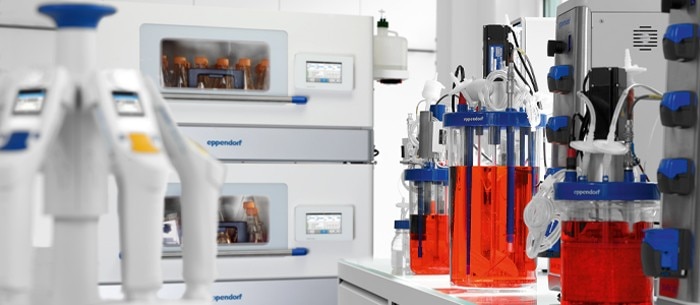
The information needed to answer this is largely generated already. Incubators and incubator shakers with onboard logging record the actual conditions experienced, rather than just the setpoints. For a CO2 incubator, these may include temperature, CO2, O2, and relative humidity, together with door openings, setpoint changes, and event data such as alerts. Whereas for an incubator shaker, recorded parameters may additionally include agitation, remaining runtime, and program completion. Devices such as the CellXpert C170i CO2 incubator and CS220 CO2 incubator shaker from Eppendorf can generate operation (run) records, which are stored on the device, and are readily exportable as PDF.
Sterilization records sit alongside this. Performed before a run, sterilization provides assurance that work in the chamber will not be compromised by contamination carried over from previous batches. Devices with an integrated high-temperature sterilization routine can produce a downloadable performance protocol documenting the cycle and its outcome, so that assurance is evidenced rather than assumed.
Documentation is only part of the picture. Equipment also has to suit the facility it will operate in, particularly where work is moving toward a controlled environment. Cleanroom compatibility, ease of cleaning, sterilization capability, and applicable certifications all determine whether existing equipment can be used in a controlled facility, or will need replacing before clinical-facing work can begin. Both the CellXpert C170i and CS220 are designed to meet cleanroom and GMP requirements.
Leer más
Who did what, and did anyone respond?
Attributability is harder to retrofit than parameter data, because it concerns people rather than instruments. Onboard user management is recommended, as it restricts who can change parameters or start a sterilization cycle, making operator actions attributable by default.
Connecting devices to a platform such as VisioNize Lab Suite extends this across the fleet. Remote device monitoring gives real-time visibility of connected device status, parameters, and performance. The platform records device telemetry of process values such as temperature, gas concentration and relative humidity, user interactions, alerts, and errors as non-editable, time-stamped entries. Parameter and event data, along with logged user interactions, can be exported from a single platform rather than device by device.
Alert and event notifications reach the team while a situation can still be corrected, which is the difference between documenting a deviation and preventing one. Those alerts are then recorded with time-stamped acknowledgments, so the record shows if a threshold was crossed, and if it was addressed in a time-appropriate manner.
By viewing a parameter alongside its setpoint and alert thresholds, they provide a clear picture of how environmental conditions tracked against expectations. For labs that run mixed or older equipment, environmental sensors can bring non-connected and third-party devices into a unified monitoring environment, expanding documentation across the full cell culture process.
Leer más
Can you evidence a defined period on demand?
With the right instrumentation, labs can export records that carry the instrument’s serial number, software version, and hardware configuration. This ties a measurement to a specific instrument in a specific state, making a record traceable rather than merely accurate.
Device performance reports address this directly. For 24/7 devices such as incubators and incubator shakers, a report covering a selected timeframe brings together setpoints, average and min/max readings, time spent within parameter ranges, recorded events, door-opening behavior, and any metadata added at the point of creation. These structured reports can support the evaluation and comparison of experiments and help assess process reproducibility. Audit reports provide the same level of visibility for the audit trail, creating a record of key events, user actions, and system changes.
Both report types are currently available through a closed beta program. From Q2 2027, Eppendorf plans to offer them within new compliance packages, adding central storage and PDF/A-2a export with digital signatures and a SHA-256 hash so that report integrity can be verified independently.
It’s important to note that equipment with structured data export, user management, and standardized performance records cannot replace a quality system. What it can do is reduce the manual burden of assembling evidence, and help teams document culture conditions consistently rather than retrospectively.
Leer más
Closing the gap before it becomes urgent
Labs rarely arrive at GxP-ready documentation in a single step, and few need to. What changes the situation is knowing which parts of the record already exist, which data is being generated but not retained, and which records would have to be built from scratch.
Gap assessments are most valuable when they are addressed early and proactively. The alternative is doing it under a partner's timeline, when the gaps that matter are the ones you cannot go back and fill.
Most labs at this stage are closer than they expect. The data is often already being produced; what is missing is usually retention, attributability, and a way to assemble it on demand. Those are addressable problems, and addressing them tends to improve the science as well as the paperwork. Better records make variability easier to explain, sample history easier to defend, and a process easier to hand over intact.
Leer más
Moving toward IND-enabling or early clinical work?
Eppendorf can help you think through how equipment records, monitoring data, and standardized reports might support a more audit-ready approach to cell culture documentation. Explore monitoring options such as VisioNize Lab Suite , or speak with an Eppendorf specialist about practical ways to bridge the gap between research-grade and GxP-ready records.Eppendorf is also developing new ways to make stability evidence easier to generate and review in VisioNize Lab Suite. If your lab has a view on what would genuinely help, the team would welcome your feedback.
Leer más
References
1. Klein, S. G. et al. Toward Best Practices for Controlling Mammalian Cell Culture Environments. Front. Cell Dev. Biol. 10, 788808 (2022).
Leer más
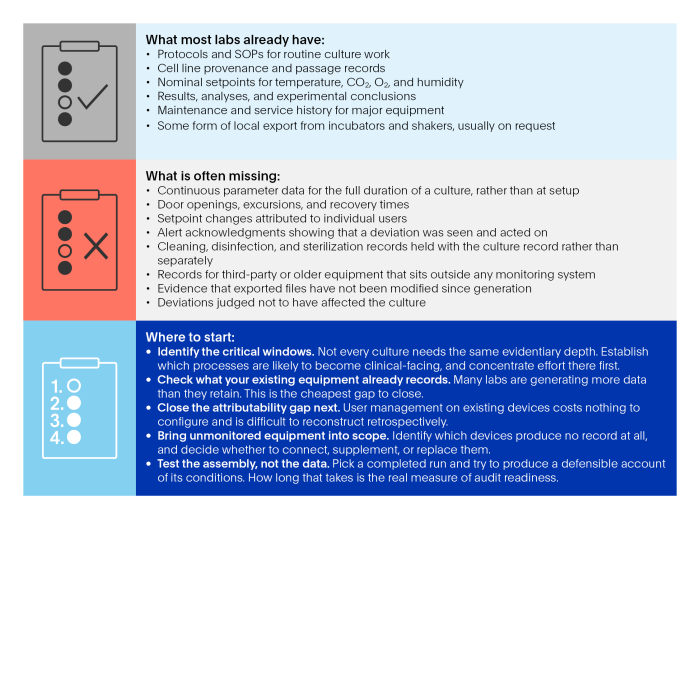
Is your documentation ready for clinical translation? A checklist for cell therapy labs
As cell therapy programmes move closer to clinical translation, documentation requirements become more demanding. Use the guide below to evaluate whether your current documentation practices provide the traceability, oversight, and evidence needed to support cell therapy translation from research into more regulated environments.
Leer más