MENÚ
ES | EUR
-
-
-
-
- WHX Labs Dubai 2026
- analytica 2026
- Forum Labo 2026
- SLAS Europe 2026
- Forum Labo 2026 Bioprocess
- Bioprocessing Summit Europe 2026
- BioProcess International 2026
- Swiss Biotech Day 2025
- ISCT 2026
- Pichia 2026
- Future Labs Live 2026
- BioProScale Sympposium 2026
- ASGCT 2026
- Eppendorf Automation Forum 2026
- ESACT 2026
- ELRIG Drug Discovery 2026

-
-
-
-
- WHX Labs Dubai 2026
- analytica 2026
- Forum Labo 2026
- SLAS Europe 2026
- Forum Labo 2026 Bioprocess
- Bioprocessing Summit Europe 2026
- BioProcess International 2026
- Swiss Biotech Day 2025
- ISCT 2026
- Pichia 2026
- Future Labs Live 2026
- BioProScale Sympposium 2026
- ASGCT 2026
- Eppendorf Automation Forum 2026
- ESACT 2026
- ELRIG Drug Discovery 2026
ES | EUR
-
- Todas las pipetas, dispensadores y manipuladores de líquidos automatizados
- Pipetas mecánicas
- Pipetas electrónicas
- Pipetas multicanal
- Pipetas y dispensadores de desplazamiento positivo
- Dispensadores de botella
- Controladores de pipetas
- Accesorios para dispensadores y pipetas
- Pipeteo automatizado
- Consumibles para automatización
- Accesorios de automatización
- Servicios de manipulación de líquidos y pipetas
Sorry, we couldn't find anything on our website containing your search term.
Sorry, we couldn't find anything on our website containing your search term.
Improve Bioprocess Data Quality, Decrease Effort
Ulrike Rasche Academia de laboratorio
- Bioprocesamiento
- Almacenaje
- Soluciones digitales de laboratorio
- Eficiencia
- Bioproceso
- BioNews article
Taking samples from your bioprocess is required in order to monitor how your culture is growing, how your desired product is produced, and to what extent nutrients are consumed. Such information is indispensable for process optimization. Delegating the sampling task to an autosampler facilitates sampling 24/7 at short and regular intervals, thus enabling the compilation of complete datasets.
This article appeared first in BioNews, Eppendorf’s application-oriented customer magazine since 1993.
Have you ever invested a lot of time and effort in sampling your bioprocess, only to discover that an important data point is missing? A data point that should have been taken in the middle of the night when you were not in the lab? Situations such as these can be avoided by delegating sampling to an autosampler.
Bioprocess Autosampler takes manual work off your hands
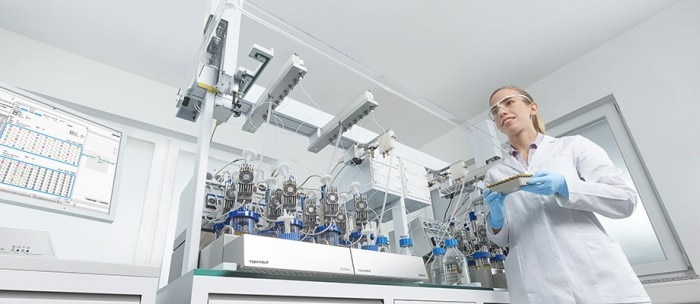
Let’s take a look at an example of how autosampling can simplify the work of a bioprocess engineer. One of our customers has tested the new Bioprocess Autosampler in an E. coli fermentation process. This user planned a parallel process involving eight bioreactors in order to compare different bioprocess conditions.
Throughout the total process run time of 35 h, samples were to be drawn at eight time points at regular intervals. How could this have been accomplished with manual sampling?
First of all, this approach would have required a shift system to cover the process run time, during which the scientists would have spent a significant portion of their work time on sampling.
This user has been using a DASbox® Mini Bioreactor System from Eppendorf for some time, and now it has been upgraded with the Bioprocess Autosampler. In our example, BioBLU® Single-Use Bioreactors were used, but the system is equally compatible with glass bioreactors. Furthermore, it can also be used with the DASGIP® parallel bioreactor system, if larger working volumes are required.
Autosampling at a glance
Per sampling step, the Bioprocess Autosampler drew one sample from a bioreactor and transferred it to a predefined sample vial, which was stored in a temperature-controlled environment. The sampling device was cleaned automatically, so that the Bioprocess Autosampler would be ready for the next sampling step. In this way, the Bioprocess Autosampler enabled regular sampling 24/7.
The storage position of each sample was predefined in the Eppendorf bioprocess control software DASware® control and the samples were positioned automatically. This automated method of sample storage eliminated the risk of human error.
Have you ever invested a lot of time and effort in sampling your bioprocess, only to discover that an important data point is missing? A data point that should have been taken in the middle of the night when you were not in the lab? Situations such as these can be avoided by delegating sampling to an autosampler.
Bioprocess Autosampler takes manual work off your hands
Let’s take a look at an example of how autosampling can simplify the work of a bioprocess engineer. One of our customers has tested the new Bioprocess Autosampler in an E. coli fermentation process. This user planned a parallel process involving eight bioreactors in order to compare different bioprocess conditions.
Throughout the total process run time of 35 h, samples were to be drawn at eight time points at regular intervals. How could this have been accomplished with manual sampling?
First of all, this approach would have required a shift system to cover the process run time, during which the scientists would have spent a significant portion of their work time on sampling.
This user has been using a DASbox® Mini Bioreactor System from Eppendorf for some time, and now it has been upgraded with the Bioprocess Autosampler. In our example, BioBLU® Single-Use Bioreactors were used, but the system is equally compatible with glass bioreactors. Furthermore, it can also be used with the DASGIP® parallel bioreactor system, if larger working volumes are required.
Autosampling at a glance
Per sampling step, the Bioprocess Autosampler drew one sample from a bioreactor and transferred it to a predefined sample vial, which was stored in a temperature-controlled environment. The sampling device was cleaned automatically, so that the Bioprocess Autosampler would be ready for the next sampling step. In this way, the Bioprocess Autosampler enabled regular sampling 24/7.
The storage position of each sample was predefined in the Eppendorf bioprocess control software DASware® control and the samples were positioned automatically. This automated method of sample storage eliminated the risk of human error.
Leer más