-
-
-
- WHX Labs Dubai 2026
- analytica 2026
- Forum Labo 2026
- SLAS Europe 2026
- Forum Labo 2026 Bioprocess
- Bioprocessing Summit Europe 2026
- BioProcess International 2026
- Swiss Biotech Day 2025
- ISCT 2026
- Pichia 2026
- Future Labs Live 2026
- BioProScale Sympposium 2026
- ASGCT 2026
- Eppendorf Automation Forum 2026
- ESACT 2026
- ELRIG Drug Discovery 2026
-

-
-
-
- WHX Labs Dubai 2026
- analytica 2026
- Forum Labo 2026
- SLAS Europe 2026
- Forum Labo 2026 Bioprocess
- Bioprocessing Summit Europe 2026
- BioProcess International 2026
- Swiss Biotech Day 2025
- ISCT 2026
- Pichia 2026
- Future Labs Live 2026
- BioProScale Sympposium 2026
- ASGCT 2026
- Eppendorf Automation Forum 2026
- ESACT 2026
- ELRIG Drug Discovery 2026
-
-
- Todas las pipetas, dispensadores y manipuladores de líquidos automatizados
- Todas las micropipetas
- Pipetas mecánicas
- Pipetas electrónicas
- Pipetas multicanal
- Pipetas y dispensadores de desplazamiento positivo
- Dispensadores de botella
- Controladores de pipetas
- Accesorios para dispensadores y pipetas
- Pipeteo automatizado
- Consumibles para automatización
- Accesorios de automatización
- Servicios de manipulación de líquidos y pipetas
- Inicio
- Lab Academy
- Life Science
- Molecular Biology
- Adaptación del tiempo de centrifugación
Adaptación del tiempo y la velocidad de centrifugación
Academia de laboratorio
- Biología molecular
- Centrifugación
- Eficiencia
- Centrífugas y rotores
- Ensayo
¿Qué puede hacer si su centrífuga y su rotor proporcionan, p. ej., solo una fuerza g inferior a la que requiere su protocolo? Puede centrifugar durante un período más largo. Pero, ¿qué tiempo y velocidad de centrifugación se necesitarán? ¿Y cómo se calcula esto? La respuesta: utilizando el factor k, una medida de la distancia de sedimentación. Esto le indicará el tiempo que tardarán las partículas en depositarse en el fondo del tubo de ensayo.
El factor k representa la eficacia de sedimentación de un sistema de centrifugación a velocidad de rotación máxima. Puede descargar nuestra Visión general de la familia de centrífugas para conocer la velocidad máxima de su centrífuga Eppendorf.
El factor k es una medida de la distancia de sedimentación en un tubo de ensayo y depende de la diferencia entre la distancia más larga y la más corta entre la muestra y el eje del rotor. Cuanto menor sea la distancia de sedimentación, menor será el tiempo de centrifugación. Además, el ángulo de los tubos dentro del rotor influye en la distancia de sedimentación.
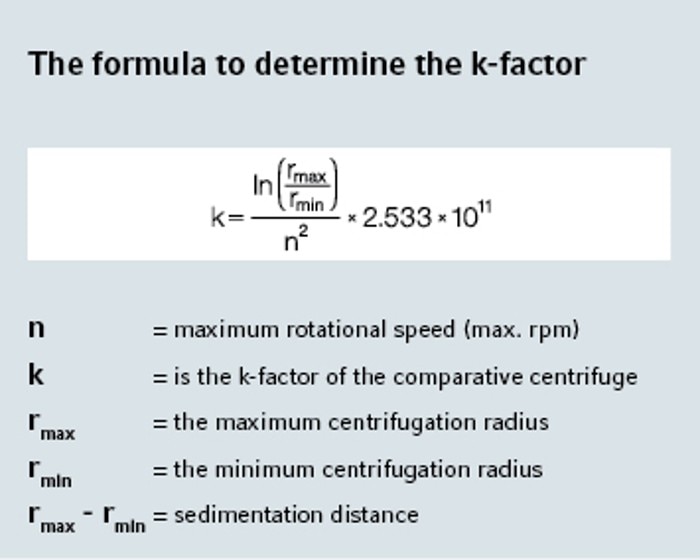
El factor k es una medida de la distancia de sedimentación y nos indica cuánto tardarán las partículas en depositarse en el fondo del tubo de ensayo.
Cuanto menor sea el factor k, mayor será la eficiencia de peletización.
Leer más
La fórmula para calcular el factor k tiene en cuenta estos parámetros:
- Radio máximo del rotor
- Radio mínimo del rotor
- Velocidad
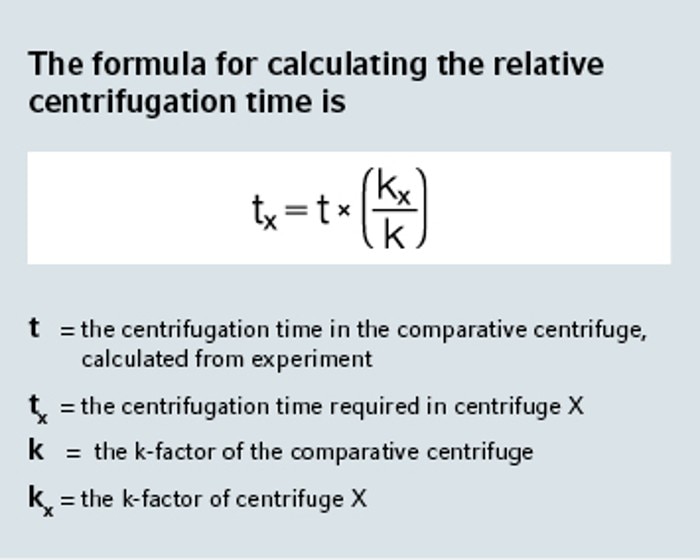
Para conseguir el mismo resultado de sedimentación y compensar el hecho de no disponer de la fuerza g necesaria, puede calcular cuánto tiempo más debe centrifugar utilizando una fórmula basada en los factores k de ambos rotores y en el tiempo de centrifugación del rotor utilizado originalmente.
¿El ajuste de la velocidad y el tiempo de centrifugación obstaculiza sus experimentos? También puede utilizar nuestra herramienta de cálculo para medir la velocidad de rotación y la fuerza centrífuga relativa necesarios utilizando el diámetro del rotor.
Más información sobre conceptos básicos de la centrifugación
Leer más