メニュー
JP | JPY
-
-
-
- Challenges and Chances: A Review of the 1st Stem Cell Community Day
- Summertime, and the Livin’ Is Easy…
- Follow-on-Biologics – More than Simple Generics
- Bacteria Versus Body Cells: A 1:1 Tie
- Behind the Crime Scene: How Biological Traces Can Help to Convict Offenders
- Every 3 Seconds Someone in the World Is Affected by Alzheimer's
- HIV – It’s Still Not Under Control…
- How Many Will Be Convicted This Time?
- Malaria – the Battle is Not Lost
- Physicians on Standby: The Annual Flu Season Can Be Serious
- At the Forefront in Fighting Cancer
- Molecular Motors: Think Small and yet Smaller Again…
- Liquid Biopsy: Novel Methods May Ease Cancer Detection and Therapy
- They Are Invisible, Sneaky and Disgusting – But Today It’s Their Special Day!
- How Many Cells Are in Your Body? Probably More Than You Think!
- What You Need to Know about Antibiotic Resistance – Findings, Facts and Good Intentions
- Why Do Old Men Have Big Ears?
- The Condemned Live Longer: A Potential Paradigm Shift in Genetics
- From Research to Commerce
- Chronobiology – How the Cold Seasons Influence Our Biorhythms
- Taskforce Microbots: Targeted Treatment from Inside the Body
- Eyes on Cancer Therapy
-
-

-
-
-
- Challenges and Chances: A Review of the 1st Stem Cell Community Day
- Summertime, and the Livin’ Is Easy…
- Follow-on-Biologics – More than Simple Generics
- Bacteria Versus Body Cells: A 1:1 Tie
- Behind the Crime Scene: How Biological Traces Can Help to Convict Offenders
- Every 3 Seconds Someone in the World Is Affected by Alzheimer's
- HIV – It’s Still Not Under Control…
- How Many Will Be Convicted This Time?
- Malaria – the Battle is Not Lost
- Physicians on Standby: The Annual Flu Season Can Be Serious
- At the Forefront in Fighting Cancer
- Molecular Motors: Think Small and yet Smaller Again…
- Liquid Biopsy: Novel Methods May Ease Cancer Detection and Therapy
- They Are Invisible, Sneaky and Disgusting – But Today It’s Their Special Day!
- How Many Cells Are in Your Body? Probably More Than You Think!
- What You Need to Know about Antibiotic Resistance – Findings, Facts and Good Intentions
- Why Do Old Men Have Big Ears?
- The Condemned Live Longer: A Potential Paradigm Shift in Genetics
- From Research to Commerce
- Chronobiology – How the Cold Seasons Influence Our Biorhythms
- Taskforce Microbots: Targeted Treatment from Inside the Body
- Eyes on Cancer Therapy
-
-
JP | JPY
Sorry, we couldn't find anything on our website containing your search term.

How the Choice of Tools Speeds up Your Work
生命科学の探究
- エッセー
- 実験室の日常
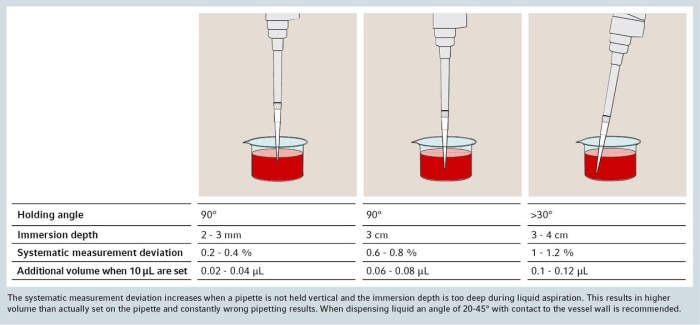
Time-saving work approaches do not always mean that you must rush. Speeding up does not need to mean a reduction in quality of results or reproducibility. If an intelligent decision is made on which tool to use to improve work, speeding up happens automatically. Ideally, reproducibility and result quality are also increased. Furthermore, it is desirable to simplify the steps needed to accomplish the results. This starts with the individual skills of the employee. Since pipetting is the most used technique in labs, a good pipetting technique saves time because experiments do not need repetition caused by inaccurate pipetting.
It makes sense to invest in a pipetting seminar for all employees. This ensures a consistent method of working amongst all employees and ensures that assays are done in the same way no matter who is pipetting. Additionally, thinking about the solutions used and the optimal tool for pipetting these can reduce waiting time e.g. when glycerol is used. Glycerol as a viscous liquid that has a bad flow behavior and is difficult to pipette because one must wait a long time until it is aspirated or dispensed. Even after waiting, it won’t be an accurate pipetting result. So choosing a direct displacement tool facilitates, speeds up, and increases accuracy when working with this liquid.
It makes sense to invest in a pipetting seminar for all employees. This ensures a consistent method of working amongst all employees and ensures that assays are done in the same way no matter who is pipetting. Additionally, thinking about the solutions used and the optimal tool for pipetting these can reduce waiting time e.g. when glycerol is used. Glycerol as a viscous liquid that has a bad flow behavior and is difficult to pipette because one must wait a long time until it is aspirated or dispensed. Even after waiting, it won’t be an accurate pipetting result. So choosing a direct displacement tool facilitates, speeds up, and increases accuracy when working with this liquid.
もっと読む
More and more companies are using robots for their routine work. This does not necessarily mean that less employees are needed, but rather that the kind of work employees are doing is shifted from manual work e.g., pipetting, to more of a programming and monitoring function. This guarantees that robots are working correctly and reduces the employees’ workload. It also offers the spare time needed to prepare other experiments, write reports, or improve assays. Furthermore, programming electronic devices speeds up work. An electronic pipette that can be programmed for dilution series can be 10 times faster than a manual pipette where the pipetting volume must be changed after each dispensing step.
As you can see from these examples, many ways exist to speed up work without being rushed. Improvement of pipetting skills, consideration of the correct tools, and an open mind towards electronics improve your everyday working situation and can help to clear your mind from time-consuming repetitive tasks.
As you can see from these examples, many ways exist to speed up work without being rushed. Improvement of pipetting skills, consideration of the correct tools, and an open mind towards electronics improve your everyday working situation and can help to clear your mind from time-consuming repetitive tasks.
もっと読む