メニュー
JP | JPY
-
-
-
-
- Challenges and Chances: A Review of the 1st Stem Cell Community Day
- Summertime, and the Livin’ Is Easy…
- Follow-on-Biologics – More than Simple Generics
- Bacteria Versus Body Cells: A 1:1 Tie
- Behind the Crime Scene: How Biological Traces Can Help to Convict Offenders
- Every 3 Seconds Someone in the World Is Affected by Alzheimer's
- HIV – It’s Still Not Under Control…
- How Many Will Be Convicted This Time?
- Malaria – the Battle is Not Lost
- Physicians on Standby: The Annual Flu Season Can Be Serious
- At the Forefront in Fighting Cancer
- Molecular Motors: Think Small and yet Smaller Again…
- Liquid Biopsy: Novel Methods May Ease Cancer Detection and Therapy
- They Are Invisible, Sneaky and Disgusting – But Today It’s Their Special Day!
- How Many Cells Are in Your Body? Probably More Than You Think!
- What You Need to Know about Antibiotic Resistance – Findings, Facts and Good Intentions
- Why Do Old Men Have Big Ears?
- The Condemned Live Longer: A Potential Paradigm Shift in Genetics
- From Research to Commerce
- Chronobiology – How the Cold Seasons Influence Our Biorhythms
- Taskforce Microbots: Targeted Treatment from Inside the Body
- Eyes on Cancer Therapy
-

-
-
-
-
- Challenges and Chances: A Review of the 1st Stem Cell Community Day
- Summertime, and the Livin’ Is Easy…
- Follow-on-Biologics – More than Simple Generics
- Bacteria Versus Body Cells: A 1:1 Tie
- Behind the Crime Scene: How Biological Traces Can Help to Convict Offenders
- Every 3 Seconds Someone in the World Is Affected by Alzheimer's
- HIV – It’s Still Not Under Control…
- How Many Will Be Convicted This Time?
- Malaria – the Battle is Not Lost
- Physicians on Standby: The Annual Flu Season Can Be Serious
- At the Forefront in Fighting Cancer
- Molecular Motors: Think Small and yet Smaller Again…
- Liquid Biopsy: Novel Methods May Ease Cancer Detection and Therapy
- They Are Invisible, Sneaky and Disgusting – But Today It’s Their Special Day!
- How Many Cells Are in Your Body? Probably More Than You Think!
- What You Need to Know about Antibiotic Resistance – Findings, Facts and Good Intentions
- Why Do Old Men Have Big Ears?
- The Condemned Live Longer: A Potential Paradigm Shift in Genetics
- From Research to Commerce
- Chronobiology – How the Cold Seasons Influence Our Biorhythms
- Taskforce Microbots: Targeted Treatment from Inside the Body
- Eyes on Cancer Therapy
-
JP | JPY
Sorry, we couldn't find anything on our website containing your search term.
- 2023 Prize Winner Dr. Marissa Scavuzzo
2023 Prize Winner Marissa Scavuzzo, Ph.D.
Case Western Reserve University School of Medicine, Cleveland, USA
Marissa Scavuzzo is a classically trained developmental biologist investigating glial cell diversity in the gut. Following degrees in neuroscience and biology from Baldwin Wallace University, she earned her Ph.D. with Dr. Malgorzata Borowiak at Baylor College of Medicine investigating the cellular and molecular mechanisms controlling pancreatic cell fate decisions. During her postdoctoral studies, she has combined her skills in single cell transcriptomics and gastrointestinal development with that of glial cell expert Dr. Paul Tesar at Case Western Reserve University School of Medicine. Her work, supported by the New York Stem Cell Foundation and the Howard Hughes Medical Institute, has paved the way towards an understanding of enteric glia in health and disease. Dr. Scavuzzo is passionate about equity, and aims to transform science education in public schools through the nonprofit Rise Up: Northeast Ohio.
Essay: The Way You Move
The intestine is unlike any other organ - hundreds of different cell types from every germ layer interact and respond to constant cellular turnover, nutritional stimuli, immune insults, microbiome interactions, and mechanical contractions. In the gut, a complex network of neurons and glia called the enteric nervous system, or the “second brain,” weave through every layer of gastrointestinal tissue from beginning to end. Enteric glia outnumber neurons and have recently emerged as crucial regulators of gut physiology. Do different subtypes of enteric glial cells exist, and if so, who are they and what do they do differently from one another? Working in the laboratory of Dr. Paul Tesar at Case Western Reserve University School of Medicine, Dr. Marissa Scavuzzo generated new technologies to map the diversity of enteric glia from every layer of the intestine. This revealed a functionally specialized mechanosensory subtype of enteric glia residing in the muscle layer called enteric glial “hub cells.” These results demonstrate that defined subpopulations of glia can execute unique gastrointestinal functions and emphasizes the need to understand how different subtypes of glia change in disease.
Essay: The Way You Move
The intestine is unlike any other organ - hundreds of different cell types from every germ layer interact and respond to constant cellular turnover, nutritional stimuli, immune insults, microbiome interactions, and mechanical contractions. In the gut, a complex network of neurons and glia called the enteric nervous system, or the “second brain,” weave through every layer of gastrointestinal tissue from beginning to end. Enteric glia outnumber neurons and have recently emerged as crucial regulators of gut physiology. Do different subtypes of enteric glial cells exist, and if so, who are they and what do they do differently from one another? Working in the laboratory of Dr. Paul Tesar at Case Western Reserve University School of Medicine, Dr. Marissa Scavuzzo generated new technologies to map the diversity of enteric glia from every layer of the intestine. This revealed a functionally specialized mechanosensory subtype of enteric glia residing in the muscle layer called enteric glial “hub cells.” These results demonstrate that defined subpopulations of glia can execute unique gastrointestinal functions and emphasizes the need to understand how different subtypes of glia change in disease.
もっと読む
Videos not loading, because cookies have been rejected. Change your
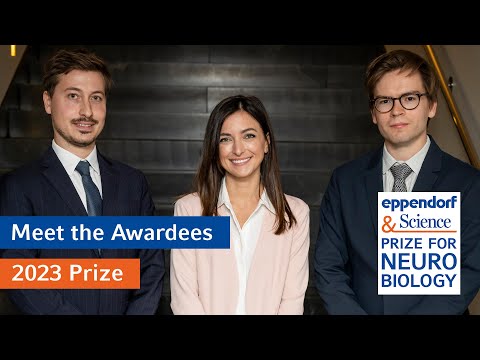
Meet the Awardees 2023

もっと読む
Downloads

PDF 0.11 MB
Research on digestion wins 2023 Eppendorf & Science Prize
JPG 0.30 MB
Marissa Scavuzzo
PDF 1.75 MB