-
-
-
- Challenges and Chances: A Review of the 1st Stem Cell Community Day
- Summertime, and the Livin’ Is Easy…
- Follow-on-Biologics – More than Simple Generics
- Bacteria Versus Body Cells: A 1:1 Tie
- Behind the Crime Scene: How Biological Traces Can Help to Convict Offenders
- Every 3 Seconds Someone in the World Is Affected by Alzheimer's
- HIV – It’s Still Not Under Control…
- How Many Will Be Convicted This Time?
- Malaria – the Battle is Not Lost
- Physicians on Standby: The Annual Flu Season Can Be Serious
- At the Forefront in Fighting Cancer
- Molecular Motors: Think Small and yet Smaller Again…
- Liquid Biopsy: Novel Methods May Ease Cancer Detection and Therapy
- They Are Invisible, Sneaky and Disgusting – But Today It’s Their Special Day!
- How Many Cells Are in Your Body? Probably More Than You Think!
- What You Need to Know about Antibiotic Resistance – Findings, Facts and Good Intentions
- Why Do Old Men Have Big Ears?
- The Condemned Live Longer: A Potential Paradigm Shift in Genetics
- From Research to Commerce
- Chronobiology – How the Cold Seasons Influence Our Biorhythms
- Taskforce Microbots: Targeted Treatment from Inside the Body
- Eyes on Cancer Therapy
-
-

-
-
-
- Challenges and Chances: A Review of the 1st Stem Cell Community Day
- Summertime, and the Livin’ Is Easy…
- Follow-on-Biologics – More than Simple Generics
- Bacteria Versus Body Cells: A 1:1 Tie
- Behind the Crime Scene: How Biological Traces Can Help to Convict Offenders
- Every 3 Seconds Someone in the World Is Affected by Alzheimer's
- HIV – It’s Still Not Under Control…
- How Many Will Be Convicted This Time?
- Malaria – the Battle is Not Lost
- Physicians on Standby: The Annual Flu Season Can Be Serious
- At the Forefront in Fighting Cancer
- Molecular Motors: Think Small and yet Smaller Again…
- Liquid Biopsy: Novel Methods May Ease Cancer Detection and Therapy
- They Are Invisible, Sneaky and Disgusting – But Today It’s Their Special Day!
- How Many Cells Are in Your Body? Probably More Than You Think!
- What You Need to Know about Antibiotic Resistance – Findings, Facts and Good Intentions
- Why Do Old Men Have Big Ears?
- The Condemned Live Longer: A Potential Paradigm Shift in Genetics
- From Research to Commerce
- Chronobiology – How the Cold Seasons Influence Our Biorhythms
- Taskforce Microbots: Targeted Treatment from Inside the Body
- Eyes on Cancer Therapy
-
-
- Recycling used plastics
Recycling of used lab consumables?
Plastic is ubiquitous in our daily life – at home and in the laboratory. We as human beings use a lot of plastic. In 2019, 460 million tons of plastics were produced globally, and this is nearly twice the amount manufactured in 2000 (234 million tons). The manufacturing of plastic released 1.8 gigatons of CO2 into the atmosphere. Compared to all other emissions, plastic production alone accounts for 3.4 % of the global CO2 emissions. If you compare these numbers with the CO2 emissions of countries, global plastic production will rank as 5th place after China, the USA, EU-27, and Japan.
Collection and recycling of plastic is the key for future development. Laboratory plastic consumables are a challenge for recycling: Whatever enters the laboratory is defined as being contaminated. This contamination can be a biological, a chemical, or even radioactive one. To improve the efforts and finally the quality of the collected plastic material, dedicated collection boxes for specific material like PP, PE, or PC.
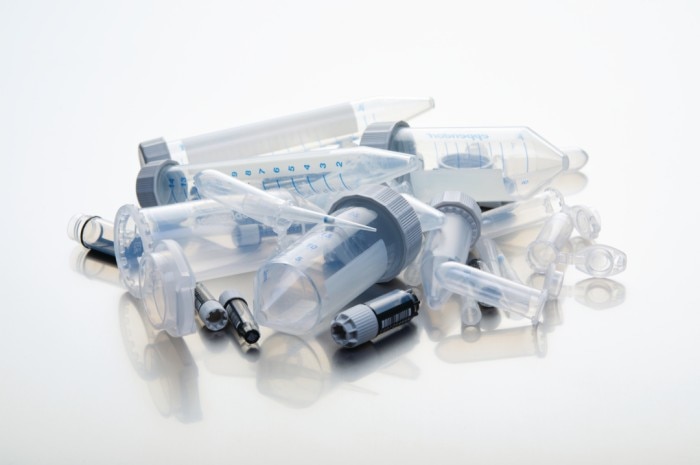
The material must be autoclaved prior shipment (although autoclavation is limited to killing germs, it does not clean the material from chemical load). Therefore, you may minimize the chemical load of your plasticware. Limit transportation, a shipment over thousands of kilometer/ miles for the next recycling facility will drastically reduce the benefit of plastic recycling due to the additional transportation impact.
Keep in mind legal restrictions, incineration of contaminated labware is set in many institutions due to safety reasons. Please check with your local biosafety and your local waste management team terms and conditions for any recycling of laboratory plastic.