-
-
-
- Challenges and Chances: A Review of the 1st Stem Cell Community Day
- Summertime, and the Livin’ Is Easy…
- Follow-on-Biologics – More than Simple Generics
- Bacteria Versus Body Cells: A 1:1 Tie
- Behind the Crime Scene: How Biological Traces Can Help to Convict Offenders
- Every 3 Seconds Someone in the World Is Affected by Alzheimer's
- HIV – It’s Still Not Under Control…
- How Many Will Be Convicted This Time?
- Malaria – the Battle is Not Lost
- Physicians on Standby: The Annual Flu Season Can Be Serious
- At the Forefront in Fighting Cancer
- Molecular Motors: Think Small and yet Smaller Again…
- Liquid Biopsy: Novel Methods May Ease Cancer Detection and Therapy
- They Are Invisible, Sneaky and Disgusting – But Today It’s Their Special Day!
- How Many Cells Are in Your Body? Probably More Than You Think!
- What You Need to Know about Antibiotic Resistance – Findings, Facts and Good Intentions
- Why Do Old Men Have Big Ears?
- The Condemned Live Longer: A Potential Paradigm Shift in Genetics
- From Research to Commerce
- Chronobiology – How the Cold Seasons Influence Our Biorhythms
- Taskforce Microbots: Targeted Treatment from Inside the Body
- Eyes on Cancer Therapy
-
-

-
-
-
- Challenges and Chances: A Review of the 1st Stem Cell Community Day
- Summertime, and the Livin’ Is Easy…
- Follow-on-Biologics – More than Simple Generics
- Bacteria Versus Body Cells: A 1:1 Tie
- Behind the Crime Scene: How Biological Traces Can Help to Convict Offenders
- Every 3 Seconds Someone in the World Is Affected by Alzheimer's
- HIV – It’s Still Not Under Control…
- How Many Will Be Convicted This Time?
- Malaria – the Battle is Not Lost
- Physicians on Standby: The Annual Flu Season Can Be Serious
- At the Forefront in Fighting Cancer
- Molecular Motors: Think Small and yet Smaller Again…
- Liquid Biopsy: Novel Methods May Ease Cancer Detection and Therapy
- They Are Invisible, Sneaky and Disgusting – But Today It’s Their Special Day!
- How Many Cells Are in Your Body? Probably More Than You Think!
- What You Need to Know about Antibiotic Resistance – Findings, Facts and Good Intentions
- Why Do Old Men Have Big Ears?
- The Condemned Live Longer: A Potential Paradigm Shift in Genetics
- From Research to Commerce
- Chronobiology – How the Cold Seasons Influence Our Biorhythms
- Taskforce Microbots: Targeted Treatment from Inside the Body
- Eyes on Cancer Therapy
-
-
- Usage of recycling material
Usage of recycling material
The goal of circular economy is to decouple economic activities from the consumption of finite resources. In other words: to keep products and material in circulation at highest value, and – in an ideal world – that materials never become waste, and nature is regenerated. Especially regarding laboratory plastics, this goal is difficult challenging to be achieved in its full scope.
The production, use, and fate of plastics is a particular challenge, as plastic waste accumulates in our environment in various forms due to waste management systems that are generally not yet fully developed for this purpose. . Nevertheless, steps have been taken in various directions, focusing on better recycling strategies. At the same time, there are many limits to the quality of secondary raw materials and their use in sensitive areas like food, medicine, or research applications. This also includes the use of recyclates for the production of laboratory consumables for which special qualities such as purity, sterility and other specific customer requirements must be met.
Contact or non-contact between recyclate and samples?
- Clear material for tubes and plates is required. Therefore, recycling material is limited to clear original material.
- No leachables are allowed. As a consequence, recycling material must be free of other components.
- Extreme stability for high speed centrifugation is needed. Recycling material must not contain traces of other plastics in recyclate as these can lead to weak-spots and – as a consequence – to material break-down.
- Sudden temperature changes of 100 °C must be with-stood. Recycled material has to contain long polymer chains as one prerequisite for material stability and material resistance in a broad temperature range.
- Handling of chemicals has to be safe. Only defined and homogenous recycled material can guarantee chemical resistance.
もっと読む
Support material and structures
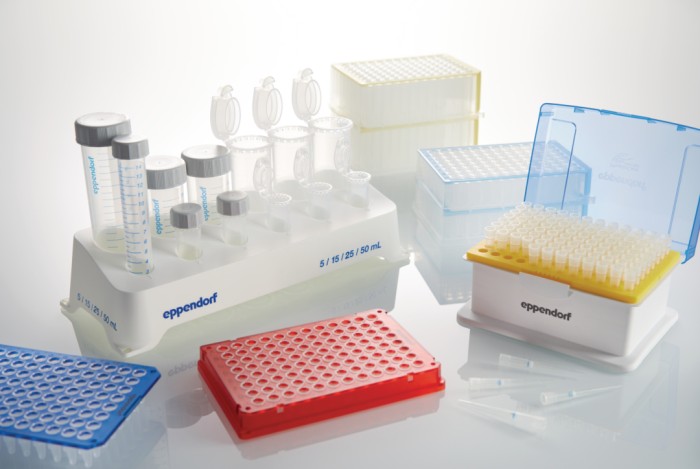
The epT.I.P.S. require a handling system for convenient storage and fixation of the tips to the pipette. The related rack or box is part of the product as a supportive factor. Whereas the refillable boxes of Eppendorf are made of Polycarbonate (PC), the singleuse racks are made of Polypropylene (PP).
These epT.I.P.S. Racks are a container for a tray with 24, 48, 96 or even 384 pipette tips, depending on the volume size range of the tip. Racks are available in 4 sizes and are closed with a lid to protect tips from dust and dirt during lab usage.
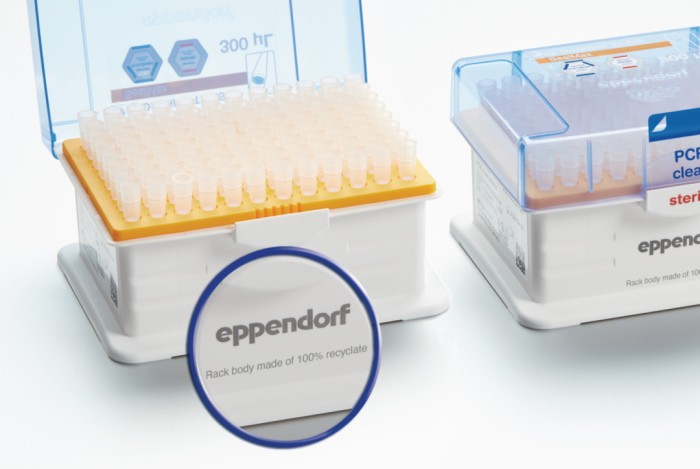
Recycled plastic in the rack
End-of-Life
Since mid of 2024, the first epT.I.P.S. racks are produced from 100% recyclate. Stepwise, we replace the different rack sizes with adapted models made of recyclate.
Due to the usage of recycling raw material, the boxes can show included tiny single dark spots. These spots appear during the molding process. These visible spots are no contamination but are caused by remaining recycled plastic particles with slightly different color than the main material.
Please check with your local biosafety/ sustainability/ waste management regarding local standards and requirements as the racks and boxes can be contaminated.