-
-
-
- Challenges and Chances: A Review of the 1st Stem Cell Community Day
- Summertime, and the Livin’ Is Easy…
- Follow-on-Biologics – More than Simple Generics
- Bacteria Versus Body Cells: A 1:1 Tie
- Behind the Crime Scene: How Biological Traces Can Help to Convict Offenders
- Every 3 Seconds Someone in the World Is Affected by Alzheimer's
- HIV – It’s Still Not Under Control…
- How Many Will Be Convicted This Time?
- Malaria – the Battle is Not Lost
- Physicians on Standby: The Annual Flu Season Can Be Serious
- At the Forefront in Fighting Cancer
- Molecular Motors: Think Small and yet Smaller Again…
- Liquid Biopsy: Novel Methods May Ease Cancer Detection and Therapy
- They Are Invisible, Sneaky and Disgusting – But Today It’s Their Special Day!
- How Many Cells Are in Your Body? Probably More Than You Think!
- What You Need to Know about Antibiotic Resistance – Findings, Facts and Good Intentions
- Why Do Old Men Have Big Ears?
- The Condemned Live Longer: A Potential Paradigm Shift in Genetics
- From Research to Commerce
- Chronobiology – How the Cold Seasons Influence Our Biorhythms
- Taskforce Microbots: Targeted Treatment from Inside the Body
- Eyes on Cancer Therapy
-
-

-
-
-
- Challenges and Chances: A Review of the 1st Stem Cell Community Day
- Summertime, and the Livin’ Is Easy…
- Follow-on-Biologics – More than Simple Generics
- Bacteria Versus Body Cells: A 1:1 Tie
- Behind the Crime Scene: How Biological Traces Can Help to Convict Offenders
- Every 3 Seconds Someone in the World Is Affected by Alzheimer's
- HIV – It’s Still Not Under Control…
- How Many Will Be Convicted This Time?
- Malaria – the Battle is Not Lost
- Physicians on Standby: The Annual Flu Season Can Be Serious
- At the Forefront in Fighting Cancer
- Molecular Motors: Think Small and yet Smaller Again…
- Liquid Biopsy: Novel Methods May Ease Cancer Detection and Therapy
- They Are Invisible, Sneaky and Disgusting – But Today It’s Their Special Day!
- How Many Cells Are in Your Body? Probably More Than You Think!
- What You Need to Know about Antibiotic Resistance – Findings, Facts and Good Intentions
- Why Do Old Men Have Big Ears?
- The Condemned Live Longer: A Potential Paradigm Shift in Genetics
- From Research to Commerce
- Chronobiology – How the Cold Seasons Influence Our Biorhythms
- Taskforce Microbots: Targeted Treatment from Inside the Body
- Eyes on Cancer Therapy
-
-

How to Reduce the Risk of RSI in 384-well Applications
Lab Academy
- 医療
- 細胞生物学
- 再現性
- 人間工学
- 効率
- チップ
- エッセー
With the advent of the high-throughput screening approach, the need for a microplate with a larger number of wells appeared and was quickly implemented as a consumable for plate assays. Applications performed in 384-well plates require repetitive liquid handling steps. Automated pipetting platforms represent an investment that smaller labs or companies often cannot afford. Then multi-channel pipettes are preferred. Thus, 16 or 24-channel pipettes designed to fit the 384-well microplate format are an alternative solution for scientists looking to increase their throughput. Compared to 8 or 12-channel pipettes, especially the electronic versions of 16 or 24-channel pipettes save pipetting time and reduce the risk of repetitive strain injuries (RSIs).
Reducing the number of arm movements help minimize the risk of RSI
もっと読む
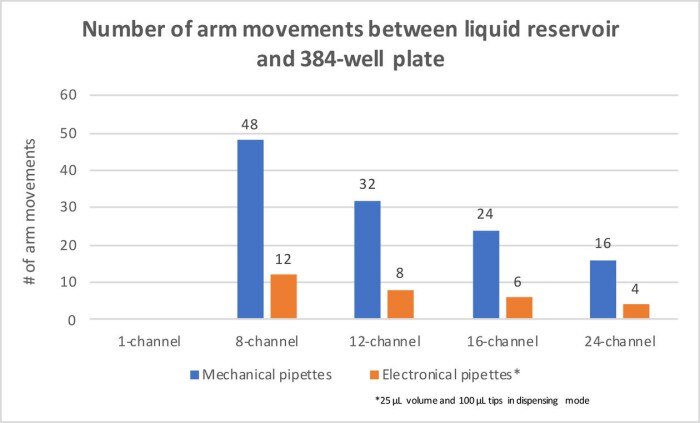
- Using multichannel pipettes instead of single-channel pipettes - if available 16 or 24-channel pipettes
a. For instance, arm movement can be reduced from 48 movements with an 8-channel pipette to 16 movements with a 24-channel pipette (=> reduces arm movement by 67%) - The use of multichannel electronic pipettes in dispensing mode further reduces arm movement significantly, as shown in Figure 1.
- The use of electronic 24-channel pipettes in dispensing mode represents the ultimate solution as only between 1 and 16 arm movements are needed, depending on the volume used.
a. For instance, when dispensing a volume of 25 µL with a 100 µL tip, 4 arm movements are needed per plate, saving additional 75% compared to 16 movements with mechanical 24-channel pipettes
b. Thus, compared to mechanical 8-channel pipettes you can save 92% of arm movements with electronic 24-channel pipette in dispensing mode
In summary, a higher number of channels has a direct impact on the number of movements required to dispense liquids into plates. With a 16 or 24-channel pipette, the number of movements is decreased, especially with electronic models used in dispensing mode, reducing significantly the risk of repetitive strain injury appearance.
もっと読む