メニュー
JP | JPY
-
-
-
- Challenges and Chances: A Review of the 1st Stem Cell Community Day
- Summertime, and the Livin’ Is Easy…
- Follow-on-Biologics – More than Simple Generics
- Bacteria Versus Body Cells: A 1:1 Tie
- Behind the Crime Scene: How Biological Traces Can Help to Convict Offenders
- Every 3 Seconds Someone in the World Is Affected by Alzheimer's
- HIV – It’s Still Not Under Control…
- How Many Will Be Convicted This Time?
- Malaria – the Battle is Not Lost
- Physicians on Standby: The Annual Flu Season Can Be Serious
- At the Forefront in Fighting Cancer
- Molecular Motors: Think Small and yet Smaller Again…
- Liquid Biopsy: Novel Methods May Ease Cancer Detection and Therapy
- They Are Invisible, Sneaky and Disgusting – But Today It’s Their Special Day!
- How Many Cells Are in Your Body? Probably More Than You Think!
- What You Need to Know about Antibiotic Resistance – Findings, Facts and Good Intentions
- Why Do Old Men Have Big Ears?
- The Condemned Live Longer: A Potential Paradigm Shift in Genetics
- From Research to Commerce
- Chronobiology – How the Cold Seasons Influence Our Biorhythms
- Taskforce Microbots: Targeted Treatment from Inside the Body
- Eyes on Cancer Therapy
-
-

-
-
-
- Challenges and Chances: A Review of the 1st Stem Cell Community Day
- Summertime, and the Livin’ Is Easy…
- Follow-on-Biologics – More than Simple Generics
- Bacteria Versus Body Cells: A 1:1 Tie
- Behind the Crime Scene: How Biological Traces Can Help to Convict Offenders
- Every 3 Seconds Someone in the World Is Affected by Alzheimer's
- HIV – It’s Still Not Under Control…
- How Many Will Be Convicted This Time?
- Malaria – the Battle is Not Lost
- Physicians on Standby: The Annual Flu Season Can Be Serious
- At the Forefront in Fighting Cancer
- Molecular Motors: Think Small and yet Smaller Again…
- Liquid Biopsy: Novel Methods May Ease Cancer Detection and Therapy
- They Are Invisible, Sneaky and Disgusting – But Today It’s Their Special Day!
- How Many Cells Are in Your Body? Probably More Than You Think!
- What You Need to Know about Antibiotic Resistance – Findings, Facts and Good Intentions
- Why Do Old Men Have Big Ears?
- The Condemned Live Longer: A Potential Paradigm Shift in Genetics
- From Research to Commerce
- Chronobiology – How the Cold Seasons Influence Our Biorhythms
- Taskforce Microbots: Targeted Treatment from Inside the Body
- Eyes on Cancer Therapy
-
-
JP | JPY
Sorry, we couldn't find anything on our website containing your search term.
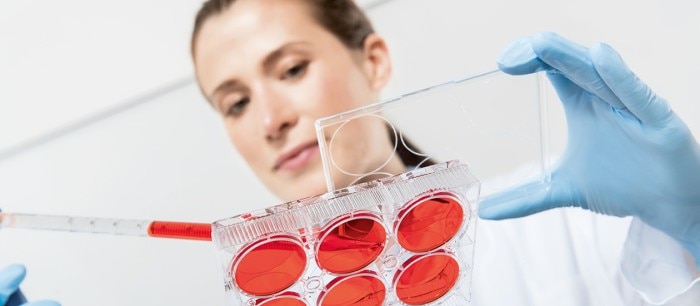
Serum in the medium - The unknown component
Lab Academy
- 細胞生物学
- Cell Therapy
- 細胞培養用消耗品
- CO₂インキュベーター
- FAQ
Serum is a common supplement in media used for cultivating animal cells. Fetal bovine serum (FBS), also known as fetal calf serum (FCS), is the most widely used. It contains vital nutrients, hormones and growth factors which stimulate cell growth. Other serum components serve as binding proteins which promote cell adhesion in vitro.
Although the use of serum is well established in cell culture, it remains the most undefined component of culture media. Serum batches usually show qualitative variations, and the lack of uniformity in composition introduces high lot-to-lot variability. In order to avoid this variability affecting cell-based experiments, it is recommended to test different serum batches for their ability to support growth of a certain cell type and to stock up on a suitable batch.
もっと読む
Fetal bovine serum (FBS), also known as fetal calf serum (FCS)
It is also possible to request that serum suppliers reserve appropriate volumes of a suitable batch. When the batch is used up, testing should be repeated to identify the next suitable batch.
Since serum is an animal-derived reagent, the risk of microbial contamination arises. This risk can be minimized by obtaining serum from suppliers that follow strict quality testing protocols.
A variety of chemically defined, serum-free media and synthetic serum substitutes is available from different suppliers. These represent an alternative to the use of serum and can enhance the long term reproducibility of experiments.
Since serum is an animal-derived reagent, the risk of microbial contamination arises. This risk can be minimized by obtaining serum from suppliers that follow strict quality testing protocols.
A variety of chemically defined, serum-free media and synthetic serum substitutes is available from different suppliers. These represent an alternative to the use of serum and can enhance the long term reproducibility of experiments.
もっと読む