メニュー
JP | JPY
-
-
-
- Challenges and Chances: A Review of the 1st Stem Cell Community Day
- Summertime, and the Livin’ Is Easy…
- Follow-on-Biologics – More than Simple Generics
- Bacteria Versus Body Cells: A 1:1 Tie
- Behind the Crime Scene: How Biological Traces Can Help to Convict Offenders
- Every 3 Seconds Someone in the World Is Affected by Alzheimer's
- HIV – It’s Still Not Under Control…
- How Many Will Be Convicted This Time?
- Malaria – the Battle is Not Lost
- Physicians on Standby: The Annual Flu Season Can Be Serious
- At the Forefront in Fighting Cancer
- Molecular Motors: Think Small and yet Smaller Again…
- Liquid Biopsy: Novel Methods May Ease Cancer Detection and Therapy
- They Are Invisible, Sneaky and Disgusting – But Today It’s Their Special Day!
- How Many Cells Are in Your Body? Probably More Than You Think!
- What You Need to Know about Antibiotic Resistance – Findings, Facts and Good Intentions
- Why Do Old Men Have Big Ears?
- The Condemned Live Longer: A Potential Paradigm Shift in Genetics
- From Research to Commerce
- Chronobiology – How the Cold Seasons Influence Our Biorhythms
- Taskforce Microbots: Targeted Treatment from Inside the Body
- Eyes on Cancer Therapy
-
-

-
-
-
- Challenges and Chances: A Review of the 1st Stem Cell Community Day
- Summertime, and the Livin’ Is Easy…
- Follow-on-Biologics – More than Simple Generics
- Bacteria Versus Body Cells: A 1:1 Tie
- Behind the Crime Scene: How Biological Traces Can Help to Convict Offenders
- Every 3 Seconds Someone in the World Is Affected by Alzheimer's
- HIV – It’s Still Not Under Control…
- How Many Will Be Convicted This Time?
- Malaria – the Battle is Not Lost
- Physicians on Standby: The Annual Flu Season Can Be Serious
- At the Forefront in Fighting Cancer
- Molecular Motors: Think Small and yet Smaller Again…
- Liquid Biopsy: Novel Methods May Ease Cancer Detection and Therapy
- They Are Invisible, Sneaky and Disgusting – But Today It’s Their Special Day!
- How Many Cells Are in Your Body? Probably More Than You Think!
- What You Need to Know about Antibiotic Resistance – Findings, Facts and Good Intentions
- Why Do Old Men Have Big Ears?
- The Condemned Live Longer: A Potential Paradigm Shift in Genetics
- From Research to Commerce
- Chronobiology – How the Cold Seasons Influence Our Biorhythms
- Taskforce Microbots: Targeted Treatment from Inside the Body
- Eyes on Cancer Therapy
-
-
JP | JPY
Sorry, we couldn't find anything on our website containing your search term.
- ホーム
- Lab Academy
- Lab Solutions
- Other
- Which Cuvette Is the Right One? Glass vs. Plastic, VIS vs. UV, Micro-Volume vs. Macro-Volume
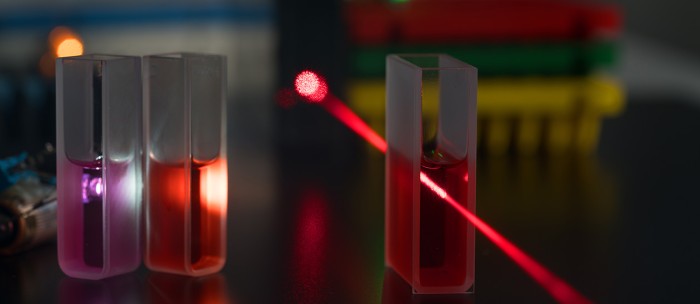
Which Cuvette Is the Right One? Glass vs. Plastic, VIS vs. UV, Micro-Volume vs. Macro-Volume
Lab Academy
- 測光
- エッセー
For the purpose of photometric analyses of liquid samples, the solution must be placed into the light path of a photometer in a defined format. Cuvettes, i.e. sample containers featuring optical windows, are the standard choice for this application.
The distance between the optical windows is accurately defined; in this way, the path length of the sample inside the cuvette is known. The selection of different types of cuvettes is vast – even if only those cuvettes are considered that are used for absorbance measurements in the area of UV-Vis spectroscopy. The most common type of cuvette is square, with external dimensions of 12.5 x 12.5 mm. This format accommodates sample volumes from the microliter range (ultra-micro cuvettes) to the milliliter range (macro cuvettes) (figure 1). The standard path length of a cuvette measures 10 mm; however, cuvettes that provide a shorter light path through the sample are also available. In addition, cuvettes differ with respect to their material, their height and the size of their measurement window (figure 1).
もっと読む
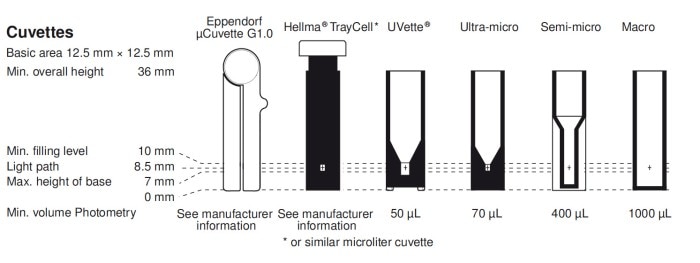
Figure 1: Cuvettes which feature the standard outer dimensions of 12.5 x 12.5 mm but which require different minimum sample volumes.
The decision about which type of cuvette to choose will depend on the instrument used, on the nature of the application and on the properties of the sample. It is generally important that cuvettes be as transparent as possible for the wavelengths to be measured so not to limit the available linear range of the photometer.
The selection of the equipment necessitates requirements on the cuvette, since it must be compatible with the device. This pertains mainly to the outer dimensions of the cuvette, as it needs to fit into the cuvette shaft, but the height of the measurement windows is also crucial. These must align perfectly with the light path that travels through the instrument. This consideration is particularly relevant for cuvettes that are designed to measure small volumes and that therefore feature very small measurement windows. Common heights of light paths are 8.5 mm and 15 mm.
The next important aspect concerns the measuring wavelengths that are involved in the application at hand. Standard cuvettes made from PMMA, polystyrene or normal glass are only transparent in the visible range. If wavelengths in the UV-range, below approximately 300 nm, are employed, cuvettes made from quartz glass, or a special type of plastic, which provide sufficient transparency in this range, must be used (figure 2).
The selection of the equipment necessitates requirements on the cuvette, since it must be compatible with the device. This pertains mainly to the outer dimensions of the cuvette, as it needs to fit into the cuvette shaft, but the height of the measurement windows is also crucial. These must align perfectly with the light path that travels through the instrument. This consideration is particularly relevant for cuvettes that are designed to measure small volumes and that therefore feature very small measurement windows. Common heights of light paths are 8.5 mm and 15 mm.
The next important aspect concerns the measuring wavelengths that are involved in the application at hand. Standard cuvettes made from PMMA, polystyrene or normal glass are only transparent in the visible range. If wavelengths in the UV-range, below approximately 300 nm, are employed, cuvettes made from quartz glass, or a special type of plastic, which provide sufficient transparency in this range, must be used (figure 2).
もっと読む
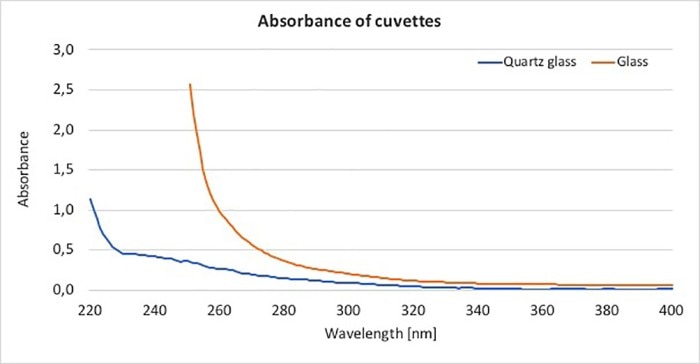
Figure 2: Differences between the absorbance spectra of cuvettes made from different materials, as measured between 220 nm and 400 nm
Heating and efficient temperature control of a sample during the measurement process is crucial for those methods that rely on reactions that occur at a certain specific temperature and that measure absorbance over time. In addition to an appropriate level of resistance of the material, it is important in this case that the contact area between the wall of the cuvette and the temperature-controlled cuvette shaft are as large as possible. For these reasons, certain cuvettes, such as macro-cuvettes, provide an advantage in temperature-controlled applications.
Other aspects that will influence the choice of cuvette include the nature, the volume and the concentration of the sample at hand.
If the sample is based on an aqueous solution, the material from which the cuvette is made is relatively inconsequential. If, on the other hand, organic solvents are involved, glass cuvettes are the preferred choice as these display higher resistance compared to variants made from plastic.
If only a small amount of sample is available, one might consider re-using the sample for following measurements. In this case, single-use plastic cuvettes are recommended. Plastic cuvettes, if individually packaged and of an appropriate purity grade, will minimize the risk of contamination. Alternatively, cuvettes may be selected which were designed to accommodate extremely small volumes.
The concentration of a sample, too, will influence the choice of cuvette as each instrument has an upper limit of detection. For example, if using a photometer with a linear measuring range of up to 2 A with a path length of 10 mm, double-stranded DNA can be reliably quantified up to a maximum concentration of 100 µg/ml. Solutions of higher concentrations must either be diluted, or the dilution can be simulated using a cuvette that features a shorter path length. According to the Lambert-Beer law, a path length of 1 mm thus permits measurement of dsDNA concentrations as high as 1,000 µg/mL.
If not prescribed by the nature of the application, the material of the cuvette presents a further choice to be made. In general, glass cuvettes display greater transparency and accuracy of measurement, and they can be re-used many times. Then again, handling of plastic cuvettes is simple and safe. Since plastic cuvettes are only used once and do not require cleaning, possible damage and loss do not have to be taken into account.
Other aspects that will influence the choice of cuvette include the nature, the volume and the concentration of the sample at hand.
If the sample is based on an aqueous solution, the material from which the cuvette is made is relatively inconsequential. If, on the other hand, organic solvents are involved, glass cuvettes are the preferred choice as these display higher resistance compared to variants made from plastic.
If only a small amount of sample is available, one might consider re-using the sample for following measurements. In this case, single-use plastic cuvettes are recommended. Plastic cuvettes, if individually packaged and of an appropriate purity grade, will minimize the risk of contamination. Alternatively, cuvettes may be selected which were designed to accommodate extremely small volumes.
The concentration of a sample, too, will influence the choice of cuvette as each instrument has an upper limit of detection. For example, if using a photometer with a linear measuring range of up to 2 A with a path length of 10 mm, double-stranded DNA can be reliably quantified up to a maximum concentration of 100 µg/ml. Solutions of higher concentrations must either be diluted, or the dilution can be simulated using a cuvette that features a shorter path length. According to the Lambert-Beer law, a path length of 1 mm thus permits measurement of dsDNA concentrations as high as 1,000 µg/mL.
If not prescribed by the nature of the application, the material of the cuvette presents a further choice to be made. In general, glass cuvettes display greater transparency and accuracy of measurement, and they can be re-used many times. Then again, handling of plastic cuvettes is simple and safe. Since plastic cuvettes are only used once and do not require cleaning, possible damage and loss do not have to be taken into account.
もっと読む

Poster
PDF 1.64 MB
Eppendorf solutions
もっと読む