メニュー
JP | JPY
-
-
-
- Challenges and Chances: A Review of the 1st Stem Cell Community Day
- Summertime, and the Livin’ Is Easy…
- Follow-on-Biologics – More than Simple Generics
- Bacteria Versus Body Cells: A 1:1 Tie
- Behind the Crime Scene: How Biological Traces Can Help to Convict Offenders
- Every 3 Seconds Someone in the World Is Affected by Alzheimer's
- HIV – It’s Still Not Under Control…
- How Many Will Be Convicted This Time?
- Malaria – the Battle is Not Lost
- Physicians on Standby: The Annual Flu Season Can Be Serious
- At the Forefront in Fighting Cancer
- Molecular Motors: Think Small and yet Smaller Again…
- Liquid Biopsy: Novel Methods May Ease Cancer Detection and Therapy
- They Are Invisible, Sneaky and Disgusting – But Today It’s Their Special Day!
- How Many Cells Are in Your Body? Probably More Than You Think!
- What You Need to Know about Antibiotic Resistance – Findings, Facts and Good Intentions
- Why Do Old Men Have Big Ears?
- The Condemned Live Longer: A Potential Paradigm Shift in Genetics
- From Research to Commerce
- Chronobiology – How the Cold Seasons Influence Our Biorhythms
- Taskforce Microbots: Targeted Treatment from Inside the Body
- Eyes on Cancer Therapy
-
-

-
-
-
- Challenges and Chances: A Review of the 1st Stem Cell Community Day
- Summertime, and the Livin’ Is Easy…
- Follow-on-Biologics – More than Simple Generics
- Bacteria Versus Body Cells: A 1:1 Tie
- Behind the Crime Scene: How Biological Traces Can Help to Convict Offenders
- Every 3 Seconds Someone in the World Is Affected by Alzheimer's
- HIV – It’s Still Not Under Control…
- How Many Will Be Convicted This Time?
- Malaria – the Battle is Not Lost
- Physicians on Standby: The Annual Flu Season Can Be Serious
- At the Forefront in Fighting Cancer
- Molecular Motors: Think Small and yet Smaller Again…
- Liquid Biopsy: Novel Methods May Ease Cancer Detection and Therapy
- They Are Invisible, Sneaky and Disgusting – But Today It’s Their Special Day!
- How Many Cells Are in Your Body? Probably More Than You Think!
- What You Need to Know about Antibiotic Resistance – Findings, Facts and Good Intentions
- Why Do Old Men Have Big Ears?
- The Condemned Live Longer: A Potential Paradigm Shift in Genetics
- From Research to Commerce
- Chronobiology – How the Cold Seasons Influence Our Biorhythms
- Taskforce Microbots: Targeted Treatment from Inside the Body
- Eyes on Cancer Therapy
-
-
JP | JPY
Sorry, we couldn't find anything on our website containing your search term.
- ホーム
- Lab Academy
- Life Science
- Cell Biology
- Long-term storage in liquid nitrogen: Should I keep frozen cells in the liquid phase or in the vapor phase

Long-term storage in liquid nitrogen: Should I keep frozen cells in the liquid phase or in the vapor phase?
Lab Academy
- 細胞生物学
- Cell Therapy
- 細胞培養用消耗品
- FAQ
Answer by Dr. Jessica Wagener, Application Specialist Cell Handling at Eppendorf
This article was published first in "Inside Cell Culture" , the monthly newsletter for cell culture professionals. Find more interesting articles about CO2 incubators on our page "FAQs and material on CO2 incubators" .
もっと読む
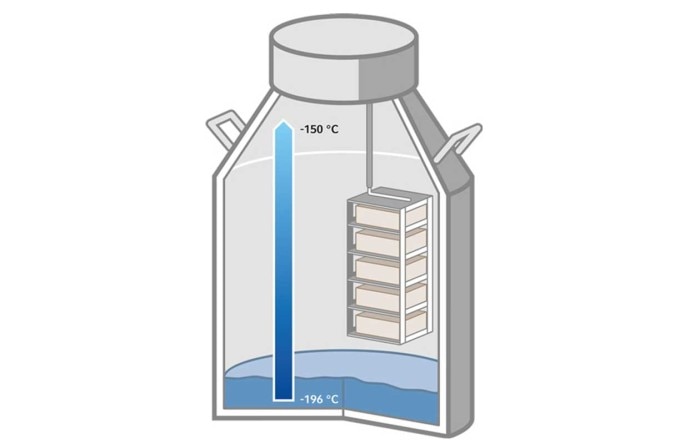
Cells can be stored in liquid nitrogen (LN2) for years without loss of cell viability. The storage temperature must be kept permanently below -130°C to prevent ice crystal formation inside the cells. It is recommended to store cryopreserved cells in the vapor phase of LN2. This method of storage reduces the risk of liquid nitrogen entering cryotubes which can result in the explosion of the tubes upon thawing. In addition, it has been described that contaminating organisms can be transferred from one cryotube to the other when the tubes are stored in the liquid phase of LN2 (1). Storage in the vapor phase reduces the risk of spreading existing contaminations, but it requires careful monitoring of the LN2 level in order to avoid the tank running empty. Cryostorage containers that are equipped with temperature and level indicator and/or are fitted with alarms support safe long-term storage of cell lines.
(1) Tedder RS et al. (1995) Hepatitis B transmission from contaminated cryopreservation tank. The Lancet. 346(8968): 137-40.
(1) Tedder RS et al. (1995) Hepatitis B transmission from contaminated cryopreservation tank. The Lancet. 346(8968): 137-40.
もっと読む
Related documents

White Paper 60
PDF
Application Note 437
PDF