メニュー
JP | JPY
-
-
-
- Challenges and Chances: A Review of the 1st Stem Cell Community Day
- Summertime, and the Livin’ Is Easy…
- Follow-on-Biologics – More than Simple Generics
- Bacteria Versus Body Cells: A 1:1 Tie
- Behind the Crime Scene: How Biological Traces Can Help to Convict Offenders
- Every 3 Seconds Someone in the World Is Affected by Alzheimer's
- HIV – It’s Still Not Under Control…
- How Many Will Be Convicted This Time?
- Malaria – the Battle is Not Lost
- Physicians on Standby: The Annual Flu Season Can Be Serious
- At the Forefront in Fighting Cancer
- Molecular Motors: Think Small and yet Smaller Again…
- Liquid Biopsy: Novel Methods May Ease Cancer Detection and Therapy
- They Are Invisible, Sneaky and Disgusting – But Today It’s Their Special Day!
- How Many Cells Are in Your Body? Probably More Than You Think!
- What You Need to Know about Antibiotic Resistance – Findings, Facts and Good Intentions
- Why Do Old Men Have Big Ears?
- The Condemned Live Longer: A Potential Paradigm Shift in Genetics
- From Research to Commerce
- Chronobiology – How the Cold Seasons Influence Our Biorhythms
- Taskforce Microbots: Targeted Treatment from Inside the Body
- Eyes on Cancer Therapy
-
-

-
-
-
- Challenges and Chances: A Review of the 1st Stem Cell Community Day
- Summertime, and the Livin’ Is Easy…
- Follow-on-Biologics – More than Simple Generics
- Bacteria Versus Body Cells: A 1:1 Tie
- Behind the Crime Scene: How Biological Traces Can Help to Convict Offenders
- Every 3 Seconds Someone in the World Is Affected by Alzheimer's
- HIV – It’s Still Not Under Control…
- How Many Will Be Convicted This Time?
- Malaria – the Battle is Not Lost
- Physicians on Standby: The Annual Flu Season Can Be Serious
- At the Forefront in Fighting Cancer
- Molecular Motors: Think Small and yet Smaller Again…
- Liquid Biopsy: Novel Methods May Ease Cancer Detection and Therapy
- They Are Invisible, Sneaky and Disgusting – But Today It’s Their Special Day!
- How Many Cells Are in Your Body? Probably More Than You Think!
- What You Need to Know about Antibiotic Resistance – Findings, Facts and Good Intentions
- Why Do Old Men Have Big Ears?
- The Condemned Live Longer: A Potential Paradigm Shift in Genetics
- From Research to Commerce
- Chronobiology – How the Cold Seasons Influence Our Biorhythms
- Taskforce Microbots: Targeted Treatment from Inside the Body
- Eyes on Cancer Therapy
-
-
JP | JPY
Sorry, we couldn't find anything on our website containing your search term.
- ホーム
- Lab Academy
- Life Science
- Cell Biology
- Mastering Seed Trains: 5 Essential Tips for the transfer from vial to shake flask to bioreactor
Mastering Seed Trains: 5 Essential Tips for the transfer from vial to shake flask to bioreactor
Lab Academy
- バイオプロセス
- 細胞生物学
- 医薬
- Cell Therapy
- 効率
- 細胞培養用消耗品
- バイオプロセス
- エッセー
In this article, we will cover 5 essential tips for the transfer from vial to shake flask to bioreactor – to optimize inoculum preparation.
This article was published first in " Inside Cell Culture " , the monthly newsletter for cell culture professionals. Find more interesting articles about CO2 incubators/shakers on our page " FAQs and material on CO2 incubators ".
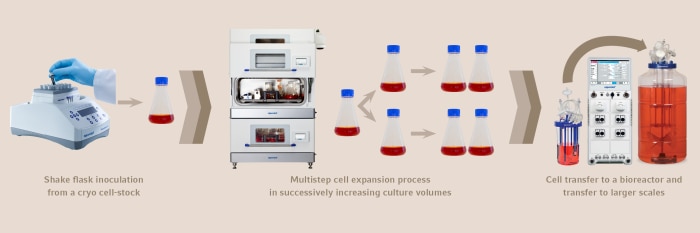
In the realm of biopharmaceutical production, seed trains are a pivotal strategy for efficient inoculum preparation of the final production vessel. This approach focuses on streamlining the process of scaling up cell cultures from vial to flasks to bioreactors to meet the demands of large-scale production. Based on our in-depth White paper " Optimizing the Inoculum Preparation in Shake Flasks and Bioreactors during Cell Culture Seed Trains " we here explore five essential tips for optimizing seed trains.
Unlock the Full Potential of Your Bioprocess: Download Our Comprehensive White Paper on Seed Train Optimization
Finding the right seed train strategy is a transformative approach that can significantly enhance the efficiency of biopharmaceutical production processes. By adopting these strategies, organizations can achieve higher cell densities, reduce contamination risks, and streamline their operations, ultimately leading to faster and more cost-effective production cycles. Are you ready to revolutionize your biopharmaceutical production?
Download our White Paper " Optimizing the Inoculum Preparation in Shake Flasks and Bioreactors during Cell Culture Seed Trains ” now to transform your bioprocessing capabilities and stay ahead in the competitive biopharma landscape!
In the realm of biopharmaceutical production, seed trains are a pivotal strategy for efficient inoculum preparation of the final production vessel. This approach focuses on streamlining the process of scaling up cell cultures from vial to flasks to bioreactors to meet the demands of large-scale production. Based on our in-depth White paper " Optimizing the Inoculum Preparation in Shake Flasks and Bioreactors during Cell Culture Seed Trains " we here explore five essential tips for optimizing seed trains.
1. Embrace Single-Use Technology
One of the primary considerations for setting up a seed train is the adoption of single-use materials. These systems offer several advantages over traditional vessels, including reduced risk of contamination due to minimized need for cleaning and setup. This not only accelerates the seed train process but also ensures consistent and reliable performance, crucial for maintaining sterile conditions throughout the cultivation phases.2. Optimize Culture Transfer Techniques
Efficient culture transfer is vital to maintaining the integrity of the seed train. Aseptic techniques must be employed to prevent contamination during the transfer of cultures from one vessel to another. Utilizing water-free thawing devices and inversion transfer caps can facilitate smooth transitions between different scales. These tools allow for the aseptic transfer of cell cultures, reducing the risk of contamination that can compromise the entire process.3. Select the Optimal Passaging Point
Timing is everything when it comes to cell culture passaging. The optimal point for transferring cultures is during the logarithmic phase of growth, where cells exhibit high viability and are in their prime physiological state. This minimizes lag phases and promotes rapid growth in subsequent vessels. Regular monitoring of cell viability and growth rates is essential to determine the best time for subculturing, ensuring a consistent and reproducible seed train routine.4. Enhance Shake Flask Operations
Shake flask cultures serve as the initial stage of a seed train before moving to larger vessels like bioreactors. Optimizing conditions at this stage sets the foundation for successful downstream processes. Key factors include selecting the appropriate flask design—baffled flasks can enhance aeration and yield higher cell densities. Additionally, maintaining optimal shaking speeds and fill volumes based on cell type and flask size is crucial. Online monitoring solutions can provide real-time insights into the metabolic state of the cells, allowing for adjustments that improve inoculum quality.5. Implement Advanced Bioreactor Strategies
Finally, culture transitioning within bioreactors requires careful management of scale-up parameters. Bioreactors offer sophisticated control over culture conditions, such as temperature, pH, and agitation speed. Maintaining consistency across different bioreactor scales is essential to avoid inhomogeneous conditions that can affect culture quality. Testing scale-up parameters in small-scale systems before full implementation can mitigate risks and ensure optimal outcomes.Unlock the Full Potential of Your Bioprocess: Download Our Comprehensive White Paper on Seed Train Optimization
Finding the right seed train strategy is a transformative approach that can significantly enhance the efficiency of biopharmaceutical production processes. By adopting these strategies, organizations can achieve higher cell densities, reduce contamination risks, and streamline their operations, ultimately leading to faster and more cost-effective production cycles. Are you ready to revolutionize your biopharmaceutical production?
Download our White Paper " Optimizing the Inoculum Preparation in Shake Flasks and Bioreactors during Cell Culture Seed Trains ” now to transform your bioprocessing capabilities and stay ahead in the competitive biopharma landscape!
もっと読む